 格物
- 学名
- Dioscorea communis
- 分类等级
- 种
- 上级类群
- 薯蓣属
- 大类
- 被子植物
- 命名
- Lizabeth R. Caddick、Paul Wilkin,2002 年
- 数据库
- NCBI 分类 · GBIF
百科正文
植物描述
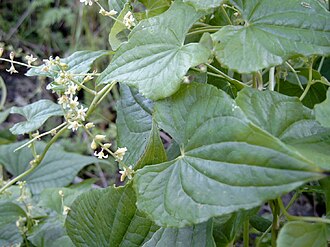
它是一种攀援草本植物,可长至2至4米高,其茎会逆时针方向缠绕生长。 叶片呈螺旋状排列,为心形,长可达10厘米,宽可达8厘米,叶柄长可达5厘米。此植物为雌雄异株,即雄株与雌株是分开的。单朵花并不起眼,呈绿黄色,直径3至6毫米,有六枚花瓣;雄花排列成细长的5至10厘米总状花序,雌花则成较短的花簇。果实是鲜红色的浆果,直径约1厘米。它相当大的块茎与植株的其他部分一样,都具有毒性。
如同大多数经过研究的薯蓣属物种,黑薯𬞟在叶柄或叶片背面拥有花外蜜腺。
分布
黑薯𬞟为原生植物,广泛分布于欧洲南部与中部、非洲西北部及亚洲西部,其分布范围西起爱尔兰与加那利群岛,东至伊朗和克里米亚。
栖息地
黑薯𬞟是典型的林下植物,从海边到山区都有其踪迹。它通常生长于茂密的树林中,但也能在草地和树篱中找到。
用途
由于含有皂苷,黑薯𬞟的所有部分(包含块茎)都有毒,因此通常不作内服。 据报导,唯一的例外是其嫩芽,可在皂苷含量尚低时采收作为蔬菜食用。
然而,它曾被用作糊药,以治疗瘀伤和发炎的关节。有人建议应谨慎地局部使用黑薯𬞟,因为它容易引起疼痛的水泡。
研究已从其浆果汁和根茎中分离出草酸钙沉淀物和组织胺,这些物质可能是导致与黑薯𬞟相关的皮肤刺激和接触性皮肤炎的原因。
化学成分
其根茎含有菲类化合物(7-羟基-2,3,4,8-四甲氧基菲、2,3,4-三甲氧基-7,8-亚甲二氧基菲、3-羟基-2,4,-二甲氧基-7,8-亚甲二氧基菲、2-羟基-3,5,7-三甲氧基菲及2-羟基-3,5,7-三甲氧基-9,10-二氢菲)。
以上内容摘自维基百科「黑薯蘋」,按 CC BY-SA 4.0 使用,去掉了参考文献、外部链接等尾部小节,公式改写成了纯文本。全文、配图和出处见原文。
英文维基百科补充中文条目比较短,下面是英文条目「Dioscorea communis」的原文
Dioscorea communis or Tamus communis is a species of flowering plant in the yam family Dioscoreaceae and is commonly known as black bryony, lady's-seal or black bindweed.
Description
It is a climbing herbaceous plant growing to 2–4 m (6.6–13 ft) tall, with stems that twine anticlockwise. The leaves are spirally arranged, heart-shaped, up to 10 cm (3.9 in) long and 8 cm (3.1 in) broad, with a petiole up to 5 cm (2.0 in) long. It is dioecious, with separate male and female plants. The flowers are individually inconspicuous, greenish-yellow, 3–6 mm diameter, with six petals; the male flowers produced in slender 5–10 cm racemes, the female flowers in shorter clusters. The fruit is a bright red berry, 1 cm diameter. Its fairly large tuber is, like the rest of the plant, poisonous.
Like most Dioscorea species that have been examined, D. communis possesses extrafloral nectaries at the petiole or leaf underside.
Distribution
Dioscorea communis is native and widespread throughout southern and central Europe, northwest Africa and western Asia, from Ireland to the Canary Islands, east to Iran and Crimea.
Habitat
Dioscorea communis is a typical plant of the forest understory, from the sea to the mountains, usually in dense woods, but it can also be found in meadows and hedges.
Uses
All components of the black bryony plant, including the tubers, are poisonous due to saponin content, so it is not typically used internally. An exception is only reported for young shoots, which are harvested when saponin content is still low and consumed as vegetable.
However, it has been used as a poultice for bruises and inflamed joints. It has been suggested that black bryony be used topically with caution, due to a tendency for the plant to cause painful blisters.
Studies have isolated calcium oxalate deposits and histamines in the berry juice and rhizomes, which may contribute to skin irritation and contact dermatitis associated with black bryony.
Chemistry
The rhizome contains phenanthrenes (7-hydroxy-2,3,4,8-tetramethoxyphenanthrene, 2,3,4-trimethoxy-7,8-methylenedioxyphenanthrene, 3-hydroxy-2,4,-dimethoxy-7,8-methylenedioxyphenanthrene, 2-hydroxy-3,5,7-trimethoxyphenanthrene and 2-hydroxy-3,5,7-trimethoxy-9,10-dihydrophenanthrene).
以上内容摘自英文维基百科「Dioscorea communis」,按 CC BY-SA 4.0 使用,去掉了参考文献、外部链接等尾部小节,公式改写成了纯文本。全文、配图和出处见原文。