 格物
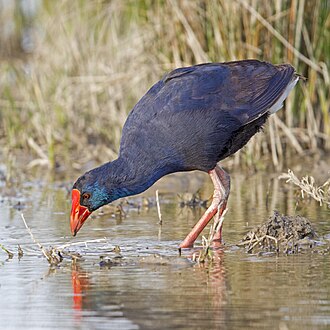
图:Andreas Trepte · CC BY-SA 4.0 · Wikimedia Commons
- 学名
- Porphyrio porphyrio
- 分类等级
- 种
- 英文名
- Western Swamphen
- 上级类群
- 紫水鸡属
- 大类
- 鸟类
- 命名
- 卡尔·林奈,1758 年
- 中文别名
- 紫水鸡
- 保护状况(IUCN)
- 无危物种
- 特有于
- 凯奥拉德奥国家公园、塔多巴老虎保护区、Asan Conservation Reserve、Baisipali Wildlife Sanctuary、Hulimavu Lake
- 数据库
- NCBI 分类 · GBIF · IUCN 红色名录
百科正文
特征
西紫水鸡体重约773.88克,翼长约234.9毫米,嘴峰长约56.2毫米,喙宽度约9.4毫米,喙厚度约21.3毫米,跗跖长约79.9毫米,尾长约85.5毫米。西紫水鸡在其分布区内为留鸟,其栖息在半开放的湖泊、沼泽等湿地环境中,食性为草食性,主要食物来源是水生植物。
分布
伊比利亚半岛和非洲西北部(摩洛哥至突尼斯)。
以上内容摘自维基百科「西紫水鸡」,按 CC BY-SA 4.0 使用,去掉了参考文献、外部链接等尾部小节,公式改写成了纯文本。全文、配图和出处见原文。
英文维基百科补充中文条目比较短,下面是英文条目「Western swamphen」的原文
The western swamphen (Porphyrio porphyrio) is a species of swamphen in the rail family Rallidae, one of the six species of purple swamphen. This chicken-sized bird, with its large feet, bright plumage and red bill and frontal shield is easily recognisable in its native range. It used to be considered the nominate subspecies of the purple swamphen, but is now recognised as a separate species. The western swamphen is found in wetlands in Spain (where the largest population lives), Portugal, southeastern France, Italy (Sardinia and Sicily) and northwestern Africa (Morocco, Algeria and Tunisia).
Taxonomy
The western swamphen was formally described in 1758 by the Swedish naturalist Carl Linnaeus in the tenth edition of his Systema Naturae. He placed it with the coots in the genus Fulica and coined the binomial name Fulica porphyrio. The specific epithet porphyrio is Latin for a swamphen. The word is from Ancient Greek πορφυριον (porphurion) meaning "swamphen" which in turn is from πορφυρα (porphura) meaning "purple". The species had been described in 1678 by the English ornithologist Francis Willughby under that Latin name Porphyrio and English name "purple water-hen". Linnaeas specified the type location as Asia, Africa but this has been restricted to the lands bordering the western Mediterranean. The western swamphen is now one of 12 species placed in the genus Porphyrio that was introduced in 1760 by the French zoologist Mathurin Jacques Brisson.
The western swamphen was formerly considered as the nominate subspecies in the purple swamphen species complex. The complex was split into six species based primarily on a molecular phylogenetic studies published in 1997 and 2015. Following this revision, the species is now considered monotypic, with no subspecies recognised.
Behaviour
The species makes loud, quick, bleating and hooting calls which are hardly bird-like in tone. It is particularly noisy during the breeding season. Despite being clumsy in flight it can fly long distances, and is a good swimmer, especially for a bird without webbed feet.
Breeding
Western swamphens are generally seasonal breeders, correlating with peak rainfall in many places, or summer in more temperate climes. The purple swamphen breeds in warm reed beds. The pattern of social behaviour tends to be monogamy.
Pairs nest in a large pad of interwoven reed flags, etc., on a mass of floating debris or amongst matted reeds slightly above water level in swamps, clumps of rushes in paddocks or long unkempt grass. Each bird can lay 3–6 speckled eggs, pale yellowish stone to reddish buff, blotched and spotted with reddish brown. The incubation period is 23–27 days, and is performed by both sexes. The precocious chicks are feathered with downy black feathers and able to leave the nest soon after hatching, but will often remain in the nest for a few days. Young chicks are fed by their parents (and group members) for between 10–14 days, after which they begin to feed themselves.
Food and feeding
The western swamphen prefers wet areas with high rainfall, swamps, lake edges and damp pastures. The birds often live in pairs and larger communities.
Relationship with humans
Ancient times
Swamphens were often kept in captivity in ancient Greece and ancient Rome. The behaviour of the species was described in some detail by Aristotle in History of Animals (4th century BC), and they were also mentioned by Aristophanes (5th century BC), Pliny the Elder (1st century BC), Aelian and Athenaeus (2nd to 3rd century AD). These birds included both western swamphens (originating from the Balearic Islands, among others) and grey-headed swamphens (originating from Turkey), and the two were already distinguished by Pliny the Elder who considered the former superior. They typically were not kept for food, but instead were decorative birds in villas and temples. If raised in captivity, swamphens tend to become quite tame. There are many depictions of the species on Roman mosaics and frescos, typically in a natural or domestic environment, including the famous garden fresco from Pompeii. In early Christianity, it was also frequently depicted, but here symbolising the richness of life and often perched in the tree of life.
Status and conservation
Today the western swamphen is locally common, with the largest population in Spain. It was formerly listed as "Rare" by the European Union, but has been delisted to "Localised".
The species declined drastically in the first half of the 20th century due to habitat loss and hunting.
以上节选摘自英文维基百科「Western swamphen」,按 CC BY-SA 4.0 使用,去掉了参考文献、外部链接等尾部小节,公式改写成了纯文本。篇幅所限,较长的小节只摘了开头一部分,有的小节没有收;全文、配图和出处见原文。