格物
生命之树 › 真核生物 › 动物界 › 真后生动物亚界 › 两侧对称动物 › 后口动物总门 › 脊索动物门 › 脊椎动物亚门 › 有颌下门 › 肉鳍鱼总纲 › 四足形类 › 希望螈目 › 四足总纲 › 爬行动物 › 坚尾龙类 › 鸟纲 › 今鸟亚纲 › 今颚下纲 › 新鸟总目 › 雀形目 › 鸣禽亚目
鹎科科
Pycnonotidae
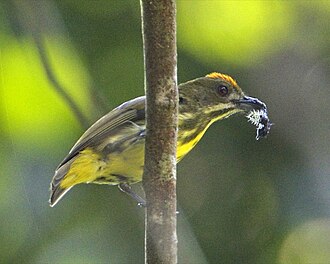
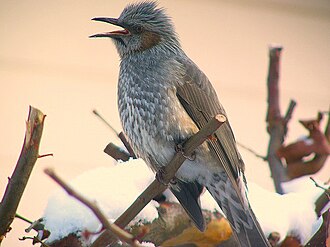
鹎鸟是鹎科 的成员,是中等体型的雀形目鸣禽。它们遍布于大部分的非洲大陆并延伸到中东地区,在热带亚洲至印度尼西亚地区,向北至日本列岛。一些岛屿种 分布于印度洋中的热带岛屿。借由生物分类法,它们可被归类于32个属之下的160个种。虽然在广泛的栖息地中发现了不同的成员物种,但在非洲的成员物种主要存在于雨林中,而亚洲的成员物种主要分布在较开阔的地区。
摘自维基百科「鹎科」,CC BY-SA 4.0
- 学名
- Pycnonotidae
- 分类等级
- 科
- 上级类群
- 鸣禽亚目
- 大类
- 鸟类
- 命名
- 乔治·罗伯特·格雷,1840 年
- 数据库
- NCBI 分类 · GBIF
下级类群(14)
百科正文
描述
它们普遍颈部较短、体型修长、尾部长、翅短且形状偏圆滑,且大多喙较细长、末端微呈钩状。大致上来说,雄性与雌性体型相似,尽管雌性经常略小。
它们是高度透过鸣声沟通的鸟类。
行为与生态
繁殖
它们一般呈单配偶制。一些成员物种有共同育幼(英语:alloparenting)的现象,没有生育后代的个体,经常是年轻且较早出生的,会协助优势繁殖对(英语:dominant breeding pair)抚育后代。 多达五个有斑点的蛋产在开放的树巢中,并由雌性孵化。孵化期通常持续11到14天,雏鸟在12至16天后长出羽翼。
食性
它们的营养来源范围很广,从水果到种子、花蜜、小昆虫和其他节肢动物,甚至小型脊椎动物。大多成员物种都以水果类植物之根、芽、坚果和种子为主食,并以一些昆虫为补充。生活在开阔原野的成员物种倾向杂食,然而有显著的少数成员物种倾向摄取特定食物,尤其是在非洲。
以上内容摘自维基百科「鹎科」,按 CC BY-SA 4.0 使用,去掉了参考文献、外部链接等尾部小节,公式改写成了纯文本。全文、配图和出处见原文。
英文维基百科补充中文条目比较短,下面是英文条目「Bulbul」的原文
The bulbuls are members of a family, Pycnonotidae, of medium-sized passerine songbirds, which also includes greenbuls, brownbuls, leafloves, and bristlebills. The family is distributed across most of Africa and into the Middle East, tropical Asia to Indonesia, and north as far as Japan. A few insular species occur on the tropical islands of the Indian Ocean. There are 161 species in 28 genera. While different species are found in a wide range of habitats, the African species are predominantly found in rainforest, whereas Asian bulbuls are predominantly found in more open areas.
Taxonomy
The family Pycnonotidae was introduced by the English zoologist George Robert Gray in 1840 as a subfamily Pycnonotinae of the thrush family Turdidae.
The Persian word bulbul (بلبل) is sometimes used to refer to the "nightingale" as well as the bulbul, but the English word bulbul refers to the birds discussed in this article.
A few species that were previously considered to be members of the Pycnonotidae have been moved to other families. Several Malagasy species that were formerly placed in the genus Phyllastrephus are now placed in the family Bernieridae. In addition, the genus Nicator containing three African species is now placed in a separate family Nicatoridae.
A study published in 2007 by Ulf Johansson and colleagues using three nuclear markers found that the genus Andropadus was non-monophyletic. In the subsequent revision, species were moved to three resurrected genera: Arizelocichla, Stelgidillas and Eurillas. Only the sombre greenbul (Andropadus importunus) was retained in Andropadus. A study by Subir Shakya and Frederick Shelden published in 2017 found that species in the large genus Pycnonotus formed several deeply divergent clades. The genus was split and genera were resurrected to accommodate these clades.
The family forms two main clades. One clade contains species that are only found in Africa; many of these have greenbul in the common name.
Description
Bulbuls are short-necked slender passerines. The tails are long and the wings short and rounded. In almost all species the bill is slightly elongated and slightly hooked at the end. They vary in length from 13 cm and 13.3 g (0.47 oz) for the tiny greenbul to 29 cm and 93 g (3.3 oz) in the straw-headed bulbul. Overall the sexes are alike, although the females tend to be slightly smaller. In a few species the differences are so great that they have been described as functionally different species. The soft plumage of some species is colorful with yellow, red or orange vents, cheeks, throat or supercilia, but most are drab, with uniform olive-brown to black plumage. Species with dull coloured eyes often sport contrasting eyerings. Some have very distinct crests. Bulbuls are highly vocal, with the calls of most species being described as nasal or gravelly. One author described the song of the brown-eared bulbul as "one of the most unattractive noises made by any bird".
Behaviour and ecology
Breeding
The bulbuls are generally monogamous. One unusual exception is the yellow-whiskered greenbul which at least over part of its range appears to be polygamous and engage in a lekking system. Some species also have alloparenting arrangements, where non-breeders, usually the young from earlier clutches, help raise the young of a dominant breeding pair. Up to five speckled eggs are laid in open tree nests and incubated by the female. Incubation usually lasts between 11 and 14 days, and chicks fledge after 12–16 days.
Feeding
Bulbuls eat a wide range of foods, ranging from fruit to seeds, nectar, small insects and other arthropods and even small vertebrates. The majority of species are frugivorous and supplement their diet with some insects, although there is a significant minority of specialists, particularly in Africa. Open country species in particular are generalists. Bulbuls in the genus Criniger and bristlebills in the genus Bleda will join mixed-species feeding flocks.
Relationship to humans
The red-whiskered bulbuls and red-vented bulbuls have been captured for the pet trade in great numbers and have been widely introduced to tropical and subtropical areas, for example, southern Florida, Fiji, Australia and Hawaii. Some species are regarded as crop pests, particularly in orchards.
In general, bulbuls and greenbuls are resistant to human pressures on the environment and are tolerant of disturbed habitat. Around 13 species are considered threatened by human activities, mostly specialised forest species that are threatened by habitat loss.
以上节选摘自英文维基百科「Bulbul」,按 CC BY-SA 4.0 使用,去掉了参考文献、外部链接等尾部小节,公式改写成了纯文本。篇幅所限,较长的小节只摘了开头一部分,有的小节没有收;全文、配图和出处见原文。