 格物
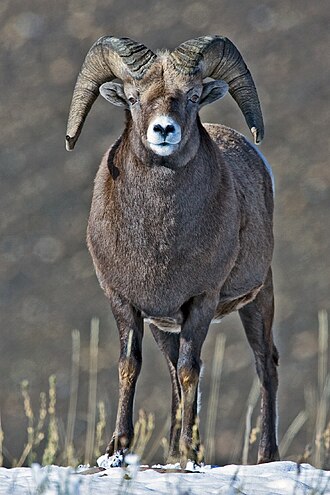
图:Alan D. Wilson · CC BY-SA 3.0 · Wikimedia Commons
生命之树 › 真核生物 › 动物界 › 真后生动物亚界 › 两侧对称动物 › 后口动物总门 › 脊索动物门 › 脊椎动物亚门 › 有颌下门 › 肉鳍鱼总纲 › 四足形类 › 希望螈目 › 四足总纲 › 哺乳动物 › 兽型类 › 全兽类 › 兽亚纲 › 有胎盘类 › 北方真兽高目 › 劳亚兽总目 › 偶蹄目 › 牛科 › 羊亚科 › 羊族 › 羊属
大角羊种
Ovis canadensis
大角羊 是北美和西伯利亚地区的三种山地羊之一,另两种分别为白大角羊(Ovis dalli)和西伯利亚的雪山盘羊(Ovis nivicola)。目前的分类学家一般将大角羊分为以下三个亚种:
落基山大角羊(Ovis canadensis canadensis)
西耶拉大角羊(Ovis canadensis sierrae),也叫加州大角羊
沙漠大角羊(Ovis canadensis nelsoni)
摘自维基百科「大角羊」,CC BY-SA 4.0
- 学名
- Ovis canadensis
- 分类等级
- 种
- 英文名
- bighorn sheep
- 上级类群
- 羊属
- 大类
- 哺乳动物
- 命名
- 乔治·肖,1804 年
- 保护状况(IUCN)
- 无危物种
- 数据库
- NCBI 分类 · GBIF · IUCN 红色名录
百科正文
- 落基山大角羊(Ovis canadensis canadensis)
- 西耶拉大角羊(Ovis canadensis sierrae),也叫加州大角羊
- 沙漠大角羊(Ovis canadensis nelsoni)
部分大角羊的种群处于濒危状态。其中墨西哥种群为濒危野生动植物种国际贸易公约附录II所列的保护动物。
其种加词“canadensis”意为“加拿大的”。
特征
大角羊因公羊的弯曲大角而得名。母羊虽然也有角,但却要短小许多,并且只有微微的弯曲。颜色包括浅褐色、灰色和咖啡色,臀部和腿部则为白色。落基山大角羊雌性重达90公斤,雄性偶尔会超过135公斤。西耶拉大角羊则要小许多,通常雌性只有63公斤,雄性重为90公斤左右。公羊的角重量可达到14公斤。相当于其身体骨骼其他部分的总和。
大角羊以草和灌木为食,善于攀爬陡峭的山喦,这样它们可以躲避天敌的追踪。大角羊的天敌主要包括有狼、郊狼、金雕、美洲狮,以群居为主。大角羊通常不能驯化。
经济价值
猎取大角羊的主要目的是它们的肉和角。大角羊角可以用于部落仪式和战利品。目前大角羊则越来越多地成为北美各个国家公园重要的生态旅游资源。
文化
落基山大角羊是加拿大艾伯塔省的省兽,同时也是科罗拉多州的州兽,出现在科罗拉多州野生动物保护部的标志上。.
以上内容摘自维基百科「大角羊」,按 CC BY-SA 4.0 使用,去掉了参考文献、外部链接等尾部小节,公式改写成了纯文本。全文、配图和出处见原文。
英文维基百科补充中文条目比较短,下面是英文条目「Bighorn sheep」的原文
The bighorn sheep (Ovis canadensis) or bighorn is a species of sheep native to North America. It is named for its large horns, a pair of them may weigh up to 14 kg (30 lb); the sheep altogether typically weigh up to 143 kg (315 lb). Recent genetic testing indicates three distinct subspecies of Ovis canadensis, one of which is endangered: O. c. sierrae.
Sheep originally crossed to North America over the Bering Land Bridge from Siberia; the population in North America peaked in the millions, and the bighorn sheep entered into the mythology of Native Americans. By 1900, the population had crashed to several thousand due to diseases introduced through European livestock and overhunting.
Taxonomy and genetics
Ovis canadensis is one of two species of mountain sheep in North America; the other species being O. dalli, the Dall sheep. Wild sheep crossed the Bering land bridge from Siberia into Alaska during the Pleistocene (about 750,000 years ago); subsequently, they spread through western North America as far south as Baja California and northwestern mainland Mexico. Divergence from their closest Asian ancestor (snow sheep) occurred about 600,000 years ago. In North America, wild sheep diverged into two extant species — Dall sheep, which occupy Alaska and northwestern Canada, and bighorn sheep, which range from southwestern Canada to Mexico. However, the status of these species is questionable given that hybridization has occurred between them in their recent evolutionary history.
Former subspecies
In 1940, Ian McTaggart-Cowan split the species into seven subspecies, with the first three being mountain bighorns and the last four being desert bighorns:
Description
Bighorn sheep are named for the large, curved horns borne by the rams (males). Ewes (females) also have horns, but they are shorter and straighter. They range in color from light brown to grayish or dark, chocolate brown, with a white rump and lining on the backs of all four legs. Males typically weigh 58–143 kg (128–315 lb), are 90–105 cm (35–41 in; 2.95–3.44 ft) tall at the shoulder, and 1.6–1.85 m (63–73 in; 5.2–6.1 ft) long from the nose to the tail. Females are typically 34–91 kg (75–201 lb), 75–90 cm (30–35 in; 2.46–2.95 ft) tall, and 1.28–1.58 m (50–62 in; 4.2–5.2 ft) long. Male bighorn sheep have large horn cores, enlarged cornual and frontal sinuses, and internal bony septa. These adaptations serve to protect the brain by absorbing the impact of clashes. Bighorn sheep have preorbital glands on the anterior corner of each eye, inguinal glands in the groin, and pedal glands on each foot.
Natural history
Ecology
The Rocky Mountain and Sierra Nevada bighorn sheep occupy the cooler mountainous regions of Canada and the United States. In contrast, the desert bighorn sheep subspecies are indigenous to the hot desert ecosystems of the Southwestern United States and Mexico. Bighorn sheep inhabit alpine meadows, grassy mountain slopes, and foothill country near rugged, rocky cliffs and bluffs. Since bighorn sheep cannot move through deep snow, they prefer drier slopes, where the annual snowfall is less than about 150 cm (60 in) per year. A bighorn's winter range usually has lower elevations than its summer range.
Bighorn sheep are highly susceptible to certain diseases carried by domestic sheep, such as psoroptic scabies and pneumonia; additional mortality occurs as a result of accidents involving rock falls or falling off cliffs (a hazard of living in steep, rugged terrain).
Relationship with humans
Conservation
Bighorn sheep were widespread throughout the western United States, Canada, and northern Mexico two hundred years ago. The population was estimated to be 150,000 to 200,000. Unregulated hunting, habitat destruction, overgrazing of rangelands, and diseases contracted from domestic livestock all contributed to the decline, the most drastic occurring from about 1870 through 1950.
In 1936, the Arizona Boy Scouts mounted a statewide campaign to save the bighorn sheep. The scouts first became interested in the sheep through the efforts of Major Frederick Russell Burnham. Burnham observed that fewer than 150 of these sheep still lived in the Arizona mountains. The National Wildlife Federation, the Izaak Walton League, and the National Audubon Society also joined the effort. On January 18, 1939, over 600,000 hectares (1,500,000 acres) of land were set aside to create the Kofa National Wildlife Refuge and the Cabeza Prieta National Wildlife Refuge.
以上节选摘自英文维基百科「Bighorn sheep」,按 CC BY-SA 4.0 使用,去掉了参考文献、外部链接等尾部小节,公式改写成了纯文本。篇幅所限,较长的小节只摘了开头一部分,有的小节没有收;全文、配图和出处见原文。