 格物
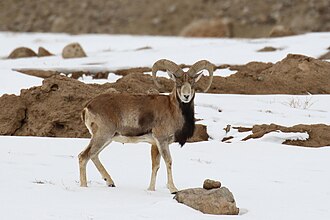
图:Fabrice Stoger · CC BY-SA 4.0 · Wikimedia Commons
- 学名
- Ovis vignei
- 分类等级
- 种
- 英文名
- Urial
- 上级类群
- 羊属
- 大类
- 哺乳动物
- 命名
- 爱德华·布莱思,1841 年
- 保护状况(IUCN)
- 易危物种
- 异名
- Ovis orientalis vignei
- 数据库
- NCBI 分类 · GBIF · IUCN 红色名录
百科正文
雄性赤羊有着大角,在头顶向外弯曲至头后;雌性赤羊的角则较短及扁平。雄性赤羊的角可以生长至1米高。平均成年赤羊肩高为80-90厘米。
赤羊生活在俄罗斯、巴基斯坦、印度及中亚洲的山区。它们的栖息地包含低于树带界线的草原斜坡。赤羊很少在山上的岩石区域出现。它们以草为主要食粮,但如有需要亦可以吃树叶。
赤羊的交配期于九月开始。在交配时期,雄性赤羊会由独居转为与4-5头雌性赤羊居住,约于5个月后诞下1-2头幼羊。
赤羊的保护状态是易危的,这是由于它们的栖息地完全适合人类居住。赤羊的数量于近几年开始恢复。
- 赤羊的科学分类存在争议。赤羊的亚种包括:
- 阿富汗赤羊(Ovis vignei cycloceros)
- 旁遮普赤羊(Ovis vignei punjabiensis)
- 拉达克赤羊(Ovis vignei vignei)
以上内容摘自维基百科「赤羊」,按 CC BY-SA 4.0 使用,去掉了参考文献、外部链接等尾部小节,公式改写成了纯文本。全文、配图和出处见原文。
英文维基百科补充中文条目比较短,下面是英文条目「Urial」的原文
The urial ( OOR-ee-əl; Ovis vignei), also known as arkars, shapo, or shapu, is a wild sheep native to Central and South Asia. It is listed as Vulnerable on the IUCN Red List.
Taxonomy
Ovis vignei was the scientific name proposed by Edward Blyth in 1841 for wild sheep in the Sulaiman Mountains. The specific name honours Godfrey Vigne (1801–1863).
The vignei subspecies group consists of six individual subspecies:
Ladakh urial (Ovis vignei vignei): northern India (Ladakh), northern Pakistan (Gilgit-Baltistan)
Transcaspian urial (Ovis vignei arkal): Ustjurt-Plateau (Turkmenistan, Uzbekistan, northern Iran) and western Kazakhstan
Blanford's urial or Baluchistan urial (Ovis vignei blanfordi): Pakistan (Balochistan)
Bukhara urial (Ovis vignei bochariensis): Uzbekistan, Tajikistan, Turkmenistan, Afghanistan
Afghan urial or Turkmenian sheep (Ovis vignei cycloceros): southern Turkmenistan, eastern Iran, Afghanistan, Pakistan (north Balochistan)
Punjab urial (Ovis vignei punjabiensis): Pakistan (Punjab)
Characteristics
Urial males have large horns, curling outwards from the top of the head turning in to end somewhere behind the head; females have shorter, compressed horns. The horns of the males are up to 100 cm (39 in) long. The shoulder height of an adult male urial is between 80 and 90 cm (31 and 35 in).
Distribution and habitat
The urial is native to montane areas in the Pamir Mountains, Hindu Kush and Himalayas up to an elevation of 4,500 m (14,800 ft). It is distributed from northeastern Iran, Afghanistan, Turkmenistan, Tajikistan, Uzbekistan and southwestern Kazakhstan to northern Pakistan and Ladakh in northwestern India. It prefers grassland, open woodland and gentle slopes, but also inhabits cold arid zones with little vegetation.
Population
The Punjab urial is endemic to Kala Chitta Range and Salt Range in northern Punjab. A 2024–25 survey estimated 532 Punjab urials at Kalabagh Game Reserve with an average density of 8.9 animals/km sq. An earlier survey in 2021 estimated 3,484 Punjab urials in the wider area of 7,953 km2 (3,071 sq mi), with an average density of 0.4 animals/km sq. The Ladakh urial is found in Gilgit-Baltistan, Pakistan and Ladakh, India. A 2024–25 survey by the Government of Gilgit-Baltistan counted 229 individuals in five districts of Gilgit-Baltistan. In Ladakh, a 2018 survey estimated 686 individuals. The population of Baluchistan urials in Khuzdar and Lasbela over a four year period in 2019–2022 was found to have decreased from 860 individuals in 2019 to 534 in 2022.
Behaviour and ecology
Urials are sexually dimorphic. The mating season begins in November. Rams select four or five ewes, which give birth to a lamb, or less often two, after a gestation of five months in April to June.
以上内容摘自英文维基百科「Urial」,按 CC BY-SA 4.0 使用,去掉了参考文献、外部链接等尾部小节,公式改写成了纯文本。全文、配图和出处见原文。