格物
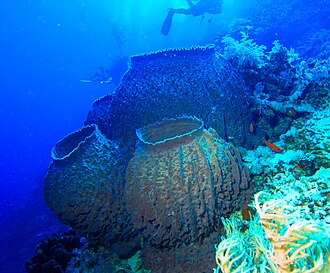
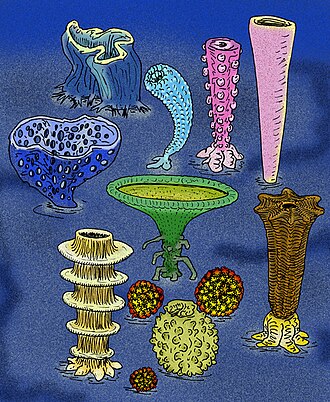
图:Albert Kok at Dutch Wikipedia (Original text: Albert Kok) · Public domain · Wikimedia Commons
多孔动物门门
Porifera
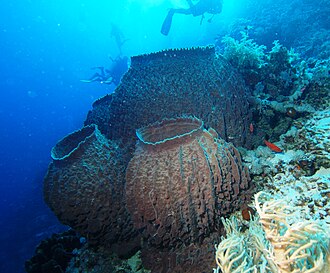
海绵 是一类原始的水生无脊椎动物,在生物分类学上构成名为多孔动物门 的分类单元。因外形像植物,而且着生于海洋或湖泊底部,所以海绵千百年来都被认为是植物,但后来发现它们几乎具备所有最基本的动物特征,于是在19世纪中期被归入动物界。海绵缺乏神经系统、消化系统和循环系统,身上布满了通水的小孔和沟道,多数种类依靠维持恒定的海水流过其身体来获取食物和氧气,并清除体内的废弃物。典型的海绵由两层联系松散的细胞构成体壁,围绕着中央体腔构成管状身体,体壁有众多的小孔和沟道。此外,也有缺乏中央腔而身体有众多小孔和沟道的类型。
摘自维基百科「海绵」,CC BY-SA 4.0
- 学名
- Porifera
- 分类等级
- 门
- 上级类群
- 动物界
- 大类
- 其他动物
- 命名
- 罗伯特·埃德蒙·格兰特,1836 年
- 中文别名
- 海绵动物门
- 数据库
- NCBI 分类 · GBIF
下级类群(6)
百科正文
海绵曾被认为是所有动物的最近共同祖先中最先分化的一支,在整个动物界的演化树上位于最基部,和其他所有动物(即真后生动物)形成姐妹群关系,但目前的研究指出栉水母比海绵更早出现。动物学中专门研究海绵的分支学科被称作海绵学(spongiology)。
下级分类
依据世界海洋物种目录(World Register of Marine Species,WoRMS),多孔动物门包含以下类群:
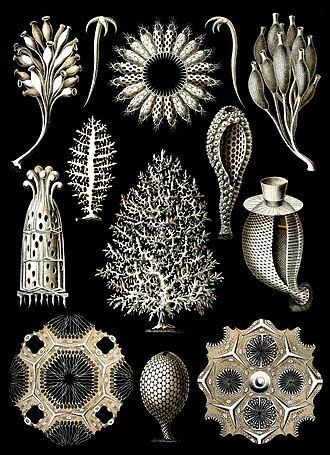
钙质海绵纲 Calcarea(= Calcispongia/Calcispongiae)
寻常海绵纲/普通海绵纲 Demospongiae(= 硬骨海绵纲 Sclerospongiae)
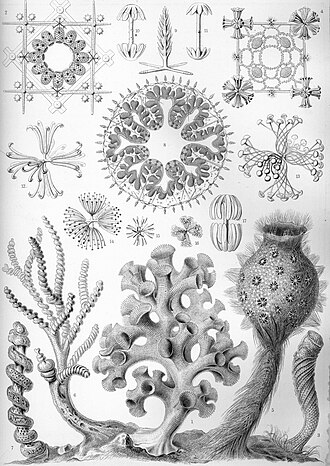
六放海绵纲 Hexactinellida(= 玻璃海绵纲 Hyalospongiae)
- 同骨海绵纲 Homoscleromorpha
- 地位未定 incertae sedis
- 肉质海绵目 Carnosa(非单系,已弃用)
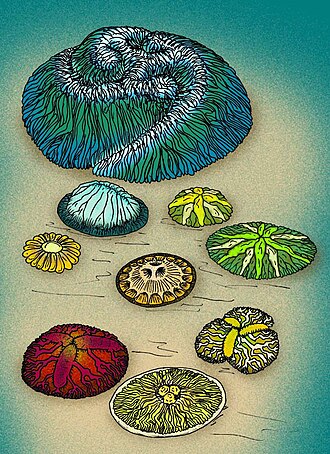
- 属 Placodictyum ?(可能属于海参)
以上内容摘自维基百科「海绵」,按 CC BY-SA 4.0 使用,去掉了参考文献、外部链接等尾部小节,公式改写成了纯文本。全文、配图和出处见原文。
英文维基百科补充中文条目比较短,下面是英文条目「Sponge」的原文
Sponges or sea sponges are primarily marine invertebrates of the animal phylum Porifera (; meaning 'pore bearer'). They are filter feeders that are typically bound to the seabed, being sessile. Sponges are one of the most ancient members of living seabed community (macrobenthos), with many species being important reef-builders. Some sponge species inhabit freshwater.
Sponges are multicellular organisms consisting of jelly-like mesohyl sandwiched between two thin layers of cells, and usually have tube-like bodies full of pores and channels that allow water to circulate through them. They have unspecialized cells that can transform into other types and that often migrate between the main cell layers and the mesohyl in the process. They do not have complex nervous, digestive or circulatory systems. Instead, most sponges rely on maintaining a constant water flow through their bodies to obtain food and oxygen and to remove waste products, usually via flagellar movements of the so-called "collar cells".
Sponges may be the sister group to all other animals, although the evidence for this relationship remains inconclusive, and different studies may recover different placements between sponges and other animal clades. Fossil evidence of primitive sponges such as Otavia dates to as early as the Tonian period (around 800 Mya). The branch of zoology that studies sponges is spongiology. Historically, the skeletons of sea sponges were used as the cleaning tool of the same name, though this is no longer a common practice.
Etymology
The term sponge derives from the Ancient Greek word σπόγγος spóngos. The scientific name Porifera is a neuter plural of the Modern Latin term porifer, which comes from the roots porus meaning "pore, opening", and -fer meaning "bearing or carrying".
以上节选摘自英文维基百科「Sponge」,按 CC BY-SA 4.0 使用,去掉了参考文献、外部链接等尾部小节,公式改写成了纯文本。篇幅所限,较长的小节只摘了开头一部分,有的小节没有收;全文、配图和出处见原文。