格物
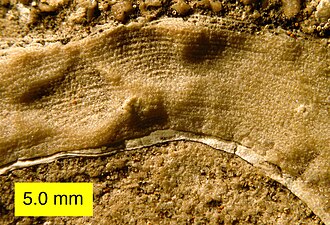
图:Wilson44691 · Public domain · Wikimedia Commons
- 学名
- Stromatoporoidea
- 分类等级
- 纲
- 上级类群
- 多孔动物门
- 大类
- 其他动物
百科正文
分布
层孔虫化石的地理分布甚广,在世界各地志留纪、泥盆纪的碳酸盐沉积地层中几乎都有它们的代表。中国的层孔虫化石很多,常见的属包括拉贝希层孔虫(Labechia)和方格层孔虫(Clathrodictyon)等。珠穆朗玛峰的侏罗纪中发现有准放射层孔虫(Actinostromina)等。在日本则多产于侏罗纪的鸟巢石灰岩上。
特征
其化石为粒状或纤维状,仅发现由碳酸钙组成之块状或层状群体之骨骼化石,未发现动物体。骨骼由石灰质组成,外形变化很大,有半球状、块状、分枝状、薄层状、圆柱状等,最小直径仅数毫米,最大则可达数米以上,由同心层状排列的钙质细层和与之垂直的支柱构成,常相互垂直,形如网格。细层平直、弯曲或褶皱,支柱限于细层之间或穿过细层,有时细层及支柱发育不完整而形成不规则的网格状。细层及支柱均是坚实的或穿有细孔。此外,内部还有厚层、虫室、假虫管等构造。层孔虫的微细构造在分类上十分重要,现已划分出14种类型。有的层孔虫外形为圆柱状,中央具有空心的轴管,管内可具横板,管的周围被细层和支柱或泡沫状组织所围绕,如常见于泥盆纪的双孔层孔虫(Amphipora)。硬件表面常有呈放射状排列的星状沟及刺、瘤、凹陷等。其本身可形成礁,也可和珊瑚及苔藓虫一起形成礁。
生活习性
全为海生,群体底栖、固着海底或附在其他物体上生长。通常生活在清澈温暖、盐度适中、阳光充足、水动力较强的浅海中,也有生活在潟湖或礁前较深水域中的。常和珊瑚、藻类等构成生物礁。
以上内容摘自维基百科「層孔蟲」,按 CC BY-SA 4.0 使用,去掉了参考文献、外部链接等尾部小节,公式改写成了纯文本。全文、配图和出处见原文。
英文维基百科补充中文条目比较短,下面是英文条目「Stromatoporoidea」的原文
Stromatoporoidea is an extinct clade of sea sponges common in the fossil record from the Middle Ordovician to the Late Devonian. They can be characterized by their densely layered calcite skeletons lacking spicules. Stromatoporoids were among the most abundant and important reef-builders of their time, living close together in flat biostromes or elevated bioherms on soft tropical carbonate platforms.
Externally, some species have raised bumps (mamelons) and star-shaped crevices (astrorhizae), which together help vent exhalant water away from the living surface. Internally, stromatoporoids have a mesh-like skeletal system combining extensive horizontal layers (laminae), vertical rods (pillars), and boxy spaces (galleries), along with other features. The most common growth forms range from laminar (flattened) to domical (dome-shaped). Spheroidal, finger-like, or tree-like species also occur, though they are rare in most environments.
Stromatoporoids competed and coexisted with other reef-builders such as tabulate and rugose corals. Some stromatoporoid species are useful as environmental proxies, since their form and distribution can help approximate the depositional environment of sedimentary strata. They hosted a diverse fauna of encrusting symbionts both within and outside their skeletons. Some studies have argued that stromatoporoids were mixotrophs (engaged in a mutualistic relationship with photosynthetic algae), similar to modern scleractinian corals. Though this hypothesis is plausible, circumstantial evidence is inconclusive.
Prior to the 1970s, stromatoporoids were most frequently equated with colonial hydrozoans in the phylum Cnidaria (which also includes corals, sea anemones, and jellyfish). They are now classified as sponges in the phylum Porifera, based on their similarity to modern sclerosponges. True Paleozoic stromatoporoids (sensu stricto) encompass seven orders. Two or three of these orders appeared in the Ordovician while the rest evolved in the Silurian. They rediversified subsequent to mass extinctions at the end of the Ordovician and Silurian, but a more profound decline began in the Late Devonian. With a few putative exceptions, they apparently died out during the Hangenberg event at the end of the Devonian. A number of hypercalcified Mesozoic sponges have been classified as stromatoporoids, but they are likely unrelated to the Paleozoic radiation, thus making 'stromatoporoids' (in the broad sense) a polyphyletic group if they are included. Some Carboniferous sponges have been identified as stromatoporoids with a somewhat greater degree of confidence.
Morphology
Stromatoporoids are robust sponges with a dense calcite skeleton lacking spicules. Like other sponges, they grow outwards and upwards from a single base attached firmly to the substrate. Most were ambitopic (occupying soft substrate such as mud or sand for most of their life), though some were encrusting (concreted onto hard substrates such as rocks or other organisms). The base was stabilized by a crust-like layer covered with concentric wrinkles.
Classification
Taxonomy
- From Stearn et al. (1999) and The Treatise on Invertebrate Paleontology:
- Order Actinostromatida [Upper Ordovician? (Katian) – Upper Devonian (Frasnian)]
- Order Amphiporida [late Silurian (Ludlow) – Upper Devonian (Famennian)]
Order Clathrodictyida [Upper Ordovician (Katian) – Upper Devonian (Famennian), Upper Mississippian? (Serpukhovian)]
Evolution
Origination
The first unambiguous stromatoporoids appeared in the Ordovician, but superficially similar organisms have been reported from the Early Cambrian. These are most likely cases of convergent evolution rather than true forerunners. One example were the Kazachstanicyathida, an order of archaeocyath sponges with low growth habits and porous internal domes comparable to cyst plates.
Paleoecology
Stromatoporoid reefs
Like modern corals, stromatoporoids were gregarious filter feeders which congregated into closely packed patches. They were adaptable and could thrive at a variety of depths, light levels, and fluctuating sea level regimes. In these regards, they were more similar to corals than to modern calcareous sponges, which generally occupy a narrow selection of rocky habitats with high nutrient supply and low light levels.
以上节选摘自英文维基百科「Stromatoporoidea」,按 CC BY-SA 4.0 使用,去掉了参考文献、外部链接等尾部小节,公式改写成了纯文本。篇幅所限,较长的小节只摘了开头一部分,有的小节没有收;全文、配图和出处见原文。