格物
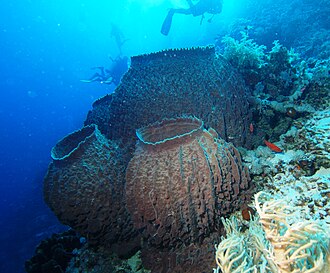
图:Albert Kok · CC BY-SA 3.0 · Wikimedia Commons
- 学名
- Demospongiae
- 分类等级
- 纲
- 上级类群
- 多孔动物门
- 大类
- 其他动物
- 命名
- 威廉·梭雷斯,1885 年
- 中文别名
- 普通海绵纲
- 异名
- 四放海绵亚纲
- 数据库
- NCBI 分类 · GBIF
下级类群(5)
百科正文
下级分类
- 寻常海绵纲 Demospongiae
- †原单轴海绵目 Protomonaxonida(已灭绝)
- 亚纲 Heteroscleromorpha
- 群海绵目 Agelasida
- 小轴海绵目 Axinelida
- 目 Biemnida
- 目 Bubarida
- 目 Clionaida
- 目 Desmacellida
- 简骨海绵目 Haplosclerida
- 目 Merliida
- 繁骨海绵目 Poecilosclerida
- 多鞭海绵目 Polymastiida
- 目 Scopalinida
- 目 Sphaerocladina
- 目 Spongillida
- 目 Suberitida
- 荔枝海绵目 Tethyida
- 四放海绵目 Tetractinellida
- 星骨海绵亚目 Astrophorina
- 旋星海绵亚目 Spirophorina
- 托俄萨海绵亚目 Thoosina
- 目 Trachycladida
- 角质海绵亚纲 Keratosa
- 枝角海绵目 Dendroceratida
- 网角海绵目 Dictyoceratida
- 真海绵亚纲 Verongimorpha
- 目 Chonrillida
- 砂皮海绵目 Chondrosida
- 真海绵目 Verongida
形态特征
寻常海绵纲的某些种类有骨针,骨针为硅质,针与针之间借助海绵质(一种类似蚕丝的物质)互相粘着。某些寻常海绵的骨针包裹在海绵质内部,而另一些种类的骨针则完全消失,只有海绵质的纤维错综交互构成骨架网络。
以上内容摘自维基百科「寻常海绵纲」,按 CC BY-SA 4.0 使用,去掉了参考文献、外部链接等尾部小节,公式改写成了纯文本。全文、配图和出处见原文。
英文维基百科补充中文条目比较短,下面是英文条目「Demosponge」的原文
Demosponges or common sponges are sponges of the class Demospongiae (from Ancient Greek: δῆμος, romanized: dêmos, lit. 'common people' + σπογγιά, spongiá, 'sponge'), the most diverse group in the phylum Porifera which include greater than 90% of all extant sponges with nearly 8,800 species worldwide (according to the World Porifera Database). Being siliceous sponges, they are predominantly leuconoid in structure with an endoskeleton made of a meshwork of spicules consisting of fibers of the protein spongin, the mineral silica, or both. Where spicules of silica are present, they have a different shape from those in the otherwise similar glass sponges. Some species, in particular from the Antarctic, obtain the silica for spicule-building from the ingestion of diatoms.
The many diverse orders in this class include all of the large sponges. About 311 million years ago, in the Late Carboniferous, the order Spongillida split from the marine sponges, and is the only sponges to live in freshwater environments. Some species are brightly colored, with great variety in body shape; the largest species are over 1 m (3.3 ft) across. They reproduce both sexually and asexually. They are the only extant organisms that methylate sterols at the 26-position, a fact used to identify the presence of demosponges before their first known unambiguous fossils.
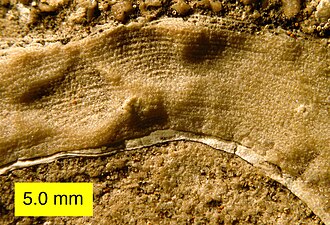
Because of many species' long life span (500–1,000 years) it is thought that analysis of the aragonite skeletons of these sponges could extend data regarding ocean temperature, salinity, and other variables farther into the past than has been previously possible. Their dense skeletons are deposited in an organized chronological manner, in concentric layers or bands. The layered skeletons look similar to reef corals. Therefore, demosponges are also called coralline sponges.
Demosponges can be found in aquatic ecosystems worldwide, freshwater and saltwater. They can be found anywhere from the Intertidal Zones, to the deepest abyss of the oceans. The deepest point that a demosponge was found was 9,990 feet deep in the Philippine Trench.
Classification and systematics
The Demospongiae have an ancient history. The first demosponges may have appeared during the Precambrian deposits at the end of the Cryogenian "Snowball Earth" period. Their presence has been indirectly detected by fossilized steroids, called steranes, hydrocarbon markers characteristic of the cell membranes of the sponges, rather than from direct fossils of the sponges themselves. They represent a continuous chemical fossil record of demosponges through the end of the Neoproterozoic. The earliest Demospongiae fossil was discovered in the lower Cambrian (Series 2, Stage 3; approximately 515 Ma) of the Sirius Passet Biota of North Greenland: this single specimen had a spicule assemblage similar to that found in the subclass Heteroscleromorpha. The earliest sponge-bearing reefs date to the Early Cambrian (they are the earliest known reef structure built by animals), exemplified by a small bioherm constructed by archaeocyathids and calcified microbes at the start of the Tommotian stage about 530 Ma, found in southeast Siberia.
Reproduction
Spermatocytes develop from the transformation of choanocytes and oocytes arise from archeocytes. Repeated cleavage of the zygote egg takes place in the mesohyl and forms a parenchymella larva with a mass of larger internal cells surrounded by small, externally flagellated cells. The resulting swimming larva enters a canal of the central cavity and is expelled with the exhalant current.
Methods of asexual reproduction include both budding and the formation of gemmules. In budding, aggregates of cells differentiate into small sponges that are released superficially or expelled through the oscula. Gemmules are found in the freshwater family Spongillidae. They are produced in the mesohyl as clumps of archeocytes, are surrounded with a hard layer secreted by other amoebocytes. Gemmules are released when the parent body breaks down, and are capable of surviving harsh conditions. In a favorable situation, an opening called the micropyle appears and releases amoebocytes, which differentiate into cells of all the other types.
Economic importance
The most economically important group of demospongians to human are the bath sponges. These are harvested by divers and can also be grown commercially. They are bleached and marketed; the spongin gives the sponge its softness.
以上节选摘自英文维基百科「Demosponge」,按 CC BY-SA 4.0 使用,去掉了参考文献、外部链接等尾部小节,公式改写成了纯文本。篇幅所限,较长的小节只摘了开头一部分,有的小节没有收;全文、配图和出处见原文。