格物
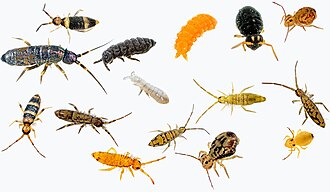
图:A J Cann · CC BY-SA 2.5 · Wikimedia Commons
- 学名
- Collembola
- 分类等级
- 纲
- 英文名
- springtail
- 上级类群
- 六足亚门
- 大类
- 其他动物
- 命名
- 约翰‧卢伯克,1870 年
- 数据库
- NCBI 分类 · GBIF
下级类群(2)
百科正文
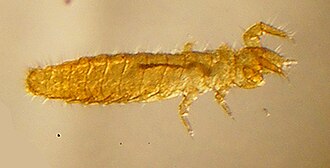
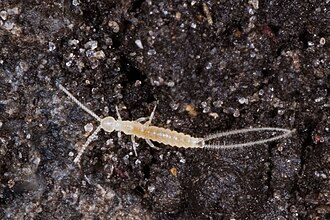
弹尾纲无翅,长在5毫米以下。善于跳跃,分布很广。常生活在潮湿处,如落叶下、石下、青苔间、地面、水边或积水地面上、腐植土中、蚁与白蚁巢穴中,雪地上也有发现以腐植质、菌类、地衣为主要食物,有些种类危害活的植物的种子、根茎、嫩叶,被认为是农作物及园艺作物的害虫。
弹尾纲以往以弹尾目被列入昆虫纲的无翅亚纲,还曾与原尾目及双尾目合并为内口纲。
下级分类
- 弹尾纲包括以下目:
- 长角跳虫目 Entomobryomorpha
- 短角跳虫目 Neelipleona
- 跳虫目 Poduromorpha
- 愈腹目 Symphypleona
以上内容摘自维基百科「弹尾纲」,按 CC BY-SA 4.0 使用,去掉了参考文献、外部链接等尾部小节,公式改写成了纯文本。全文、配图和出处见原文。
英文维基百科补充中文条目比较短,下面是英文条目「Springtail」的原文
Springtails (class Collembola) form the largest of the three lineages of modern hexapods that are no longer considered insects, the others being Protura and Diplura. Although the three lineages are sometimes grouped together in a class called Entognatha because they have internal mouthparts, they do not appear to be any more closely related to one another than they are to insects, which have external mouthparts. There are more than 9,000 species worldwide.
Springtails are omnivorous, free-living organisms that prefer moist conditions. They do not directly engage in the decomposition of organic matter, but contribute to it indirectly through the fragmentation of organic matter and the control of soil microbial communities. The word Collembola is from the Ancient Greek κόλλα kólla meaning 'glue' and ἔμβολος émbolos meaning 'peg'; this name was given due to the existence of the collophore, which was previously thought to stick to surfaces to stabilize the creature.
Early DNA sequence studies suggested that Collembola represent a separate evolutionary line from the other Hexapoda, but others disagreed. This seemed to be caused by widely divergent patterns of molecular evolution among the arthropods. The adjustments of traditional taxonomic rank for springtails reflect the occasional incompatibility of traditional groupings with modern cladistics: when they were included with the insects, they were ranked as an order; as part of the Entognatha, they are ranked as a subclass. If they are considered within Hexapoda, they are elevated to full class status.
Morphology
Members of the Collembola are normally less than 6 mm (0.24 in) long, have six or fewer abdominal segments, and possess a tubular appendage (the collophore or ventral tube) with reversible, sticky vesicles, projecting ventrally from the first abdominal segment. It is believed to serve various functions, e.g. fastening the body on a smooth surface, fluid uptake and excretion, cleaning the body surface, and orientation of the organism itself during jump.
Genomics
Given their small size, springtails have been neglected in terms of genome analysis. They are one of the few arthropod groups that do not have high-quality reference genomes. Even though some earlier genome sequences were produced, they do not meet modern standards (contig N50 > 1 MB). One of the first genomes was presented in 2025, that of Orchesella flavescens, which is 270 MB and was assembled into 6 chromosome-level scaffolds.
Systematics and evolution
Traditionally, springtails were divided into the orders Arthropleona, Symphypleona, and occasionally also Neelipleona. The Arthropleona were divided into two superfamilies, the Entomobryoidea and the Poduroidea. However, molecular-based phylogenetic studies show Arthropleona is paraphyletic. Thus, the Arthropleona are abolished in modern classifications, and their superfamilies are raised in rank accordingly, being now orders Entomobryomorpha and the Poduromorpha.
Ecology
Foraging
Specific feeding (foraging) strategies and mechanisms are employed to match specific niches. Herbivorous and detritivorous species fragment biological material present in soil and leaf litter, supporting decomposition and increasing the availability of nutrients for plants and various species of microbes and fungi. Carnivorous species maintain populations of small invertebrates such as nematodes, rotifers, and other collembolan species.
Climate warming impact
In polar regions that are expected to experience among the most rapid impact from climate warming, springtails have shown contrasting responses to warming in experimental warming studies. There are negative, positive and neutral responses reported. Neutral responses to experimental warming have also been reported in studies of non-polar regions.
Reproduction
Sexual reproduction occurs through the clustered or scattered deposition of spermatophores by male adults. Stimulation of spermatophore deposition by female pheromones has been demonstrated in Sinella curviseta. Mating behavior can be observed in Symphypleona. Among Symphypleona, males of some Sminthuridae use a clasping organ located on their antenna.
以上节选摘自英文维基百科「Springtail」,按 CC BY-SA 4.0 使用,去掉了参考文献、外部链接等尾部小节,公式改写成了纯文本。篇幅所限,较长的小节只摘了开头一部分,有的小节没有收;全文、配图和出处见原文。