格物

图:Gregor ?nidar · CC BY 2.0 · Wikimedia Commons
- 学名
- Entognatha
- 分类等级
- 纲
- 上级类群
- 六足亚门
- 大类
- 其他动物
- 命名
- Rudolf von Stummer-Traunfels,1891 年
- 数据库
- GBIF
百科正文
内口纲包含有弹尾目、双尾目和原尾目三个目。这些动物在六足亚门之中的演化是独立于昆虫之外的,并且各个目之间也相互独立。这三个目并不紧密关连,因此内口纲被认为是一个并系群。
形态学
这些小动物一开始便是无翼的了,而不如其他一些昆虫是在之后才退化掉的。内口纲这一名称是因为其口器是内缩在头部里面的缘故。其他和昆虫之间的差别还有,内口纲的每根触角都是有肉的,而昆虫则只有尾部两根有。在其下的三个目之中,只有弹尾目有眼睛。不过,许多的弹尾目动物仍然是瞎的,且即使存在着复眼,亦不会超过八只单眼。
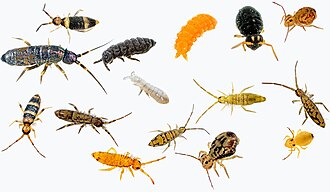
弹尾目在其第一节腹部上有一只腹管,称之为粘管,可以吸收空气中的水分;在第三节腹部上则有个抓住分叉部位的持钩,此一分叉部位的作用有如弹簧一般,而这也是弹尾目此一名称的缘由。
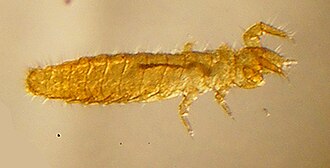
原尾目没有眼睛或触角。它们在腹部有腹针,被认为是退化后的腿部。
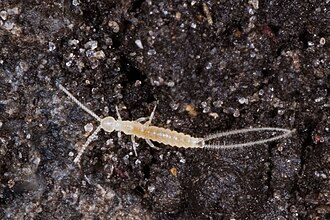
双尾目有一对尾须。
以上内容摘自维基百科「內口綱」,按 CC BY-SA 4.0 使用,去掉了参考文献、外部链接等尾部小节,公式改写成了纯文本。全文、配图和出处见原文。
英文维基百科补充中文条目比较短,下面是英文条目「Entognatha」的原文
The Entognatha (from Ancient Greek ἐντός (entós), meaning "inside", and γνάθος (gnáthos), meaning "jaw") are a class of wingless and ametabolous arthropods, which, together with the insects, makes up the subphylum Hexapoda. Their mouthparts are entognathous, meaning that they are retracted within the head, unlike the insects. Entognatha are apterous, meaning that they lack wings. The class contains three orders: Collembola (springtails, 9000 species), Diplura ("two-tail", 1000 species) and Protura ("first-tail", 800 species). These three groups were historically united with the now-obsolete order Thysanura to form the subclass Apterygota, but it has since been recognized that these orders might not be closely related, and Entognatha and Apterygota are now both considered to be paraphyletic groups.
Morphology
These minute arthropods are apterous, unlike some orders of insects that have lost their wings secondarily (but are derived from winged ancestors). Their mouthparts are enclosed within a pouch in the head capsule, called the gnathal pouch, so only the tips of the mandibles and maxillae are exposed beyond the cavity. This pouch is created in the embryo by a flap or lateral head sclerite near the mouth on each side of the head which fuses with the labium. Other differences from insects are that each antennal segment is musculated; in insects, only the two basal segments are. Sperm transfer is always indirect, and there is an ovipositor in the females. Of the three orders, only collembolans possess eyes; nevertheless, many collembolans are blind, and even when compound eyes are present, there are no more than eight ommatidia.
Collembolans have a ventral tube termed a collophore on the first abdominal segment. The collophore is involved in moisture absorption. On the third abdominal segment is the retinaculum that holds the furcula. The furcula is the "spring" for which the Collembola are given the name springtails.
Proturans, sometimes referred to as "coneheads", do not have eyes or antennae. They possess a telson and abdominal styli thought to be vestigial legs.
Diplurans have a pair of caudal cerci, from which their name, meaning "two-tailed", is derived. They also possess abdominal styli.
以上内容摘自英文维基百科「Entognatha」,按 CC BY-SA 4.0 使用,去掉了参考文献、外部链接等尾部小节,公式改写成了纯文本。全文、配图和出处见原文。