格物
- 学名
- Tragelaphus eurycerus
- 分类等级
- 种
- 英文名
- bongo
- 上级类群
- 薮羚属
- 大类
- 哺乳动物
- 命名
- William Ogilby,1837 年
- 保护状况(IUCN)
- 近危物种
- 数据库
- NCBI 分类 · GBIF · IUCN 红色名录
百科正文
紫羚包括两个亚种:
低地亚种(或西部亚种):生活在西部非洲,保育状态为近危;
山地亚种(或东部亚种):只生活在肯尼亚中部偏远地区,保育状态为濒危。
特征
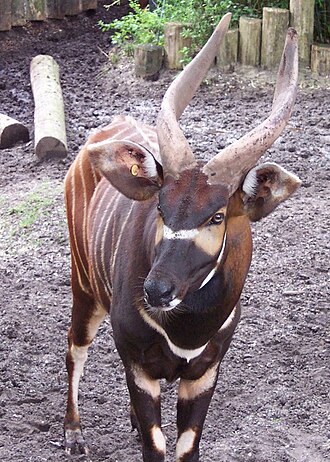
紫羚的外部特征包括:红褐色的体毛,面部黑白相间的印记,体表黄白相间的条纹,长长的螺旋状角。在薮羚属中,它们是唯一的一种雄性和雌性都长角的动物。
雄性和雌性的体型大小相近,身高约为1.1-1.3米,体长1.7-2.5米。雌性体重为210-235千克,雄性较重,为240-405千克。
分布与栖息地
生活在最高可达海拔4,000米的茂密的非洲丛林中,主要分布在肯尼亚(东部亚种)和西部非洲大部分国家(西部亚种)的孤立地区。由于农耕地的开发和木材的过量砍伐,其数量比历史上已经大大减少。
习性与繁殖
与其他森林地区的有蹄动物相似,紫羚很少组成较大的群体。雄性一般为独居,雌性则与幼仔一起以6-8头为单位组成小的群体。种群数量很少多于20头。
尽管以夜行性为主,但偶尔也会在白天活动。紫羚是一种非常温驯的动物,很容易受惊。紫羚的食谱比较广泛,以树叶、矮木、藤蔓、树皮以及植物的其他部分为食。
孕期约为285天(9.5个月),每胎产一仔,断奶期为6个月。性成熟期为24-27个月。紫羚幼仔在种群中成长速度非常快,一般到了3.5个月时就开始长角。
以上内容摘自维基百科「紫羚」,按 CC BY-SA 4.0 使用,去掉了参考文献、外部链接等尾部小节,公式改写成了纯文本。全文、配图和出处见原文。
英文维基百科补充中文条目比较短,下面是英文条目「Bongo (antelope)」的原文
The bongo (Tragelaphus eurycerus) is a large, mostly nocturnal, forest-dwelling antelope, native to sub-Saharan Africa. Bongos are characterised by a striking reddish-brown coat, black-and-white markings, white-yellow stripes, and long, slightly spiraled horns. Bongos have complex social interactions and are found in African dense forest mosaics. They are the third-largest antelope in the world.
In 2000, the Association of Zoos and Aquariums in the US upgraded the bongo to a Species Survival Plan participant and in 2006 added the Bongo Restoration to Mount Kenya Project to its list of the Top Ten Wildlife Conservation Success Stories of the year. As of 2013, these successes have been compromised by reports of possibly only 100 mountain bongos left in the wild due to logging and poaching.
Taxonomy
The scientific name of the bongo is Tragelaphus eurycerus, and it belongs to the family Bovidae. It was first described by Irish naturalist William Ogilby in 1837. The generic name Tragelaphus is composed of two Greek words: trag-, meaning a goat; and elaphos, meaning deer. The specific name eurycerus originated from the fusion of eurus (broad, widespread) and keras (an animal's horn). The common name "bongo" originated probably from the Kele language of Gabon. The first known use of the name "bongo" in English dates to 1861.
Appearance
Bongos are one of the largest of the forest antelopes. In addition to the deep chestnut colour of their coats, they have bright white stripes on their sides to help with camouflage.
Adults of both sexes are similar in size. Adult height is about 1.1 to 1.3 m (3.6 to 4.3 ft) at the shoulder and length is 2.15 to 3.15 m (7.1 to 10.3 ft), including a tail of 45–65 cm (18–26 in). Females weigh around 150–235 kg (331–518 lb), while males weigh about 220–405 kg (485–893 lb).
Social organization and behavior
Like other forest ungulates, bongos are seldom seen in large groups. Males, called bulls, tend to be solitary, while females with young live in groups of six to eight. Bongos have seldom been seen in herds of more than 20. Gestation is about 285 days (9.5 months), with one young per birth, and weaning occurs around 6 months. Sexual maturity is reached at 24–27 months. The preferred habitat of this species is so dense and difficult to operate in that few Europeans or Americans observed this species until the 1960s.
Ecology
Distribution and habitat
Bongos are found in tropical jungles with dense undergrowth up to an altitude of 4,000 m (13,000 ft) in Central Africa, with isolated populations in Kenya, and these West African countries: Cameroon, the Central African Republic, the Republic of the Congo, the Democratic Republic of the Congo, Ivory Coast, Equatorial Guinea, Gabon, Ghana, Guinea, Liberia, Sierra Leone, and South Sudan.
Historically, bongos are found in three disjunct parts of Africa: East, Central, and West. Today, all three populations' ranges have shrunk in size due to habitat loss for agriculture and uncontrolled timber cutting, as well as hunting for meat.
Population and conservation
Few estimates of population density are available. Assuming average population densities of 0.25 animals per km2 in regions where it is known to be common or abundant, and 0.02 per km2 elsewhere, and with a total area of occupancy of 327,000 km2 (126,000 sq mi), a total population estimate around 28,000 is suggested. Only about 60% are in protected areas, so the actual numbers of the lowland subspecies may only be in the low tens of thousands. In Kenya, their numbers have declined significantly, and on Mount Kenya, they were extirpated within the last decade due to illegal hunting with dogs.
Status
The IUCN Antelope Specialist Group considers the western or lowland bongo, T. e. eurycerus, to be lower risk (near threatened) and the eastern or mountain bongo, T. e. isaaci, of Kenya, to be critically endangered. These bongos may be endangered due to human environmental interaction, as well as hunting and illegal actions towards wildlife.
CITES lists bongos as an Appendix III species, only regulating their exportation from a single country, Ghana. It is not protected by the US Endangered Species Act and is not listed by the USFWS.
以上节选摘自英文维基百科「Bongo (antelope)」,按 CC BY-SA 4.0 使用,去掉了参考文献、外部链接等尾部小节,公式改写成了纯文本。篇幅所限,较长的小节只摘了开头一部分,有的小节没有收;全文、配图和出处见原文。