格物
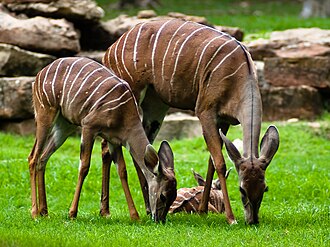
图:Malcolm · CC BY-SA 2.0 · Wikimedia Commons
- 学名
- Tragelaphus imberbis
- 分类等级
- 种
- 上级类群
- 薮羚属
- 大类
- 哺乳动物
- 命名
- 爱德华·布莱思,1869 年
- 保护状况(IUCN)
- 近危物种
- 数据库
- NCBI 分类 · GBIF · IUCN 红色名录
百科正文
特征
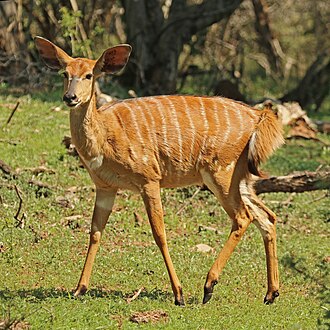
小旋角羚肩高90-110厘米,雌羚重55-70公斤,公羚重70-110公斤,公羚较雌羚大。公羚呈灰褐色,雌羚呈栗色,下身较浅色。背上有10条白色斑纹,颈下有两条白色斑纹。公羚有细小的鬃毛,角约长70厘米,扭曲一转。
生态
小旋角羚栖息在干旱的丛林及森林,主要吃叶子。它们是夜间及拂晓活动的。它们会以2-5只群居,最多可以多达24只,公羚与雌羚的数目相约。
小旋角羚可以跳远达9米,跳高2.5米。它们最高速达每小时80-100公里。
小旋角羚在东非的数量约有12万只。
以上内容摘自维基百科「小旋角羚」,按 CC BY-SA 4.0 使用,去掉了参考文献、外部链接等尾部小节,公式改写成了纯文本。全文、配图和出处见原文。
英文维基百科补充中文条目比较短,下面是英文条目「Lesser kudu」的原文
The lesser kudu (Tragelaphus imberbis) is a medium-sized antelope found in East Africa. The species is not especially closely related to the greater kudu, though both belong the artiodactyl tribe Tragelaphini (family Bovidae), of striped, spiral-horned African bovids, along with the nyala, elands, balbok, bushbucks, bongo, and sitatunga. It was first scientifically described by English zoologist Edward Blyth in 1869. The species is sometimes assigned as the only species of the genus Ammelaphus, with that designation typically as a subgenus.
The lesser kudu is a browser subsisting off of foliage from tall bushes, trees, and herbaceous perennial plants. They are not territorial, and mainly crepuscular, preferring to be active after dusk until the dawn hours, seeking shelter in dense thickets just after the sunrise. The Lesser Kudu inhabits dry bushland regions, bordering on arid grasslands, as well as scrubland and light open forest habitat.
The lesser kudu is native to Ethiopia, Kenya, Somalia, South Sudan, Tanzania, and Uganda, but it is possibly extirpated from Djibouti. It may have been present in Saudi Arabia and Yemen as recently as 1967, though its presence in the Arabian Peninsula is still controversial.
The total population of the Lesser Kudu is decreasing. Presently, the International Union for Conservation of Nature rates the Lesser Kudu as "near threatened".
The handsome head of the male Lesser Kudu, with his elegant spiraled horns, is the symbol of the Saint Louis Zoo.
Taxonomy and genetics
The scientific name of the lesser kudu is Tragelaphus imberbis. The animal is classified under the genus Tragelaphus in family Bovidae. It was first described by the English zoologist Edward Blyth in 1869. The generic name, Tragelaphus, derives from Greek word tragos, meaning a male goat, and elaphos, which means a deer, while the specific name imberbis comes from the Latin term meaning unbearded, referring to this kudu's lack of mane. The vernacular name kudu (or koodoo) may have originated from the Khoikhoi kudu, or via the Afrikaans koedoe.
Physical description
The lesser kudu is a spiral-horned antelope, characterised by large, rounded ears. The head-and-body length is typically between 110 and 140 cm (43 and 55 in). Males reach about 95–105 cm (37–41 in) at the shoulder, while females reach 90–100 cm (35–39 in). Males typically weigh 92–108 kg (203–238 lb) and females 56–70 kg (123–154 lb). The bushy tail is 25–40 cm (9.8–15.7 in) long, white underneath and with a black tip at the end.
Distinct signs of sexual dimorphism are seen in the antelope. The female is considerably smaller than the male. The females and juveniles have a rufous coat.
Ecology and Behavior
The lesser kudu is mainly active at night and during the dawn, and seeks shelter in dense thickets just after the sunrise. The midday is spent in rest and rumination in shaded areas. They spend about equal time foraging, standing and lying, and roaming.
The lesser kudu is a shy and wary animal. It can camouflage so well in dense vegetation such that only its ears and tail can indicate its presence. The lesser kudu's thin torso allows it to move through dense vegetation with ease. When alarmed, the animal stands motionless.
Habitat and distribution
The Lesser Kudu inhabits dry bushland regions. It is closely associated with Acacia and Commiphora thornbush in semiarid areas of northeastern Africa. The animal avoids open areas and long grass, preferring shaded areas with short grasses instead. Found in woodlands and hilly areas, as well, the lesser kudu is generally found at altitudes below 1,200 m (3,900 ft); though they have been recorded at heights about 1,740 m (5,710 ft) near Mount Kilimanjaro.
Threats and conservation
The Lesser Kudu's shyness and its ability to camouflage itself in dense cover has protected it from the risks of poaching. For instance, the Lesser Kudu is widespread in the Ogaden region, which is rich in dense bush, despite intense hunting by local people.
However, rinderpest outbreaks, to which the Lesser Kudu is highly susceptible, have resulted in a steep decline of 60% in the animal's population in Tsavo National Park in Kenya.
以上节选摘自英文维基百科「Lesser kudu」,按 CC BY-SA 4.0 使用,去掉了参考文献、外部链接等尾部小节,公式改写成了纯文本。篇幅所限,较长的小节只摘了开头一部分,有的小节没有收;全文、配图和出处见原文。