 格物
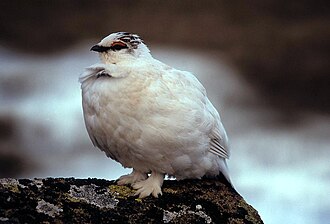
图:Tim Bowman · Public domain · Wikimedia Commons
- 学名
- Lagopus muta
- 分类等级
- 种
- 英文名
- Rock Ptarmigan
- 上级类群
- 雷鸟属
- 大类
- 鸟类
- 命名
- Lars Jonasson Montin,1781 年
- 保护状况(IUCN)
- 无危物种
- 体重
- 665 克(成年体重、雄性);555 克(成年体重、雌性)
- 数据库
- NCBI 分类 · GBIF · IUCN 红色名录
百科正文
生态环境
岩雷鸟多栖息在海拔1300~2000米处的砾石苔原、桧树灌丛和沼泽地。
分布地域
本种分布于全北界的冻土苔原带和高山苔原带。
特征
中等体型松鸡。外形颇似柳雷鸟,但夏羽甚为灰暗而冬季眼先黑色。嘴较细小。虽然本种与柳雷鸟颇为相似,但在中国的地理分布相去甚远,在野外不会混淆。 岩雷鸟的叫声为粗声的kuh, kuh, kwa-kwa-kwa,雄鸟会发出awebo, awebo猛叫。
以上内容摘自维基百科「岩雷鸟」,按 CC BY-SA 4.0 使用,去掉了参考文献、外部链接等尾部小节,公式改写成了纯文本。全文、配图和出处见原文。
英文维基百科补充中文条目比较短,下面是英文条目「Rock ptarmigan」的原文
The rock ptarmigan (Lagopus muta) is a medium-sized game bird in the grouse tribe. It is known simply as the ptarmigan in Europe. It is the official bird for the Canadian territory of Nunavut, where it is known as the aqiggiq (ᐊᕿᒡᒋᖅ), and the official game bird for the province of Newfoundland and Labrador. In Japan, it is known as the raichō (雷鳥), which means "thunder bird"; it is the official bird of Gifu, Nagano, and Toyama Prefectures and is a protected species nationwide.
Etymology
The ptarmigan's genus name, Lagopus, is derived from Ancient Greek lagos (λαγώς lagṓs), meaning "hare", + pous (πούς poús), "foot", in reference to the bird's feathered legs.
The species name, muta, comes from Neo-Latin and means "mute", referring to the simple croaking song of the male. It was for a long time misspelt mutus, in the erroneous belief that the ending of Lagopus denotes masculine gender.
Description
The rock ptarmigan is 34–36 cm (13–14 in) long with an 8 cm (3.1 in) tail and with a wingspan of 54–60 cm (21–24 in) and a weight of 440–640 g (15.5–22.6 oz). It is about ten percent smaller than the willow ptarmigan.
The rock ptarmigan is camouflaged to match the seasons; its feathers moult from white in winter to grey and brown in spring or summer. The breeding male has greyish upper parts with white wings and underparts.
Taxonomy
The rock ptarmigan has 23 accepted subspecies:
L. m. atkhensis (Turner, 1882) - Tanaga Island, Adak Island and Atka Island. (west-central of the Aleutian Islands, US)
- L. m. dixoni (Grinnell, 1909) - Glacier Bay Island and southeastern Alaska
- L. m. evermanni (Elliot D.G., 1896) - Attu Island of the west Aleutian Islands, US)
- L. m. gerasimovi (Red'kin, 2005) - Karaginskiy Island in Russia
- L. m. helvetica (Thienemann, 1829) - Alps
Sounds and displays
Male rock ptarmigans emit a repertoire of guttural snores and rattles, most often directed to other males during breeding season. On open leks, single or multiple males also carry out displays on the ground and in the air to assert their territory, including chasing other males while flying.
Aerial courtship rituals involve fast forward flight with rapidly-beating wings followed by an upward glide, tail fanned out.
Distribution and habitat
The rock ptarmigan is a sedentary species which breeds across Arctic and Subarctic Eurasia and North America (including Greenland) on rocky mountainsides and tundra. It is widespread in the Arctic Cordillera and across the Eurasian Arctic from Norway, Sweden east to the Siberian Far East.
Ecology
Feeding
Food sources can vary tremendously depending on the region of their distribution. In Alaska, rock ptarmigans consume aspen buds, dwarf birch and willow buds and catkins as a staple winter diet. They transition their diets over to Empetrum nigrum (crowberries) and Vaccinium vitis-idaea (cowberry or lingonberry) shrubs during the spring. The greatest variety in its diet occurs during early summer, when it feeds on willow leaves, as well as the leaves and flowers of Dryas and locoweed.
Ecophysiology
Energy storage and assimilation
Rock ptarmigan have a limited capacity for fat storage, which requires overwintering birds to forage frequently. Most of the minuscule mass gained over winter is to the ovary, oviduct and hypertrophy, in preparation for the spring breeding season. Rock ptarmigan maximize assimilation of nutrient poor foods with their elongated ceca. Metabolic requirements can be partially supplemented by fermentation, the energy gain from fermentation alone, however, is not independently significant.
In culture
Rock ptarmigan meat is a popular part of festive meals in Icelandic cuisine. Hunting of rock ptarmigans was banned in Iceland in 2003 and 2004 due to its declining population. Hunting has been allowed again since 2005, but is restricted to selected days, which are revised yearly and all trade of rock ptarmigan is illegal.
In Thomas Bewick's A History of British Birds (1797) the species is named as "White Grouse" with alternatives "White Game, or Ptarmigan".
以上节选摘自英文维基百科「Rock ptarmigan」,按 CC BY-SA 4.0 使用,去掉了参考文献、外部链接等尾部小节,公式改写成了纯文本。篇幅所限,较长的小节只摘了开头一部分,有的小节没有收;全文、配图和出处见原文。