 格物
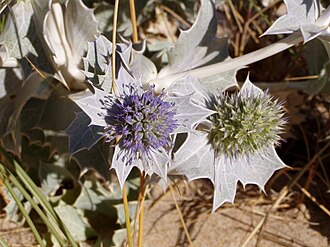
图:Júlio Reis (Tintazul) · CC BY-SA 2.5 · Wikimedia Commons
- 学名
- Eryngium maritimum
- 分类等级
- 种
- 上级类群
- 刺芹属
- 大类
- 被子植物
- 命名
- 卡尔·林奈,1753 年
- 数据库
- NCBI 分类 · GBIF
百科正文
滨海刺芹主要生长于海滨沙地,植株高20至60厘米。其蓝色花朵密生成一个半球状花头,叶子则与冬青相似,呈浅绿色。
在伊丽莎白一世时期的英格兰,滨海刺芹被认为是一种春药。莎士比亚喜剧《温莎的风流妇人》中法斯塔夫有一段台词就提到了滨海刺芹:
小行星199194的名称“Calcatreppola”即来自于滨海刺芹(滨海刺芹又名Calcatreppola marittima)。
以上内容摘自维基百科「滨海刺芹」,按 CC BY-SA 4.0 使用,去掉了参考文献、外部链接等尾部小节,公式改写成了纯文本。全文、配图和出处见原文。
英文维基百科补充中文条目比较短,下面是英文条目「Eryngium maritimum」的原文
Eryngium maritimum, also called the sea holly, sea eryngo, or sea eryngium, is a perennial species of flowering plant in the carrot family Apiaceae, native to the coasts of most of Europe and the Mediterranean. Its prickly holly-like leaves and compact flower heads give it the appearance of a thistle. Despite its common name, it is not a holly but an umbellifer.
Etymology
E. maritimum was formally described by Linnaeus in his Species Plantarum I: 233 (1753).
Eryngium, the genus name, may have arisen from a description of the plant by the Ancient Greek Theophrastus (c. 300 BC), who referred to it as "Eryngion", meaning a spiny plant. Alternatively, the name may have come from the Greek word "eruggarein", meaning to eructate (belch), since the plant was used to treat various digestive disorders such as trapped gases. The specific epithet maritimum means "of the sea".
The common English name appears to date from the 16th century.
Description
Sea holly is a bluish-grey, succulent, clumped perennial to 50+ cm, entirely hairless, with sizeable, wavy, stiff, spiny leaves. It is adapted to the dry (xerophytic) with a deep, well-developed root system and waxy leaf cuticle. The lowest leaves (5–15 cm, with. stalk) are rolled when young, and are palmately 3(5)-lobed with roundish outline and truncate or cordate base, thick margins, often with purplish veins, and stomata on both sides. The stem leaves are similar but smaller and stalkless. The stalks are channelled and dilated at the base. The cotyledons abruptly contract into a petiole.
Identification
Apart from its specific coastal habitat in sand or sometimes shingle, sea holly is recognisable by the bluish-grey holly-like spiny leaves.
Hybrids
Although hybrids of E. maritimum have been reported, they are relatively few. For example, records have been made of a hybrid between E. maritimum and E. campestre (=Eryngium x rocheri Corb. ex Guétrot) in France, and in the region of Valencia, Spain.
Distribution
The species is found along the coasts of most of Europe and the Mediterranean.
It is found along the coasts of England, Wales, and Ireland, however, it has largely become rare to extinct from the coasts of northeast England and much of Scotland. Nevertheless, it may have once been more common and widespread there. It was formerly extant in Shetland, but it never properly established itself at the northernmost limit of its native range. The last documented occurrence in Shetland was at Fitful Head in 1884, where the plant is presumed to have been widespread on the sands of the Bay of Quendale.
Habitat and ecology
Sea holly grows characteristically on the well-drained substrates of sand dunes and shingles, and is restricted to regions with mild winters. More rarely, it can be found growing on rocky coasts with patches of sand interspersed between artificial hard coastal protection features with a similar structure to shingle. In northern Britain, its distribution is limited by the lack of suitable dune systems on which to grow.
Status
Despite a widespread native European distribution, populations of this species have declined significantly in the northern parts of its range, with some of these already having become extinct. It is now threatened or endangered in most European countries and included in endangered plant lists and Red Data Books of several of these countries In Britain, its historic decline may be at least partly attributable to being dug up from the wild on account of its popularity as an ornamental plant in gardens on dry soils.
In culture, use and relationship with humans
Like other species in the genus, E. maritimum has been traditionally consumed to combat various ailments, especially thanks to the plant's high antioxidant activity and content of phenolic and flavonoid compounds. It has been utilised for its diuretic, stimulant, cytotonic, stone inhibitor, aphrodisiac, expectorant and anthelmintic properties. Moreover, essential oils, extracted by hydro-distillation, from the aerial parts of the plant have been found to contain oxygenated sesquiterpenes with antimicrobial activity against E. coli and L. monocytogenes.
以上节选摘自英文维基百科「Eryngium maritimum」,按 CC BY-SA 4.0 使用,去掉了参考文献、外部链接等尾部小节,公式改写成了纯文本。篇幅所限,较长的小节只摘了开头一部分,有的小节没有收;全文、配图和出处见原文。