格物
- 学名
- Juglandaceae
- 分类等级
- 科
- 上级类群
- 壳斗目
- 大类
- 被子植物
- 命名
- 卡尔·尤利乌斯·佩勒布,1818 年
- 异名
- 马尾树科
- 数据库
- NCBI 分类 · GBIF
下级类群(6)

百科正文
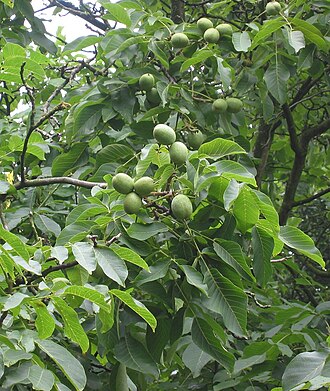
本科植物的花为单性,雌雄同株,雄花排成下垂的柔荑花序,雌花单生、簇生或成为直立的穗状花序。果实为坚果,核果或翅果状。
本科植物共有8属,60余种,主要分布于北半球,中国有7属25种,分布在全国各地。胡桃和山核桃是重要的干果和油料作物,果皮可用于制造活性炭,木材坚硬,是重要的硬木产品,用于制作枪托等。枫杨是优良的行道树种,叶和放养野蚕。麻核桃则被广泛应用于文玩界。
以上内容摘自维基百科「胡桃科」,按 CC BY-SA 4.0 使用,去掉了参考文献、外部链接等尾部小节,公式改写成了纯文本。全文、配图和出处见原文。
英文维基百科补充中文条目比较短,下面是英文条目「Juglandaceae」的原文
The Juglandaceae are an angiosperm family known as the walnuts. They are trees, or sometimes shrubs, in the order Fagales. Members of this family are native to the Americas, Eurasia, and Southeast Asia.
The nine or ten genera in the family have a total of around 63 species, and include the commercially important nut-producing trees walnut (Juglans), pecan (Carya illinoinensis), and hickory (Carya). The Persian walnut, Juglans regia, is one of the major nut crops of the world. Walnut, hickory, and gaulin are also valuable timber trees while pecan wood is also valued as cooking fuel.
The genetic relationships between different members of the family have recently been studied in more detail.
Description
Members of the walnut family are trees (rarely large shrubs) with aromatic leaves that are usually alternate, but opposite in Alfaroa and Oreomunnea. The leaves are pinnately compound or ternate, and usually 20–100 cm long. The trees are wind-pollinated, and both the male and female the flowers are usually arranged in catkins.Members of this family are often monoecious, but can be dioecious.
The fruits of the Juglandaceae are often confused with drupes but are accessory fruit because the outer covering of the fruit is technically an involucre and thus not morphologically part of the carpel; this means it cannot be a drupe but is instead a drupe-like nut.
Ecology
Climate change
Members of Juglandaceae have been projected to experience a range shift as the climate changes. Species distribution models show that within Europe Juglans regia will experience a northward shift to stay within a climatically suitable habitat. Different climate scenarios were modeled, revealing that the severity of range shift will increase with greater temperature changes. Expansion could extend beyond the native range, making this species invasive.
Some members of Juglandaceae have been documented to have formed associations with both ectomycorrhizal fungi and arbuscular mycorrhizal fungi. Dual mycorrhizal associations and their functional significance are still being studied, but they may confer ecological advantages. Within Juglandaceae, these relationships remain an ongoing area of research.
Taxonomy
- The known living genera are grouped into subfamilies, tribes, and subtribes as follows:
- Subfamily Rhoipteleoideae Reveal
- Rhoiptelea Diels & Hand.-Mazz. 1932
- Subfamily Engelhardioideae Iljinskaya 1990
- Alfaroa Standl. 1927—gaulin
- Engelhardia Lesch. ex Blume 1825–1826—cheo
- Oreomunnea Oerst. 1856
- Subfamily Juglandoideae Eaton 1836
- Tribe Platycaryeae Nakai 1933
- Platycarya Siebold & Zucc. 1843
- Tribe Juglandeae Rchb. 1832
- Subtribe Caryinae D.E. Stone & P. S. Manos 2001
- Carya Nutt. 1818—hickory and pecan
- Annamocarya A.Chev. 1941 (sometimes included in Carya due to new molecular evidence)
- Subtribe Juglandinae D.E. Stone & P. S. Manos 2001
- Cyclocarya Iljinsk 1953—wheel wingnut
- Juglans L. 1753—walnut
- Pterocarya Kunth 1824—wingnut
Systematics
Recent research
Recent molecular studies, by analyzing chloroplast and nuclear DNA sequences, have clarified the relationships in Juglandaceae. There is evidence that whole genome duplication happened in an ancestral species. Studies have shown there to be two new species within Engelhardia. These two species are Engelhardia anminiana H.H Meng 2018 and Engelhardia borneensis H.H Meng 2018.
Human uses
Food
Members of this family, such as walnuts (Juglans) and pecans (Carya illinoinensis) are often farmed for their fruits which are eaten across the world. The United States of America produces the most pecans, followed by Mexico. China produces the majority of the worlds walnuts, followed by the United States of America. [1] Sap from the hickory trees (Carya) was collected by Native-Americans to be used as a sweetener.
Timber
Walnut wood is generally known for its rich dark brown color, which makes it popular amongst woodworkers. It is often used for smaller wooden objects, such as cabinets and furniture. The wood of butternut (Juglans cinerea) is usually a lighter tan color.
Hickory (Carya) wood is also popular. It is known for being flexible, making it often used to make various sporting equipment. Bows, ax handles, skis, and lacrosse sticks are commonly made out of hickory wood. Its shock resistant qualities made it popular amongst the American pioneers for building their cabins.
以上节选摘自英文维基百科「Juglandaceae」,按 CC BY-SA 4.0 使用,去掉了参考文献、外部链接等尾部小节,公式改写成了纯文本。篇幅所限,较长的小节只摘了开头一部分,有的小节没有收;全文、配图和出处见原文。