格物
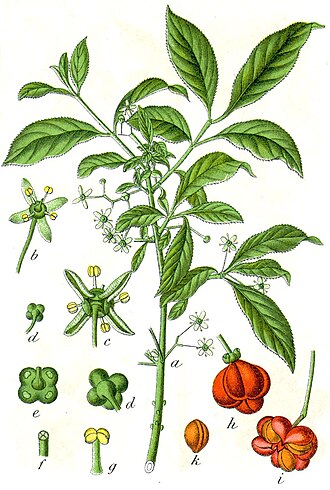
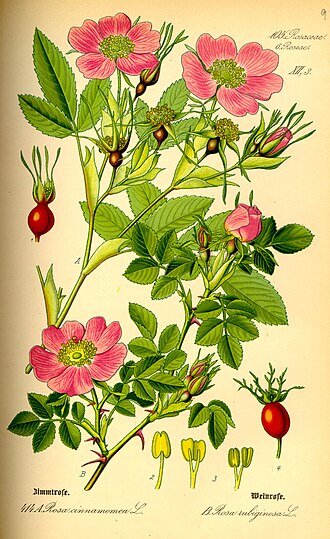
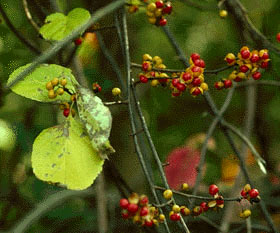
图:Johann Georg Sturm (Painter: Jacob Sturm) · Public domain · Wikimedia Commons
- 学名
- Celastrales
- 分类等级
- 目
- 上级类群
- 真双子叶植物
- 大类
- 被子植物
- 命名
- 约翰·海因里希·弗里德里希·林克,1829 年
- 数据库
- NCBI 分类 · GBIF
下级类群(3)
百科正文
分类
- 依照APG III分类法,包括两个科:
- 卫矛科 Celastraceae
- 洋酢浆草科 Lepidobotryaceae
根据旧有的克朗奎斯特分类法,卫矛目是一个大目,包括12个科:卫矛科(55属,850种)、四棱果科、翅子藤科(21属,400种)、木根草科、刺茉莉科、苦皮树科、冬青科、茶茱萸科、鳞枝树科、心翼果科、棒果木科、毒鼠子科。
以上内容摘自维基百科「卫矛目」,按 CC BY-SA 4.0 使用,去掉了参考文献、外部链接等尾部小节,公式改写成了纯文本。全文、配图和出处见原文。
英文维基百科补充中文条目比较短,下面是英文条目「Celastrales」的原文
The Celastrales are an order of flowering plants found throughout the tropics and subtropics, with only a few species extending far into the temperate regions. The 1200 to 1350 species are in about 100 genera. All but seven of these genera are in the large family Celastraceae. Until recently, the composition of the order and its division into families varied greatly from one author to another.
Description
The Celastrales are a diverse order that has no conspicuous distinguishing characteristic, so is consequently hard to recognize. The flowers are usually small with a conspicuous nectary disk. The stipules are small or rarely absent. The micropyle has two openings and is therefore called a bistomal micropyle. Flowers with well-developed male and female parts are often functionally unisexual. The seed often has an aril. In bud, the sepals have a quincuncial arrangement. This means that two sepals are inside, two are outside, and the remaining sepal is half inside and half outside.
Relationships
Perhaps the most conspicuous and unusual trait of the Celastrales is the nectary disk, a feature that it shares with another rosid order, Sapindales. Since the orders are not closely related, the disk must have been an independent development in each of these lines.
The Celastrales are a member of the Celastrales, Oxalidales (including Huaceae), and Malpighiales (COM) clade of Fabidae, with Fabidae being one of the two groups of Eurosids.
Circumscription
The name Celastrales was first used by Thomas Baskerville in 1839. In the time since Baskerville first defined the order, until the 21st century, great differences of opinion occurred about what should be included in the order and in its largest family, the Celastraceae. The family Celastraceae was the only group consistently placed in the order by all authors who accepted it. Because of the ambiguity and complexity of its definition, the Celastraceae became a dumping ground for genera of dubious affinity. Several genera were assigned to this family with considerable doubt about whether they really belonged there. Also, some genera that properly belong in the Celastraceae were placed elsewhere.
By the end of the 20th century, Goupia and Forsellesia had been excluded from the Celastraceae and also from the Celastrales. Goupia is now in the Malpighiales. Forsellesia is now in the Crossosomatales. It continues to be the subject of a dispute about whether its proper name is Forsellesia or Glossopetalon.
After being placed elsewhere, Canotia, Brexia, and Plagiopteron were found to belong in the Celastraceae. The family Hippocrateaceae was found to be deeply nested within the Celastraceae and is no longer recognized as a separate family.
In 2000, Vincent Savolainen et alii found that three families - Lepidobotryaceae, Parnassiaceae, and Celastraceae - were closely related.
Families
The Celastrales have been divided into families in various ways. In their APG II classification in 2003, the Angiosperm Phylogeny Group recognized three families in the Celastrales – Lepidobotryaceae, Parnassiaceae, and Celastraceae. When they revised their classification in 2009, they recognized only two families because Pottingeria and the two genera of Parnassiaceae were transferred to the Celastraceae. Nicobariodendron became one of the five taxa placed incertae sedis in the angiosperms.
In the 2006 phylogeny, Nicobariodendron was not sampled, but those species that were sampled fell into two strongly supported clades. One was a small clade consisting only of the family Lepidobotryaceae. Its sister was a very large clade containing the rest of the order. The large clade consisted of five strongly supported groups. These are the family Parnassiaceae, the genus Pottingeria, the genus Mortonia (in the Celastraceae), and a pair of genera from the Celastraceae (Quetzalia and Zinowiewia), and the rest of the Celastraceae. No relationships were resolved among these groups.
In 2008, Simmons and others produced a phylogeny of the Celastrales that achieved better resolution than the 2006 study by sampling more species and more DNA.
Phylogeny
The following phylogenetic tree was made by combining parts of three different trees. Bootstrap support is 100% except where shown. Branches with less than 50% bootstrap support are collapsed. The clade numbers are from Simmons et al. (2008).
以上节选摘自英文维基百科「Celastrales」,按 CC BY-SA 4.0 使用,去掉了参考文献、外部链接等尾部小节,公式改写成了纯文本。篇幅所限,较长的小节只摘了开头一部分,有的小节没有收;全文、配图和出处见原文。