格物
- 学名
- Epitheria
- 分类等级
- 总界
- 上级类群
- 有胎盘类
- 大类
- 哺乳动物
- 命名
- 马尔科姆·麦肯纳,1975 年
百科正文
英文维基百科补充中文条目比较短,下面是英文条目「Epitheria」的原文
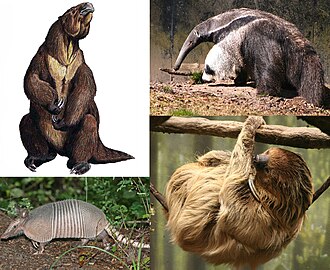
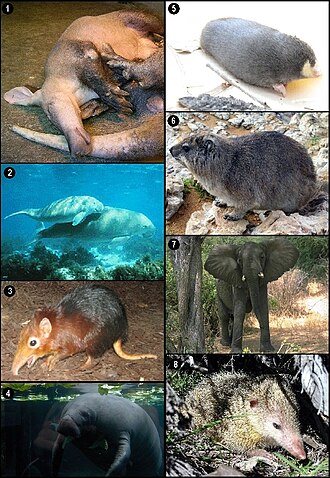
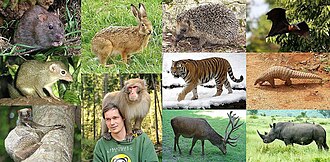
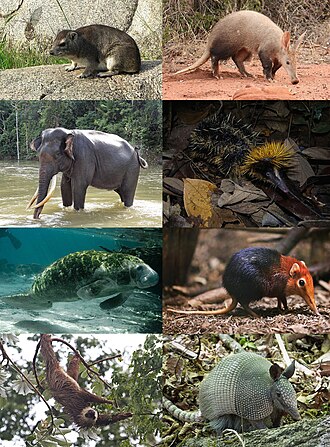
Epitherians comprise all the placental mammals except the Xenarthra. They are primarily characterized by having a stirrup-shaped stapes in the middle ear, which allows for passage of a blood vessel. This is in contrast to the column-shaped stapes found in marsupials, monotremes, and xenarthrans. They are also characterized by having a shorter fibula relative to the tibia.
Epitheria like Xenarthra and Afrotheria originated after the K-Pg boundary 66 million years ago, with the placental diversification occurring within the first hundred thousand years after the K-Pg event and the first modern placental orders began appearing 2–3 million years later. Epitheres are one of the most successful groups of animals.
The monophyly of Epitheria has been challenged by molecular phylogenetic studies. While preliminary analysis of a set of retroposons shared by both Afrotheria, and Boreoeutheria (presence/absence data) supported the Epitheria clade, more extensive analysis of such transposable element insertions around the time of the divergence of Xenarthra, Afrotheria, and Boreoeutheria strongly support the hypothesis of a near-concomitant origin (trifurcation) of these three superorders of mammals.
Another analysis suggests that the root of this clade lies between the Atlantogenata and Boreoeutheria.
Alternative hypotheses
Alternative hypotheses place either Atlantogenata and Boreoeutheria, or Afrotheria and Exafroplacentalia (Notolegia) at the base of the tree:
One Bayesian analysis places the root between Atlantogenata and Boreoeutheria.
以上内容摘自英文维基百科「Epitheria」,按 CC BY-SA 4.0 使用,去掉了参考文献、外部链接等尾部小节,公式改写成了纯文本。全文、配图和出处见原文。