格物
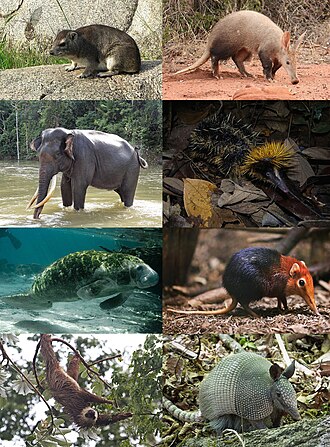
图:derivative work: user:The Explaner · CC BY-SA 4.0 · Wikimedia Commons
- 学名
- Atlantogenata
- 分类等级
- 总界
- 上级类群
- 有胎盘类
- 大类
- 哺乳动物
百科正文
英文维基百科补充中文条目比较短,下面是英文条目「Atlantogenata」的原文
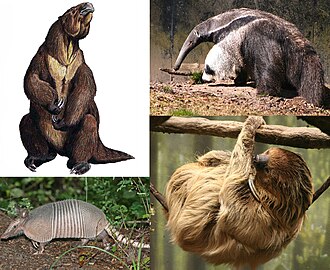
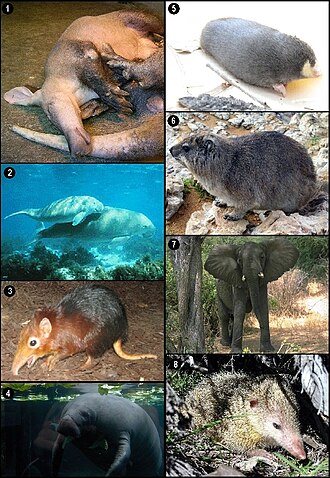
Atlantogenata ("born around the Atlantic Ocean") is a magnorder of placental mammals containing the cohorts or superorders Xenarthra and Afrotheria. These groups originated and radiated in the South American and African continents, respectively, presumably in the Cretaceous. Together with Boreoeutheria, they make up Placentalia. The monophyly of this grouping is supported by some genetic evidence.
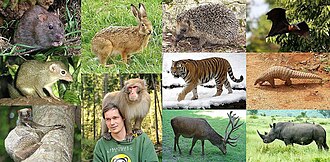
Alternative hypotheses are that Boreoeutheria and Afrotheria combine to form Epitheria (as generally supported by anatomical and other physiological evidence) or that Boreoeutheria and Xenarthra combine to form Exafroplacentalia or Notolegia.
According to some studies, updated analysis of transposable element insertions around the time of divergence strongly supports the fourth hypothesis of a near-concomitant origin (trifurcation) of the three superorders of placental mammals: Afrotheria, Boreoeutheria, and Xenarthra. However, a 2016 analysis concluded such conflicting phylogenies were a consequence of poorly fitting evolutionary models, and that the Atlantogenata hypothesis is the best supported. Based on a molecular clock analysis, crown-group Atlantogenata was estimated to have diverged 84–97 million years ago.
Below shows the phylogeny of the extant atlantogenate families.
以上内容摘自英文维基百科「Atlantogenata」,按 CC BY-SA 4.0 使用,去掉了参考文献、外部链接等尾部小节,公式改写成了纯文本。全文、配图和出处见原文。