格物
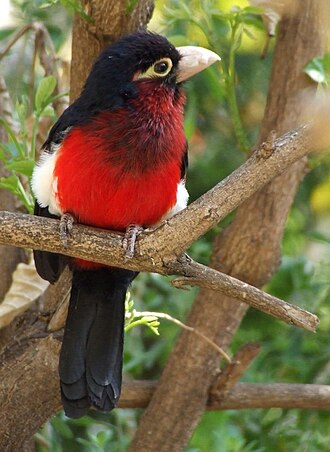
图:The original uploader was Althepal at English Wikipedia. · CC BY-SA 2.5 · Wikimedia Commons
- 学名
- Lybiidae
- 分类等级
- 科
- 上级类群
- 䴕形目
- 大类
- 鸟类
- 数据库
- NCBI 分类 · GBIF
下级类群(6)
- 钟声拟䴕属 Pogoniulus 属
- Gymnobucco 属
- Stactolaema 属
- Trachyphonus 属
- Tricholaema 属
- Lybius 属
百科正文
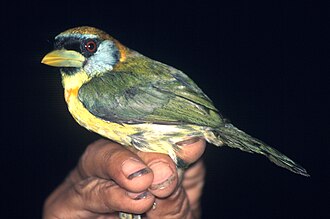
该科的鸟类一般长约20至25厘米,以节肢动物和水果等为食。
以上内容摘自维基百科「非洲拟啄木鸟科」,按 CC BY-SA 4.0 使用,去掉了参考文献、外部链接等尾部小节,公式改写成了纯文本。全文、配图和出处见原文。
英文维基百科补充中文条目比较短,下面是英文条目「Lybiidae」的原文
Lybiidae is a family of birds also known as the African barbets. There are 44 species ranging from the type genus Lybius of forest interior to the tinkerbirds (Pogoniulus) of forest and scrubland. They are found throughout sub-Saharan Africa, with the exception of the far south-west of South Africa.
The African terrestrial barbets, Trachyphoninae, range from the southern Sahara to South Africa. Members of one genus, Trachyphonus, are the most open-country species of barbets. The subfamily Lybiinae contains the African arboreal barbets. There are 37 species of Lybiinae in 8 genera.
Taxonomy
The phylogenetic relationship between the African barbets and the eight other families in the order Piciformes is shown in the cladogram below. The number of species in each family is taken from the AviList taxonomy.
Description and ecology
Most African barbets are about 20–25 cm (7.9–9.8 in) long, plump-looking, with large heads, and their heavy bill is fringed with bristles; the tinkerbirds are smaller, ranging down to the red-rumped tinkerbird (Pogoniulus atroflavus) at 7 g (0.25 oz) and 9 cm (3.5 in).
They are mainly solitary birds, eating insects and fruit. Figs and numerous other species of fruiting tree and bush are visited. An individual barbet may feed on as many as 60 different species in its range. They will also visit plantations and take cultivated fruit and vegetables. Fruit is eaten whole and indigestible material such as seed pits regurgitated later (often before singing). Regurgitation does not usually happen in the nest (as happens with toucans), although tinkerbirds do place sticky mistletoe seeds around the entrances of their nests, possibly to deter predators. Like other barbets, they are thought to be important agents in seed dispersal in tropical forests.
As well as taking fruit, African barbets also take arthropod prey, gleaned from the branches and trunks of trees. A wide range of insects are taken, including ants, cicadas, dragonflies, crickets, locusts, beetles, moths and mantids. Scorpions and centipedes are also taken, and a few species will take small vertebrates such as lizards, frogs and geckos.
The precise nesting details of many African barbets are not yet known, although peculiarly among the Piciformes, some sociable species will nest in riverbanks or termite nests. Like many members of their order, Piciformes, their nests are in holes bored into a tree, and they usually lay between 2 and 4 eggs (except for the yellow-breasted barbet which lays up to 6), incubated for 13–15 days. Nesting duties are shared by both parents.
There has been generally little interference by humans. Some of the species which require primary woodland are declining due to deforestation, occasionally to the benefit of close relatives. For example, the loss of highland woods in Kenya has seen the moustached tinkerbird almost disappear and the red-fronted tinkerbird expand its range.
Systematics
Subfamily Lybiinae
Subfamily Trachyphoninae
It is not entirely resolved whether the Early to Middle Miocene genus Capitonides from Europe belongs to this family or the Asian barbets (now Megalaimidae). Indeed, given that the prehistoric birds somewhat resembled a primitive toucan (without these birds' present autapomorphies), they might occupy a more basal position among the barbet-toucan clade altogether. On the other hand, they show some similarities to Trachyphonus in particular and have even been placed into this genus, but this move is not widely accepted.
"CMC 152", a distal carpometacarpus similar to that of barbets and found at the Middle Miocene locality of Grive-Saint-Alban (France) was considered to differ from Capitonides in the initial description, being closer to extant (presumably Old World) barbets. This fossil is sometimes lumped into Trachyphonus too; in this case it may have more merit.
Supposed fossil remains of Late Miocene Pogoniulus were found at Kohfidisch (Austria) but are not yet thoroughly studied. It is not clear whether they belong to the extant genus but given the late date this may well be so.
Sources cited
Ballmann, Peter (1969): Les Oiseaux miocènes de la Grive-Saint-Alban (Isère) [The Miocene birds of Grive-Saint-Alban (Isère)]. Geobios 2: 157–204. [French with English abstract] doi:10.1016/S0016-6995(69)80005-7 (HTML abstract)
Mlíkovský, Jirí (2002): Cenozoic Birds of the World, Part 1: Europe. Ninox Press, Prague. ISBN 80-901105-3-8 PDF fulltext
以上内容摘自英文维基百科「Lybiidae」,按 CC BY-SA 4.0 使用,去掉了参考文献、外部链接等尾部小节,公式改写成了纯文本。全文、配图和出处见原文。