格物
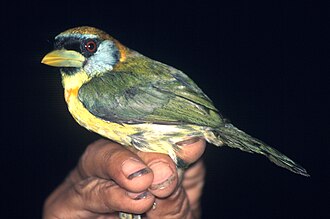
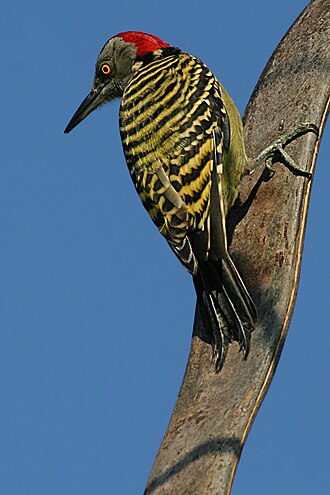
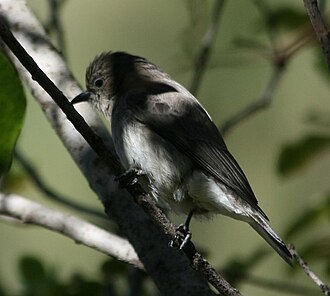
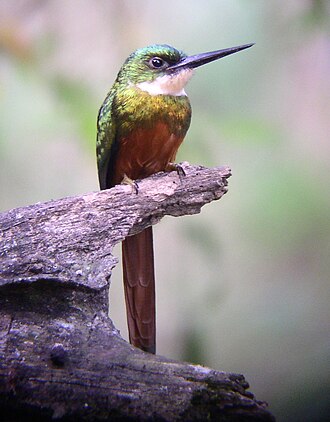
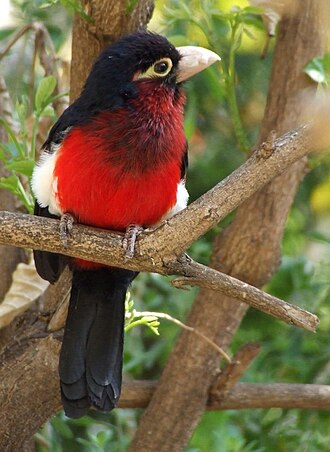
图:José Loaiza, Aves y Conservación · Public domain · Wikimedia Commons
- 学名
- Capitonidae
- 分类等级
- 科
- 上级类群
- 䴕形目
- 大类
- 鸟类
- 命名
- 夏尔·吕西安·波拿巴,1838 年
- 数据库
- GBIF
下级类群(2)
百科正文
该科成员颈短,头大,眼睛表上有一簇长的羽毛,大多数种色彩鲜艳。习在树洞中筑巢,每次产二至四枚卵。它们以果实和昆虫为食,皆是留鸟。
以上内容摘自维基百科「美洲拟啄木鸟科」,按 CC BY-SA 4.0 使用,去掉了参考文献、外部链接等尾部小节,公式改写成了纯文本。全文、配图和出处见原文。
英文维基百科补充中文条目比较短,下面是英文条目「New World barbet」的原文
The New World barbets are a family, Capitonidae, of 15 birds in the order Piciformes, which inhabit humid forests in Central and South America. They are closely related to the toucans.
The New World barbets are plump birds, with short necks and large heads. They get their name from the bristles that fringe their heavy bills. Most species are brightly coloured and live in tropical forest.
These barbets are mostly arboreal birds, which nest in tree holes dug by breeding pairs, laying two to four eggs. They eat fruit and insects. These birds do not migrate.
Taxonomy
Fossil New World barbets have been found dating from the Miocene in Florida. The closest relatives of the barbets are the toucans, and these two families are also closely related to the honeyguides and woodpeckers (with which they form the order Piciformes).
Formerly, the barbets have been treated as one family. This has turned out to be paraphyletic, though, with regard to toucans; thus, only the New World true barbets are retained in the Capitonidae. The African barbets (Lybiidae) and the Asian barbets (Megalaimidae), as well as the two toucan-barbets from the Americas (Semnornithidae) are currently split from this family. Alternatively, the toucans, which evolved from a common ancestor shared with the American barbets, might be included in the traditional all-encompassing barbet family. As they have evolved characteristics that are unique to themselves, they are usually treated separately, thus the barbets are split up according to the four lineages.
The phylogenetic relationship between the New World barbets and the eight other families in the order Piciformes is shown in the cladogram below. The number of species in each family is taken from the list maintained by Frank Gill, Pamela C. Rasmussen and David Donsker on behalf of the International Ornithological Committee (IOC).
Fossils
Genus Capitonides (Early – Middle Miocene of Europe) (fossil)
†Capitonides europeus
Ecology
While most New World barbet species inhabit lowland forest, some range into montane and temperate forests, as well. Most are restricted to habitats containing trees with dead wood, which are used for nesting.
The diet of barbets is mixed, with fruit being the dominant part. Small prey items are also taken, especially when nesting. Barbets are capable of shifting their diet quickly in the face of changing food availability. Numerous species of fruiting trees and bushes are visited; an individual barbet may feed on as many as 60 different species in its range. They also visit plantations and take cultivated fruit and vegetables. Fruit is eaten whole, and indigestible material such as seed pits is regurgitated later (often before singing). Regurgitation does not usually happen in the nest (as happens with toucans). Like their relatives, New World barbets are thought to be important agents in seed dispersal in tropical forests.
As well as taking fruit, they also take arthropod prey, gleaned from the branches and trunks of trees. A wide range of insects is taken, including ants, beetles, and moths. Scorpions and centipedes are also taken, and a few species take small vertebrates such as frogs.
Relationship with people
New World barbets have little direct impact on humans. The loss of forest can have a deleterious effect on barbet species dependent on old growth, to the benefit of species that favor more disturbed or open habitat.
Three species of New World barbets are listed as threatened by the IUCN: The white-mantled barbet of Colombia is listed as endangered and the five-coloured barbet as vulnerable, the two having a relatively small range threatened by deforestation for the timber industry and to create space for agriculture (including coca and marijuana) and livestock, and mining. The quite recently discovered scarlet-banded barbet of Peru is considered vulnerable due to its small population size (estimated at under 1000 birds), although its remote habitat is not immediately threatened.
以上内容摘自英文维基百科「New World barbet」,按 CC BY-SA 4.0 使用,去掉了参考文献、外部链接等尾部小节,公式改写成了纯文本。全文、配图和出处见原文。