格物
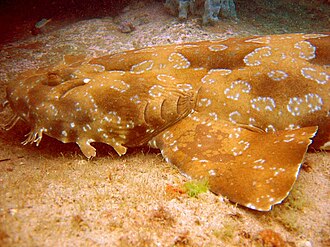
- 学名
- Orectolobiformes
- 分类等级
- 目
- 上级类群
- 板鳃亚纲
- 大类
- 鱼类
- 命名
- Shelton P. Applegate,1972 年
- 数据库
- NCBI 分类 · GBIF
下级类群(5)
百科正文
下层分类
- 喉须鲛科 Parascylliidae
- 鲸鲨科 Rhincodontidae
- 须鲨科 Orectolobidae
- 天竺鲨科 Hemiscylliidae
- 绞口鲨科 Ginglymostomatidae
- 豹纹鲨科 Stegostomatidae
- 长须鲨科 Brachaeluridae
以上内容摘自维基百科「鬚鮫目」,按 CC BY-SA 4.0 使用,去掉了参考文献、外部链接等尾部小节,公式改写成了纯文本。全文、配图和出处见原文。
英文维基百科补充中文条目比较短,下面是英文条目「Carpet shark」的原文
Carpet sharks are sharks classified in the order Orectolobiformes. Sometimes the common name "carpet shark" (given because many species resemble ornately patterned carpets) is used interchangeably with "wobbegong", which is the common name of sharks in the family Orectolobidae. Carpet sharks have five gill slits, two spineless dorsal fins, and a small mouth that does not extend past the eyes. Many species have barbels.
Characteristics
The carpet sharks are a diverse group of sharks with differing sizes, appearances, diets, and habits. They first appeared in the fossil record in the Early Jurassic; the oldest known orectolobiform genera are Folipistrix (known from Toarcian to Aalenian of Belgium and Germany), Palaeobrachaelurus (Aalenian to Barremian) and Annea (Toarcian to Bajocian of Europe). All species have two dorsal fins and a relatively short, transverse mouth that does not extend behind the eyes. Besides the nostrils are barbels, tactile sensory organs, and grooves known as nasoral grooves connect the nostrils to the mouth. Five short gill slits are just in front of the origin of the pectoral fin and the fifth slit tends to overlap the fourth one. A spiracle occurs beneath each eye which is used in respiration. The only exception to this rule is the whale shark, the spiracles of which are situated just behind the eyes. Carpet sharks derive their common name from the fact that many species have a mottled appearance with intricate patterns reminiscent of carpet designs. The patterning provides camouflage when the fish is lying on the seabed. The largest carpet shark is the whale shark (Rhincodon typus) which can grow to a length of 14 m (46 ft) to 18.8 metres (62 ft). It is the largest species of fish, but despite its size, is not dangerous, as it is a filter feeder, drawing in water through its wide mouth and sifting out the plankton.
Behaviour
Most carpet sharks feed on the seabed in shallow to medium-depth waters, detecting and picking up molluscs, crustaceans, and other small creatures. The wobbegongs tend to be ambush predators, lying hidden on the seabed until prey approaches. One has been observed swallowing a bamboo shark whole.
The methods of reproduction of carpet sharks vary. Some species are oviparous and lay eggs which may be liberated directly into the water or may be enclosed in horny egg cases. Some female sharks have been observed to push egg cases into crevices and this would be an added protection for the developing embryos. Other species are ovoviviparous and the fertilised eggs are retained in the mother's oviduct. There, the developing embryos, which are usually few in number, feed on their yolk sacs at first and later hatch out and feed on nutrients secreted by the walls of the oviduct. The young are born in an advanced state, ready to live independent lives.
Distribution
Carpet sharks are found in all the oceans of the world but predominantly in tropical and temperate waters. They are most common in the western Indo-Pacific region and are usually found in relatively deep water.
Classification
Extant species
- Order Orectolobiformes
- Family Brachaeluridae Applegate (blind sharks)
- Genus Brachaelurus Ogilby, 1908
- Brachaelurus colcloughi (Ogilby, 1908) (bluegrey carpetshark)
- Brachaelurus waddi (Bloch & J. G. Schneider, 1801) (blind shark)
- Family Ginglymostomatidae Gill, 1862 (nurse sharks)
- Genus Ginglymostoma J. P. Müller & Henle, 1837
- Ginglymostoma cirratum Bonnaterre, 1788 (nurse shark)
- Ginglymostoma unami Del-Moral-Flores, Ramírez-Antonio, Angulo & Pérez-Ponce de León, 2015
- Genus Nebrius Rüppell, 1837
- Nebrius ferrugineus (Lesson, 1831) (tawny nurse shark)
- Genus Pseudoginglymostoma Dingerkus, 1986
- Pseudoginglymostoma brevicaudatum (Günther, 1867) (short-tail nurse shark)
- Family Hemiscylliidae Gill, 1862 (bamboo sharks)
- Genus Chiloscyllium J. P. Müller & Henle, 1837
- Chiloscyllium arabicum Gubanov, 1980 (Arabian carpetshark)
- Chiloscyllium burmensis Dingerkus & DeFino, 1983 (Burmese bamboo shark)
- Chiloscyllium griseum J. P. Müller & Henle, 1838 (grey bamboo shark)
- Chiloscyllium hasselti Bleeker, 1852 (Hasselt's bamboo shark)
- Chiloscyllium indicum (J. F. Gmelin, 1789) (slender bamboo shark)
Chiloscyllium plagiosum (Anonymous, referred to Bennett, 1830) (white-spotted bamboo shark)
- Chiloscyllium punctatum J. P. Müller & Henle, 1838 (brownbanded bamboo shark)
- Genus Hemiscyllium J. P. Müller & Henle, 1837
- Hemiscyllium freycineti (Quoy & Gaimard, 1824) (Indonesian speckled carpetshark)
- Hemiscyllium galei G. R. Allen & Erdmann, 2008 (Cenderwasih epaulette shark)
以上节选摘自英文维基百科「Carpet shark」,按 CC BY-SA 4.0 使用,去掉了参考文献、外部链接等尾部小节,公式改写成了纯文本。篇幅所限,较长的小节只摘了开头一部分,有的小节没有收;全文、配图和出处见原文。