格物
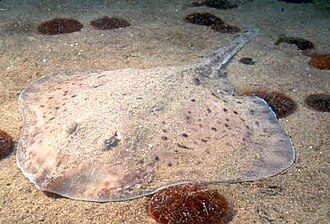
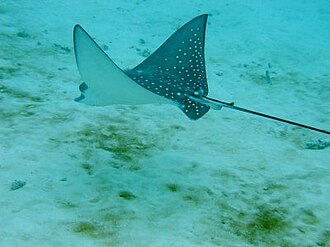
图:Andy Martinez/NOAA · Public domain · Wikimedia Commons
- 学名
- Rajiformes
- 分类等级
- 目
- 上级类群
- 板鳃亚纲
- 大类
- 鱼类
- 命名
- 列夫·贝尔格,1940 年
- 数据库
- NCBI 分类 · GBIF
下级类群(9)

百科正文
下级分类
- 目前已知的鳐目包含了4个现存及5个已灭绝的科:
- 无鳍鳐科 Anacanthobatidae
- 单鳍鳐科 Arhynchobatidae
- 吞鳐科 Gurgesiellidae
- 鳐科 Rajidae
- †硬吻鳐亚目 Sclerorhynchoidei
- †髋锯鳐科 Ischyrhizidae
- †硬尖犁头鳐科 Sclerorhynchidae
- †帆锯鳐科 Onchopristidae
- †褶鳐科 Ptychotrygonidae
- †裂根鳐科 Schizorhizidae
部分犁头鳐目物种原先也被分类于此。
以上内容摘自维基百科「鰩目」,按 CC BY-SA 4.0 使用,去掉了参考文献、外部链接等尾部小节,公式改写成了纯文本。全文、配图和出处见原文。
英文维基百科补充中文条目比较短,下面是英文条目「Rajiformes」的原文
Rajiformes is one of the four orders in the clade Batomorphi, often referred to as the superorder Batoidea, flattened cartilaginous fishes related to sharks. Rajiforms are distinguished by the presence of greatly enlarged pectoral fins, which reach as far forward as the sides of the head, with a generally flattened body. The undulatory pectoral fin motion diagnostic to this taxon is known as rajiform locomotion. The eyes and spiracles are located on the upper surface of the head and the gill slits are on the underside of the body. Most species give birth to live young, although some lay eggs enclosed in a horny capsule ("mermaid's purse").
Characteristics
Rajoids typically have a dorsoventrally flattened body. The snout is slender and pointed and the wide mouth, often covered with a fleshy nasal flap, is on the underside of the head. The eyes and well-developed spiracles are located on the top of the head. In most species, the spiracles are large and are the main means of drawing water in for respiration. There is no nictitating membrane and the cornea is continuous, with the skin surrounding the eyes. The gill slits are on the ventral surface just behind the head. The front few vertebrae are fused into a synarcual and this either articulates with the bones of the well-developed pectoral girdle or is fused to them, the suprascapulae uniting above the vertebral column. Most species have enlarged, thornlike dermal denticles on their skin, often with a row of large denticles along the spine.
The pectoral fins are large, but not clearly demarcated from the body, and together with the body are known as the disc. They start from the side of the head in front of the gill openings and end at the caudal peduncle. There are up to two dorsal fins but no anal fin. A slender tail is clearly demarcated from the disc. The caudal fin varies in size between species and the rays have a whip-like tail with no caudal fin.
Distribution
Species of the order Rajiformes are found throughout the world's oceans, from Arctic to Antarctic waters, and from shallow coastal shelves to open seas and abyssal regions. A few are found in rivers and some in estuaries, but most are marine, living near the sea bed at depths down to 3,000 m (9,800 ft) or more.
Diversity
Families
- Four extant and five extinct families of rajoid have been described:
- Anacanthobatidae
- Arhynchobatidae
- Gurgesiellidae
- Rajidae
- †Sclerorhynchoidei
- †Ischyrhizidae
- †Sclerorhynchidae
- †Onchopristidae
- †Ptychotrygonidae
- †Schizorhizidae
Formerly, some Rhinopristiforms were also included.
The smooth skates, the Anacanthobatidae, contain a single genus, Anacanthobatis, of about 10 species. They are small fish living on the continental slopes of tropical and subtropical waters, and are native to Natal, South Africa, tropical West Africa, and Taiwan. Smooth skates have a filament extending from a rounded protuberance on the snout. Both the dorsal and ventral surfaces are smooth and have no dermal denticles. The tail is slender and a little shorter than the body. No dorsal fins are present and the caudal fin is small and membranous.
The skate family Rajidae contains 14 genera and around 200 species. They are found worldwide, but are relatively uncommon near coral reefs and in shallow tropical seas. A few species occur in brackish water. The disc shape is rhomboidal, and the tail long. Two dorsal fins are found and the caudal fin is much reduced. The pelvic fins have two lobes. Most species have rough skins with dermal denticles which are especially obvious along the spine. The eggs are laid in a protective hard case with string-like elongations at the four corners.
The extinct families Sclerorhynchidae and Ptychotrygonidae had long, serrated rostrums very similar to those of extant sawsharks and sawfishes, and their relation to them has been debated.
Biology
Water for breathing is taken in through the spiracles rather than or the mouth and exits through the gill slits. Skates swim by undulating their enlarged pectoral fins, and are capable of "walking" (the technical term is punting) using their pelvic fins. Skates are carnivores, feeding on molluscs and other invertebrates on the sea bed, and small fish. Unlike other batiods which have live birth, skates lay eggs in horny cases known as mermaid's purses. Most species are benthic, resting on the sandy or muddy sea bed, sometimes undulating their pectoral fins to stir up sediment and bury themselves shallowly.
以上节选摘自英文维基百科「Rajiformes」,按 CC BY-SA 4.0 使用,去掉了参考文献、外部链接等尾部小节,公式改写成了纯文本。篇幅所限,较长的小节只摘了开头一部分,有的小节没有收;全文、配图和出处见原文。