 格物
生命之树 › 真核生物 › 动物界 › 真后生动物亚界 › 两侧对称动物 › 后口动物总门 › 脊索动物门 › 脊椎动物亚门 › 有颌下门 › 肉鳍鱼总纲 › 四足形类 › 希望螈目 › 四足总纲 › 爬行动物 › 坚尾龙类 › 鸟纲 › 鸡形目 › Phasianoidea › 雉科 › 鹑亚科 › 山鹑属
灰山鹑种
Perdix perdix
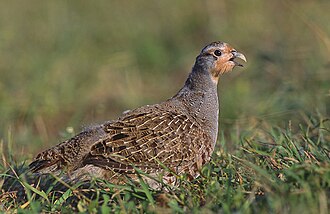
灰山鹑 为雉科山鹑属的鸟类。分布于欧洲、亚洲,西起乌拉尔山、东达西萨彦岭西部、北起鄂毕河流域、南达伊朗以及中国大陆的新疆等地,主要栖息于山脚干涸的峡谷、高山、有白杨、赤杨杂树的高地、河边或湖边的树丛、山地田野以及农村附近。该物种的模式产地在瑞典。
摘自维基百科「灰山鹑」,CC BY-SA 4.0
- 学名
- Perdix perdix
- 分类等级
- 种
- 英文名
- Grey Partridge
- 上级类群
- 山鹑属
- 大类
- 鸟类
- 命名
- 卡尔·林奈,1758 年
- 保护状况(IUCN)
- 无危物种
- 数据库
- NCBI 分类 · GBIF · IUCN 红色名录
百科正文
亚种
北疆灰山鹑(Perdix perdix robusta)。分布于西伯利亚以及中国大陆的新疆等地。该物种的模式产地在阿尔泰山脉。
保护
本种于2023年被收录入《有重要生态、科学、社会价值的陆生野生动物名录》。
以上内容摘自维基百科「灰山鹑」,按 CC BY-SA 4.0 使用,去掉了参考文献、外部链接等尾部小节,公式改写成了纯文本。全文、配图和出处见原文。
英文维基百科补充中文条目比较短,下面是英文条目「Grey partridge」的原文
The grey partridge (Perdix perdix) is a bird in the pheasant family Phasianidae of the order Galliformes, gallinaceous birds. The scientific name is the Latin for "partridge".
Taxonomy
The grey partridge was formally described in 1758 by the Swedish naturalist Carl Linnaeus in the tenth edition of his Systema Naturae under the binomial name Tetrao perdix. Linnaeus specified the type locality as Europe but this has been restricted to Sweden. The word perdix is Latin meaning "partridge", from Ancient Greek περδιξ/perdix meaning "partridge". The grey partridge together with the Daurian partridge and the Tibetan partridge are now placed in the genus Perdix that was introduced in 1760 by the French zoologist Mathurin Jacques Brisson.
Subspecies
Eight subspecies are recognised by the IOC World Bird List, though the differences are clinal, and not all are accepted by other authorities; the HBW/BirdLife International list only accepts six subspecies; the differences noted below:
P. p. perdix (Linnaeus, 1758). Nominate, found in the British Isles and southern Scandinavia to Italy and the Balkans.
P. p. armoricana (Hartert, 1917). Southwestern France.
P. p. sphagnetorum (Altum, 1894). On peaty soils in the northern part of the Netherlands and northwest Germany. Barely distinct from P. p. perdix and included in it by HBW/BLI.
P. p. hispaniensis (Reichenow, 1892). Central Pyrenees to northeast Portugal
P. p. italica (Hartert, 1917). Included in P. p. perdix by HBW/BLI. Formerly extinct in the wild, now reintroduced.
Description
The grey partridge is a rotund bird, brown-backed, with grey flanks and chest. The belly is white, usually marked with a large chestnut-brown horse-shoe mark in males, and also in many females. Hens lay up to twenty eggs in a ground nest. The nest is usually in the margin of a cereal field, most commonly winter wheat.
- Measurements:
- Length: 29–31 cm (11–12 in)
- Wingspan: 45–48 cm (18–19 in)
- Weight (P. p. perdix): 320–455 g (11.3–16.0 oz)
- Weight (P. p. robusta): 350–600 g (12–21 oz)
Males and females are the same size, and very similar in plumage, though the females tend to be slightly duller, and have a smaller dark belly patch. In the hand, the so-called "cross of Lorraine" on the tertiary coverts of females are marked with two transverse bars, as opposed to the one in males. These are present after around 16 weeks of age when the birds have moulted into adult plumage. Young grey partridges are mostly yellow-brown and lack the distinctive face and underpart markings. The song is a harsh, high-pitched kieerr-ik. When disturbed, like most gamebirds, it flies a short distance on rounded wings, often calling rick rick rick as it rises.
They are a seed-eating species, but the young in particular take insects as an essential protein supply. During the first 10 days of life, the young can only digest insects.
Distribution
Widespread and common throughout much of its range, the grey partridge is evaluated as "of Least Concern" on the IUCN Red List of Threatened Species. However, it has suffered a serious decline in the UK, and in 2015 appeared on the "Birds of Conservation Concern" Red List. This partridge breeds on farmland across most of Europe and across the western Palearctic as far as southwestern Siberia; it is a non-migratory terrestrial species, and forms flocks of up to 30 outside of the breeding season.
It has been introduced widely as a gamebird into Canada, United States, South Africa, Australia and New Zealand. A popular gamebird in large areas of North America, it is sometimes known there as "Hungarian partridge" or just "hun".
Status and conservation
Though common and not threatened, it is declining in numbers in some areas of intensive cultivation such as the United Kingdom, due to a loss of breeding habitat and insecticides harming insect numbers, an important food source for the species. Their numbers have fallen in these areas by as much as 85% in the last 25 years. Efforts are being made in the United Kingdom by organizations such as the Game & Wildlife Conservation Trust to halt this decline by creating conservation headlands.
In 1995, it was nominated a Biodiversity action plan (BAP) species. In Ireland, it is now virtually confined to the Lough Boora reserve in County Offaly where a recent conservation project has succeeded in boosting its numbers to around 900, raising hopes that it may be reintroduced to the rest of Ireland.
以上节选摘自英文维基百科「Grey partridge」,按 CC BY-SA 4.0 使用,去掉了参考文献、外部链接等尾部小节,公式改写成了纯文本。篇幅所限,较长的小节只摘了开头一部分,有的小节没有收;全文、配图和出处见原文。