 格物
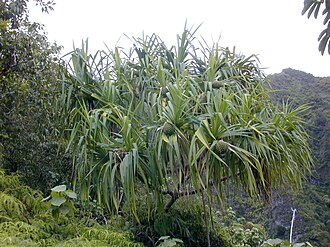
图:No machine-readable author provided. Marshman~commonswiki as… · CC BY-SA 3.0 · Wikimedia Commons
- 学名
- Pandanus tectorius
- 分类等级
- 种
- 上级类群
- 露兜树属
- 大类
- 被子植物
- 命名
- 希尼·帕金森,1773 年
- 中文别名
- 林投、露兜簕、露兜树(露兜簕)、露兜竻蔃、露兜竻心
- 保护状况(IUCN)
- 无危物种
- 异名
- 林投露兜树
- 用途
- 药用植物、食物、纤维
- 数据库
- NCBI 分类 · GBIF · IUCN 红色名录
百科正文
描述
林投可以长到4-14米〈13-46英尺〉高。单树干多刺,在4-8米(13-26英尺)的高度开叉。整棵树是由气生根坚实地固定到地面来支撑。它的叶子通常为90-150厘米(3.0-4.9英尺)长、5-7厘米(2.0-2.8英尺)宽,锯齿般的边缘。
林投花
林投花是雌雄异株,具有非常不同的雄花及雌花。雄花小、散发香气、聚簇状或总状花序,且花期短、只持续一天。而雌花类如菠萝。
林投叶
林投叶簇生于枝顶,叶缘长满锐刺。以完美的螺线形,顺着逆时针的方向每隔四片叶子绕着茎干往上绕一圈,如此叶缘硬刺便不会刺伤旁边的叶子。以螺线形环绕还有另一好处,可以让每片叶子均匀地接收阳光。
中医药疗病
其根、果及果核可入药,性味甘、淡,可发汗解表、清热利尿。
制绳
制造麻绳的方法是在山上找出林投树的气根, 气根是浅啡色, 一般有5至15厘米的粗度, 把它劈下, 用刀把外皮剥下, 用手指把所需要的粗度撕下, 一般一根林投气根可制作几十条麻绳, 把这些撕下来的气根用阳光晒干, 就可完成。
以上内容摘自维基百科「林投」,按 CC BY-SA 4.0 使用,去掉了参考文献、外部链接等尾部小节,公式改写成了纯文本。全文、配图和出处见原文。
英文维基百科补充中文条目比较短,下面是英文条目「Pandanus tectorius」的原文
Pandanus tectorius is a species of Pandanus (screwpine) that is native to Malesia, Papuasia, eastern Australia, and the Pacific Islands. It grows in the coastal lowlands typically near the edge of the ocean. Common names in English include thatch screwpine, Tahitian screwpine, hala tree (pū hala in Hawaiian) and pandanus. The fruit is edible and sometimes known as hala fruit.
The local Hawaiian name hala derives ultimately from Proto-Malayo-Polynesian *paŋdan which is also the base for the Pandanus generic name via Malay: pandan; the Malay name for the plant itself is pandan laut (lit. 'sea pandan').
Description
P. tectorius is a small tree that grows upright to reach 4–14 m (13–46 ft) in height. The single trunk is slender with brown ringed bark. It is spiny, grows to 4.5–11 m (15–35 ft) in width, and forks at a height of 4–8 metres (13–26 ft). It is supported by aerial roots (prop roots) that firmly anchors the tree to the ground. Roots sometimes grow along the branch, and they grow at wide angles in proportion to the trunk.
Leaves
The leaves are usually 90–150 cm (3–5 ft) in length and 5–7 cm (2–2+3⁄4 in) in width. They possess saw-like margins. Some varieties have spines along the edges and ribs throughout the leaves.
Taxonomy
Pandanus tectorius was first described by Sydney Parkinson in 1774. It is an angiosperm belonging to the genus Pandanus of the family Pandanaceae.
Distribution and habitat
Pandanus tectorius grows natively from the Philippines through the Pacific Ocean to Hawaii. It is found in parts of Malesia (the Cocos (Keeling) Islands, Java, the Lesser Sunda Islands, the Maluku Islands and the Philippines), throughout Papuasia, and in most of the tropical Pacific.
In Australia, it is native to an area from Port Macquarie in New South Wales to northern Queensland. Both the US and the Hawaiian Islands recognize only one indigenous species, P. tectorius.
Ecology
There are a wide range of natural enemies that pose a threat to P. tectorius such as parasites, pathogens, and herbivores. They attack the leaves, roots, stems, and growing points. The stick insect Megacrania batesii lives and feeds only on P. tectorius and two other Pandanus species.
Pandanus tectorius in Australia is threatened by a sap-sucking insect, Jamella australiae, a species of the genus Jamella of the subfamily Flatinae, known as the Pandanus planthopper.
Cultivation
Pandanus tectorius may be grown from seed or cuttings – the former will flower at around 15 years and the latter usually flowers by 3 to 4 years of age. Female trees typically flower one to three times per year while male trees will flower every 2 months. It is thought to reproduce sexually in Hawaii, but there is some evidence that apomixis occurs. Small insects, such as bees, and wind are usually the pollinators. It takes 1 to 2 years from pollination to produce fruit on female trees.
Uses
The fruit is edible. Some varieties and cultivars contain significant amounts of calcium oxalate, and thus need thorough cooking before being consumed. Other cultivars contain very little to no calcium oxalate and can be eaten raw. It is an important food source in the atolls of Micronesia and Polynesia, with the fruit commonly eaten raw or turned into a dried paste (such as mokwan in the Marshall Islands or te tuae in Kiribati) or flour. It is also one of the traditional foods of Maldivian cuisine. The fibrous nature of the fruit also serves as a natural dental floss.
In culture
The seal of Punahou School in Honolulu, Hawaii, features the hala tree, in part because lauhala, the art of weaving with the leaves of that tree, is pivotal to the history of the island, with everything from houses to pillows being made in this fashion. Local legend tells of an aged Hawaiian couple who lived long ago above the present Punahou campus, and had to travel far for water. They prayed each night for a spring, but to no avail. Finally one night, in a dream answering their prayers, they were told to uproot the stump of an old hala tree.
以上节选摘自英文维基百科「Pandanus tectorius」,按 CC BY-SA 4.0 使用,去掉了参考文献、外部链接等尾部小节,公式改写成了纯文本。篇幅所限,较长的小节只摘了开头一部分,有的小节没有收;全文、配图和出处见原文。