 格物
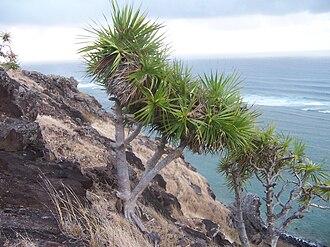
图:B.navez · CC BY-SA 3.0 · Wikimedia Commons
- 学名
- Pandanus
- 分类等级
- 属
- 上级类群
- 露兜树科
- 大类
- 被子植物
- 命名
- 希尼·帕金森,1773 年
- 数据库
- NCBI 分类 · GBIF
下级类群(5)
百科正文
形态
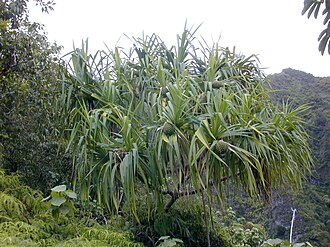
此属内不同种的植物大小有别,既有高度低于1米的灌木,亦有高达20米的中型乔木,叶片呈带状。此属植物为雌雄异株,雄株的花长约2-3厘米,带有芳香。其果实为球状,直径约10-20厘米。
分布
尽管此属植物均有分布在热带太平洋岛屿,但分布最多的地方位于波利尼西亚和密克罗尼西亚地势低的岛屿和荒芜的环礁上。
与人类的关系
部分种的果实可供食用,在新几内亚一些地方,在采收其核果时必须使用露兜树语。
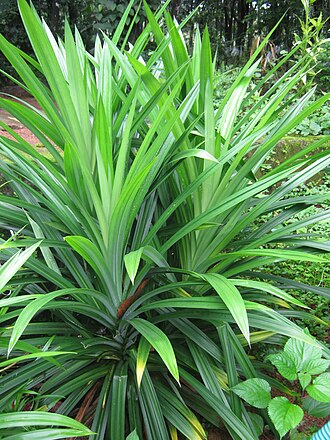
七叶兰的叶子在东南亚食物用用来增香。在华南亦有把树叶用于包裹粽子,台湾阿美族、撒奇莱雅族和噶玛兰族亦会使用本属林投叶包粽子(alibongbong,各族名称不同)。中南半岛及台湾原住民使用本属植物编织生活用品。
以上内容摘自维基百科「露兜树属」,按 CC BY-SA 4.0 使用,去掉了参考文献、外部链接等尾部小节,公式改写成了纯文本。全文、配图和出处见原文。
英文维基百科补充中文条目比较短,下面是英文条目「Pandanus」的原文
Pandanus is a genus of monocots with about 578 accepted species. They are palm-like, dioecious trees and shrubs native to the Old World tropics and subtropics. Common names include pandan, screw palm and screw pine. The genus is classified in the order Pandanales, family Pandanaceae, and is the largest in the family.
Description
The species vary in size from small shrubs less than 1 metre (3+1⁄2 feet) tall, to medium-sized trees 20 m (66 ft) tall, typically with a broad canopy, heavy fruit, and moderate growth rate. The trunk is stout, wide-branching, and ringed with many leaf scars. Mature plants can have branches. Depending on the species, the trunk can be smooth, rough, or warty. The roots form a pyramidal tract to hold the trunk. They commonly have many thick stilt roots near the base, which provide support as the tree grows top-heavy with leaves, fruit, and branches. These roots are adventitious and often branched.
Evolution
The oldest credible fossil of the genus is Pandanus estellae, which is known from a silicified fruit found in Queensland, Australia, dating to the Oligocene epoch around 32–28 million years ago. Phylogenetic analyses of the maternal DNA of Pandanus has shown the genus to be divided into two large groups (Clade I and Clade II), with each of those groups further subdivided into two smaller groups (Subclade Ia, Subclade Ib, Subclade IIa, and Subclade IIb). The split between Clades I and II was determined to have occurred during the early Miocene, whereas the splits between Subclade Ia and Ib and between Subclade IIa and IIb were determined to have occurred during the Middle Miocene Climatic Optimum.
Taxonomy
Though often called "pandanus palms", these plants are not closely related to palm trees. The genus is named after the Malay word pandan given to Pandanus amaryllifolius, the genus's most commonly known species. The name is derived from Proto-Austronesian *paŋudaN (which became Proto-Malayo-Polynesian *paŋdan and Proto-Oceanic *padran). It has many cognates in Austronesian languages, underscoring its importance in Austronesian cultures, including Atayal pangran; Kavalan pangzan; Thao panadan; Tagalog pandan; Chamorro pahong; Manggarai pandang; Malagasy fandrana, Tongan fā; Tahitian fara; Hawaiian hala all referring to plants of similar characteristics and/or uses whether in the same genus (particularly Pandanus tectorius) or otherwise (in the case of Māori whara or hara; e.g. harakeke).
Distribution and habitat
Pandanus is a Paleotropical genus. The greatest number of species are found in Madagascar and Malaysia.
Ecology
These plants grow from sea level to an altitude of 3,300 m (10,800 ft). Pandanus trees are of cultural, health, and economic importance in the Pacific, second only to the coconut on atolls. They grow wild mainly in semi-natural vegetation in littoral habitats throughout the tropical and subtropical Pacific, where they can withstand drought, strong winds, and salt spray. They propagate readily from seed, but popular cultivars are also widely propagated from branch cuttings by local people.
Species growing on exposed coastal headlands and along beaches have thick 'stilt roots' as anchors in the loose sand. Those stilt roots emerge from the stem, usually close to but above the ground, which helps to keep the plants upright and secure them to the ground.
Uses
Pandanus has multiple uses, which is dependent in part on each type and location. Some Pandanus are a source of food, while others provide raw material for clothing, basket weaving and shelter.
Pandanus leaves are used for handicrafts. Artisans collect the leaves from plants in the wild, cutting only mature leaves so that the plant will naturally regenerate. The leaves are sliced into fine strips and sorted for further processing. Weavers produce basic pandan mats of standard size or roll the leaves into pandan ropes for other designs. This is followed by a coloring process, in which pandan mats are placed in drums with water-based colors. After drying, the colored mats are shaped into final products, such as placemats or jewelry boxes. Final color touch-ups may be applied.
以上节选摘自英文维基百科「Pandanus」,按 CC BY-SA 4.0 使用,去掉了参考文献、外部链接等尾部小节,公式改写成了纯文本。篇幅所限,较长的小节只摘了开头一部分,有的小节没有收;全文、配图和出处见原文。