 格物
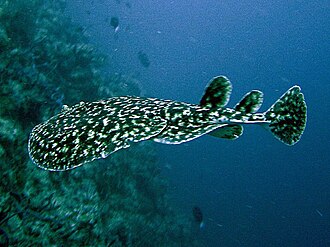
图:Matthias Kleine (Mkleine) · CC BY-SA 3.0 · Wikimedia Commons
- 学名
- Torpediniformes
- 分类等级
- 目
- 英文名
- electric ray
- 上级类群
- 鳐总目
- 大类
- 鱼类
- 命名
- Fernando de Buen y Lozano,1926 年
- 数据库
- NCBI 分类 · GBIF
下级类群(4)
百科正文
发电器官
电鳐头部的后部和肩部胸鳍内侧和左右各有一个肾状卵圆形的蜂窝状的发电器官,由鳃部肌肉变异而来。每个发电器官最基本的结构是一块块电板(electrocytes,纤维组织),约40个电板上下重叠起来,形成一个个六棱柱,每侧有600个,称为电函管。电函管有胶质物,呈半透明乳白色。每块电板具有神经末梢的一面(背面)为负极,另一面(腹面)为正极,电压70~80伏特,最大220伏,每秒可放电150次。
食物
人们解剖电鳐时发现其胃里有完整的鳗鱼、比目鱼和鲑鱼。
分类
- 根据背鳍的多少,分为4科:
- 双鳍电鳐科 Narcinidae
- 深海电鳐属 Benthobatis
- 双电鳐属 Diplobatis
- 盘臀电鳐属 Discopyge
- 双鳍电鳐属 Narcine
- 澳洲双鳍电鳐属 Narcinops
- 单鳍电鳐科 Narkidae
- 坚皮单鳍电鳐属 Crassinarke
- 伊莱克斯电鳐属 Electrolux
- 异双鳍电鳐属 Heteronarce
- 单鳍电鳐属 Narke
- 缺鳍电鳐属 Temera
- 盲电鳐属 Typhlonarke
- 澳洲睡电鳐科 Hypnidae
- 澳洲睡电鳐属 Hypnos
- 黄点𫚙科 Platyrhinidae
- 电鳐科 Torpedinidae
- 大电鲼属 Tetronarce
- 电鲼属 Torpedo
西方人发现电鳐时对它有许多传说,因此发明水雷后,水雷的英语名称是根据电鳐的拉丁种名起的torpedo,后来将这个名词专用于鱼雷。
以上内容摘自维基百科「电鳐目」,按 CC BY-SA 4.0 使用,去掉了参考文献、外部链接等尾部小节,公式改写成了纯文本。全文、配图和出处见原文。
英文维基百科补充中文条目比较短,下面是英文条目「Electric ray」的原文
The electric rays are a group of rays, flattened cartilaginous fish with enlarged pectoral fins, composing the order Torpediniformes. They are known for being capable of producing an electric discharge, ranging from 8 to 220 volts, depending on species, used to stun prey and for defense. There are 69 species in four families.
Perhaps the best known members are those of the genus Torpedo. The torpedo undersea weapon is named after it. The name comes from the Latin torpere, 'to be stiffened or paralyzed', from the effect on someone who touches the fish.
Description
Electric rays have a rounded pectoral disc with two moderately large rounded-angular (not pointed or hooked) dorsal fins (reduced in some Narcinidae), and a stout muscular tail with a well-developed caudal fin. The body is thick and flabby, with soft loose skin with no dermal denticles or thorns. A pair of kidney-shaped electric organs are at the base of the pectoral fins. The snout is broad, large in the Narcinidae, but reduced in all other families. The mouth, nostrils, and five pairs of gill slits are underneath the disc.
Electric rays are found from shallow coastal waters down to at least 1,000 m (3,300 ft) deep. They are sluggish and slow-moving, propelling themselves with their tails, not by using their pectoral fins as other rays do. They feed on invertebrates and small fish. They lie in wait for prey below the sand or other substrate, using their electricity to stun and capture it.
Relationship to humans
History of research
The electrogenic properties of electric rays have been known since antiquity, although their nature was not understood. The ancient Greeks used electric rays to numb the pain of childbirth and operations. In his dialogue Meno, Plato has the character Meno accuse Socrates of "stunning" people with his puzzling questions, in a manner similar to the way the torpedo fish stuns with electricity. Scribonius Largus, a Roman physician, recorded the use of torpedo fish for treatment of headaches and gout in his Compositiones Medicae of 46 AD.
In the 1770s the electric organs of the torpedo ray were the subject of Royal Society papers by John Walsh, and John Hunter. These appear to have influenced the thinking of Luigi Galvani and Alessandro Volta – the founders of electrophysiology and electrochemistry.
Henry Cavendish proposed that electric rays use electricity; he built an artificial ray consisting of fish shaped Leyden jars to successfully mimic their behaviour in 1773.
Bioelectricity
The electric rays have specialised electric organs. Many species of rays and skates outside the family have electric organs in the tail; however, the electric ray has two large kidney-shaped electric organs on each side of its head, where current passes from the lower to the upper surface of the body. The nerves that signal the organ to discharge branch repeatedly, then attach to the lower side of each plaque in the batteries. These are composed of hexagonal columns, closely packed in a honeycomb formation. Each column consists of 500 to more than 1,000 plaques of modified striated muscle, adapted from the branchial (gill arch) muscles. In marine fish, these batteries are connected as a parallel circuit, whereas freshwater batteries are arranged in series. This allows freshwater rays to transmit discharges of higher voltage, as freshwater cannot conduct electricity as well as saltwater.
Systematics
The 60 or so species of electric rays are grouped into 12 genera and two families. The Narkinae are sometimes elevated to a family, the Narkidae. The torpedinids feed on large prey, which are stunned using their electric organs and swallowed whole, while the narcinids specialize on small prey on or in the bottom substrate. Both groups use electricity for defense, but it is unclear whether the narcinids use electricity in feeding. The Platyrhinidae, the thornback rays, are classified within the Torpediniformes by some authorities, but do not possess electric organs.
Eschmeyer's Catalog of Fishes lists classifies the following families in the Torpediniformes:
- Family Platyrhinidae D. S. Jordan, 1923 (thornback rays or fanrays)
- Family Narkidae Fowler, 1934 (sleeper rays)
- Family Narcinidae Gill, 1862 (electric rays)
- Family Hypnidae Gill, 1862 (coffin rays)
- Family Torpedinidae Henle, 1834 (torpedo electric rays or torpedo rays)
以上节选摘自英文维基百科「Electric ray」,按 CC BY-SA 4.0 使用,去掉了参考文献、外部链接等尾部小节,公式改写成了纯文本。篇幅所限,较长的小节只摘了开头一部分,有的小节没有收;全文、配图和出处见原文。