 格物
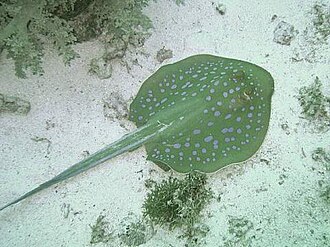
图:Civertan · CC BY-SA 2.5 · Wikimedia Commons
生命之树 › 真核生物 › 动物界 › 真后生动物亚界 › 两侧对称动物 › 后口动物总门 › 脊索动物门 › 脊椎动物亚门 › 有颌下门 › 软骨鱼纲 › 板鳃亚纲 › 新鲨亚纲
鳐总目总目
Batomorphi
鳐(yáo)总目,又名魔鬼鱼,又名𫚉总目,是软骨鱼纲的一个总目,包括鳐目,电鳐目,犁头鳐目,燕𫚉目。锯鳐已经由目降级为科并入犁头鳐目。鳐总目跟鲨鱼所属的鲨总目同属板鳃亚纲,两者关系密切。鳐总目物种的特征在于其扁平的身体,胸鳍与头部合而为一,五到六对的鳃裂则位于腹面,除六鳃𫚉外鳃裂均为5对。该总目下许多成员现遭受过度捕捞等影响种群数量下降,部分危险物种尚无任何保护措施。
摘自维基百科「鳐总目」,CC BY-SA 4.0
- 学名
- Batomorphi
- 分类等级
- 总目
- 上级类群
- 新鲨亚纲
- 大类
- 鱼类
- 数据库
- NCBI 分类
下级类群(2)
百科正文
分类
- 鳐目 Rajiformes
- 鳐科 Rajidae
- 无鳍鳐科 Anacanthobatidae
- 单鳍鳐科 Arhynchobatidae
- 吞鳐科 Gurgesiellidae
- 电鳐目 Torpediniformes
- 澳洲睡电鳐科 Hypnidae
- 双鳍电鳐科 Narcinidae
- 单鳍电鳐科 Narkidae
- 电鳐科 Torpedinidae
黄点𫚙科 Platyrhinidae:或称团扇鳐科。
- 犁头鳐目 Rhinopristiformes
- 蓝吻犁头鳐科 Glaucostegidae
- 锯鳐科 Pristidae
- 圆犁头鳐科 Rhinidae
- 犁头鳐科 Rhinobatidae
- 南犁头鳐科 Trygonorrhinidae
- 燕𫚉目 Myliobatiformes
- 梳板鳐亚目 Zanobatoidei
- 梳板鳐科 Zanobatidae
- 燕𫚉亚目 Myliobatoidei
- 六鳃𫚉总科 Hexatrygonoidea
- 六鳃𫚉科 Hexatrygonidae
- 扁𫚉总科 Urolophoidea
- 近𫚉科 Plesiobatidae
扁𫚉科 Urolophidae:或称平𫚉科。
- 巨尾𫚉总科 Urotrygonoidea
- 巨尾𫚉科 Urotrygonidae
- 𫚉总科 Dasyatoidea
- 𫚉科 Dasyatidae
- 江𫚉科 Potamotrygonidae
燕𫚉科 Gymnuridae:或称鸢𫚉科。
鲼科 Myliobatidae
以上内容摘自维基百科「鳐总目」,按 CC BY-SA 4.0 使用,去掉了参考文献、外部链接等尾部小节,公式改写成了纯文本。全文、配图和出处见原文。
英文维基百科补充中文条目比较短,下面是英文条目「Batomorphi」的原文
Batomorphi is a division of cartilaginous fishes, commonly known as rays; this taxon is sometimes considered as the superorder Batoidea, but the 5th edition of Fishes of the World classifies it as the division Batomorphi. Batomorphi, along with the shark division Selachii, both compose the subclass Elasmobranchii. Rays are the most speciose of cartilaginous fishes groups, with well over 600 species in 26 families. Rays are distinguished by their flattened bodies, enlarged pectoral fins that are fused to the head, and gill slits that are placed on their ventral surfaces.
Description
Anatomy
Like sharks, Batomorphs are cartilaginous fish (Chondrichthyes), meaning they have a boneless skeleton made of a tough, elastic cartilage. Most batomorphs are dorsoventrally flattened, with a mantle-like body, though the guitarfishes and sawfishes are somewhat less flattened, while most sharks have a spindle-shaped body. Many species of batomorph have developed their pectoral fins into broad flat appendages often referred to as the wings. The anal fin is absent. The eyes and spiracles are located on top of the head. Bottom-dwelling batomorphs breathe by taking water in through the spiracles, rather than through the mouth as most fish do, and passing it outward through the gills, whose openings or gill slits lie under the pectoral fins on the underside, whereas a shark's are on the sides of the head. Most batomorphs have five ventral gill slits, but the Hexatrygonidae have six.
Batomorphs have a ventrally located mouth and can considerably protrude their upper jaw (palatoquadrate cartilage) away from the cranium to capture prey. The jaws have euhyostylic type suspension, which relies completely on the hyomandibular cartilages for support. Most batomorphs have developed heavy, rounded teeth for crushing the shells of bottom-dwelling species, such as snails, clams, oysters, crustaceans, and some fish, depending on the species. Manta rays feed on plankton using dense gill rakers to capture them.
Habitat
Most species live on the sea floor, in a variety of geographical regions – mainly in coastal waters, although some live in deep waters to at least 3,000 metres (9,800 ft).
Evolution
Batomorphs belong to the ancient lineage of cartilaginous fishes. Fossil denticles (tooth-like scales in the skin) resembling those of today's chondrichthyans date at least as far back as the Ordovician, with the oldest unambiguous fossils of cartilaginous fish dating from the middle Devonian. A clade within this diverse family, the Neoselachii, emerged by the Triassic, with the best-understood neoselachian fossils dating from the Jurassic. The oldest confirmed ray is Antiquaobatis, from the Pliensbachian of Germany. The clade is represented today by sharks, sawfish, rays and skates.
Classification
Molecular evidence refutes the hypothesis that skates and rays are derived sharks. The monophyly of the skates, the stingrays, and the electric rays has long been generally accepted. Along with Rhinopristiformes, these comprise the four traditionally accepted major batomorph lineages, as in Nelson's 2006 Fishes of the World. However, the exact phylogeny of the major batomorph lineages, internally and with respect to one another, has been subject to diverse treatments. The following cladogram is based on a comprehensive morphological assessment of batomorph phylogeny published in 2004:
However, a 2011 study significantly reevaluated the phylogeny of batomorphs, using nuclear and mitochondrial DNA from 37 taxa, representing almost all recognized families and all of the traditional four major lineages. This is a far more numerous and diverse set of sample taxa than in any previous study, producing findings reflected in the cladogram below.
Conservation
According to a 2021 study in Nature, the number of oceanic sharks and rays has declined globally by 71% over the preceding 50 years, jeopardising "the health of entire ocean ecosystems as well as food security for some of the world's poorest countries". Overfishing has increased the global extinction risk of these species to the point where three-quarters are now threatened with extinction. This is notably the case in the Mediterranean Sea - most impacted by unregulated fishing - where a recent international survey of the Mediterranean Science Commission concluded that only 38 species of rays and skates still subsisted.
以上节选摘自英文维基百科「Batomorphi」,按 CC BY-SA 4.0 使用,去掉了参考文献、外部链接等尾部小节,公式改写成了纯文本。篇幅所限,较长的小节只摘了开头一部分,有的小节没有收;全文、配图和出处见原文。