 格物
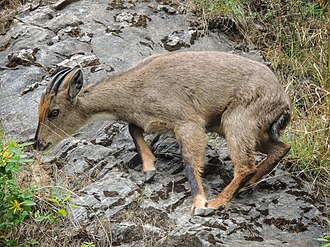
图:Subheg · CC BY-SA 4.0 · Wikimedia Commons
- 学名
- Naemorhedus goral
- 分类等级
- 种
- 英文名
- Himalayan Goral
- 上级类群
- 斑羚属
- 大类
- 哺乳动物
- 命名
- 托马斯·哈德威克,1825 年
- 中文别名
- 喜马拉雅斑羚
- 保护状况(IUCN)
- 近危物种
- 数据库
- NCBI 分类 · GBIF · IUCN 红色名录
百科正文
外观
斑羚长95-130厘米,重35-42公斤。它们是灰色或灰褐色的,脚呈黄褐色,喉咙较为淡色,沿脊骨有一道深色斑纹。雄羚颈上有短的鬃毛。雄羚及雌羚的角都是向后弯曲的,可长达18厘米。
生态及分布
斑羚分布在喜玛拉雅山及兴都库什山脉的森林,介乎海拔1000-4000米。它们一群一般会占有约100公顷的地盘。
斑羚的寿命约14-15年。每胎约产一子,妊娠期为170-218天。幼羚7-8个月大就会断奶,3岁就达至性成熟。
斑羚的群族约有4-12头,有时会一对的生活,较年老的雄羚则有时会独居的。它们是暮晨活动的,在早上或晚上最为活跃。吃过早餐后,它们会喝水及整日在岩边休息。它们吃叶子及植物的其他柔软部分,如草。
斑羚非常灵活及奔跑得很快,其毛色可以成为一种伪装。它们若受到威胁时,会发出嘶嘶声。世界自然保护联盟将它们列为近危。
以上内容摘自维基百科「喜马拉雅斑羚」,按 CC BY-SA 4.0 使用,去掉了参考文献、外部链接等尾部小节,公式改写成了纯文本。全文、配图和出处见原文。
英文维基百科补充中文条目比较短,下面是英文条目「Himalayan goral」的原文
The Himalayan goral (Naemorhedus goral) or gray goral is a bovid species native to the Himalayas. It is listed as Near Threatened on the IUCN Red List because the population is thought to be declining significantly due to habitat loss and hunting for meat.
Characteristics
The Himalayan goral is 95 to 130 cm (37 to 51 in) in length and weighs 35–42 kg (77–93 lb). It has a gray or gray-brown coat with tan legs, lighter patches on its throat, and a single dark stripe along its spine. Males have short manes on their necks. Both males and females have backward-curving horns which can grow up to 18 cm (7.1 in) in length.
In addition to certain peculiarities in the form of the skull, gorals are chiefly distinguished from the closely related serows in that they do not possess preorbital glands below their eyes, nor corresponding depressions in their skulls.
Distribution and habitat
The Himalayan goral occurs in the Himalayas from Chitral District and the Gilgit-Baltistan region in Pakistan to Nepal, Bhutan and southern Tibet, to Sikkim and Arunachal Pradesh in India, to possibly western Myanmar. It most commonly occurs from 900 to 2,750 m (2,950 to 9,020 ft). In Pakistan, it has been recorded at elevations of 1,000 to 4,000 m (3,300 to 13,100 ft). Approximately 370–1017 Himalayan goral were present in Pakistan as of 2004, occurring in seven isolated populations.
Behaviour and ecology
The Himalayan goral is crepuscular and rests on a rock ledge through the day; it feeds on leaves and associated softer parts of plants, mainly grasses. It often forms small groups of four to twelve individuals; older males pair off and are solitary.
The home range of Himalayan goral groups is typically around 40 ha (0.40 km2), with males occupying marked territories of 22–25 ha (0.22–0.25 km2) during the mating season.
The Himalayan goral is very agile and can run quickly. Due to its coloration it is very well camouflaged, so that it is extremely difficult to sight it, especially since it spends much of the day lying still. However, it is hunted by various predators, notably the Himalayan wolf.
Palaeoecology
During the Pleistocene, the Himalayan goral's range stretched into mainland Southeast Asia; fossil remains from the site of Tham Kra Duk in Thailand possess high δ18O values, likely reflecting grazing in open habitats.
Conservation
Naemorhedus goral is listed in CITES Appendix I.
以上内容摘自英文维基百科「Himalayan goral」,按 CC BY-SA 4.0 使用,去掉了参考文献、外部链接等尾部小节,公式改写成了纯文本。全文、配图和出处见原文。