 格物
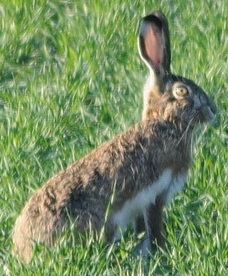
图:Luis Egido · CC BY 3.0 · Wikimedia Commons
- 学名
- Lepus granatensis
- 分类等级
- 种
- 上级类群
- 兔属
- 大类
- 哺乳动物
- 命名
- 威廉·戈特利布·罗森豪尔,1856 年
- 保护状况(IUCN)
- 无危物种
- 特有于
- 伊比利亚半岛
- 数据库
- NCBI 分类 · GBIF · IUCN 红色名录
百科正文
简介及分布范围
伊比利亚野兔(即格拉纳达野兔)是伊比利亚地方性的野兔品种。其分布范围覆盖了伊比利亚半岛的大部分,如西班牙、葡萄牙及法国,并且是当地最重要的猎物物种。
繁衍特征
伊比利亚野兔繁衍模式罕见,使人类难以对其再生模式做一个健全的管理。因此,为了研究伊比利亚野兔繁衍,人们不得不采取以下步骤实施:
- 确定基本繁衍参数
- 评估繁殖活动的季节性变化
- 估算其每年的繁衍能力
自1997年中期到1997年,在葡萄牙南部,每两个月抓捕一次伊比利亚野兔,以记录其繁衍状况。
饮食习惯
伊比利亚野兔是草食性的。研究表明,冬季伊比利亚野兔对草地的消耗比夏季高。
以上内容摘自维基百科「格拉纳达野兔」,按 CC BY-SA 4.0 使用,去掉了参考文献、外部链接等尾部小节,公式改写成了纯文本。全文、配图和出处见原文。
英文维基百科补充中文条目比较短,下面是英文条目「Granada hare」的原文
The Granada hare (Lepus granatensis), also known as the Iberian hare (Spanish: liebre Ibérica), is a species of hare that is endemic to the Iberian Peninsula and the island of Mallorca. A small species compared to other European hares, it has long been hunted as an important game species.
Taxonomy
Three subspecies of the Granada hare are known:
Lepus granatensis granatensis is the most abundant and nominate subspecies, found in Andalusia, Extremadura, Meseta Central, Valencia and the south of Aragon and Catalonia. It is the only subspecies present in Portugal.
Lepus granatensis gallaecius described by Gerrit Smith Miller Jr. in 1907 was a male adult hare collected in the Province of A Coruña. This subspecies with a darker coat occurs in the northwest of the Iberian Peninsula, in Galicia.
Lepus granatensis solisi, also called the Majorcan hare, is native to Mallorca and Ibiza in the Balearic Islands. This subspecies was described by biologists Fernando Palacios Arribas and José Fernández López in 1992, who noted its overall smaller size and differing dental morphology from the nominate subspecies. It is considered either critically endangered by some zoologists or extinct by the IUCN.
The Granada hare has been noted as having high genetic diversity.
Description
The Granada hare is a hare of average adult weight 2–2.6 kilograms (4.4–5.7 lb) with distinctive reddish outer legs and a clear contrast between the gray-brown fur of its back and the white of its underside and inner legs. This white colouration travels to the tips of the toes. It is smaller than the broom hares (L. castroviejoi) and European hares (L. europaeus) that also occupy the Iberian peninsula, having a head and body length of 44.5 to 47.3 centimetres (17.5 to 18.6 in), hind foot length of 11.66 to 12.74 cm (4.59 to 5.02 in), and ear length of 9.25 to 10.27 cm (3.64 to 4.04 in). The species has some degree of sexual dimorphism, with females being heavier on average when compared to males.
Behaviour and ecology
Females will produce 2 young in each litter on average, though litters as large as 7 leverets have been recorded.
It may be parasitized by Taenia pisiformis, a tapeworm, as well as coccidiosis-causing parasites in the genus Eimeria. These parasites have marked effects on the host hare's escape ability, with negative effects increasing with parasite quantity and variety. Many other parasites are known to affect the Granada hare, including those in genera Ixodes, Spilopsyllus, Mosgovoyia, Trichostrongylus, Graphidium, Nematodiroides, Passalurus, Micipsella, Hyalomma, Haemaphysalis, Rhipicephalus, Haemodipsus, Linguatula, and Dicrocoelium. It has never been found to contract European brown hare syndrome, though it is susceptible to some strains of rabbit hemorrhagic disease virus known since the 1990s. It may also develop bacterial infections, such as tularemia.
以上内容摘自英文维基百科「Granada hare」,按 CC BY-SA 4.0 使用,去掉了参考文献、外部链接等尾部小节,公式改写成了纯文本。全文、配图和出处见原文。