 格物
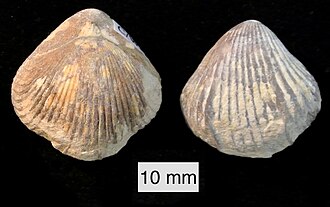
图:Wilson44691 · CC BY-SA 3.0 · Wikimedia Commons
生命之树 › 真核生物 › 动物界 › 真后生动物亚界 › 两侧对称动物 › 原口动物 › 螺旋动物 › 腕足动物门
小嘴贝亚门亚门
Rhynchonelliformea
小嘴贝型亚门(Rhynchonelliformea) 是腕足动物下的一个主要亚门。本纲大致相当于1990年代以前使用的有铰纲(Articulata)。这些所谓的“有铰类”与其他“无铰类”(舌形贝型亚门、髑髅贝型亚门)在解剖上有较大的不同。有铰类具有坚硬的碳酸钙壳体以及 tongue-and-groove 关节与铰合,因而得名。它们拥有单独的开壳肌与闭壳肌,肌肉型态较其他类群简单。
摘自维基百科「小嘴貝型亞門」,CC BY-SA 4.0
- 学名
- Rhynchonelliformea
- 分类等级
- 亚门
- 上级类群
- 腕足动物门
- 大类
- 其他动物
- 命名
- Alwyn Williams,1996 年
- 数据库
- NCBI 分类
下级类群(1)
- 小嘴贝纲 Rhynchonellata 纲
百科正文
小嘴贝型亚门 (如Treatise Part H, revised 1997–2007中所述) 可分为5个纲: 小圆货贝纲、顾脱贝纲、奇里贝纲、扭月贝纲与小嘴贝纲. 其中,小嘴贝纲至今仍存活,是现代腕足动物群的主要组成部分。其余各纲均已灭绝:小圆货贝纲、顾脱贝纲只存活于寒武纪,而奇里贝纲和扭月贝纲在古生代的大部分时期均有分布。
解剖结构
同所有腕足动物,小嘴贝型亚门的壳体由两瓣(valve)组成:腹壳(茎壳)容纳肉茎;背壳(腕壳)则作为触手冠与其他重要器官附着的平台。
壳体组成
小嘴贝型亚门的壳体由低镁碳酸钙晶体和连接的蛋白质或其他有机分子构成。其壳体具有几个主要的层。较厚而密度较低的矿化的(次级)内层由外套膜(mantle)从内部分泌。
分类历史
小嘴贝型亚门这一名称被用于替代“有铰类”(Articulata),因为后者已被一类现生海百合关节海百合亚纲(Articulata)使用。依据命名法则,腕足动物中的“有铰类”这一名称是无效的。小嘴贝型亚门的名字源于小嘴贝科,尽管它们在有铰类腕足动物中未必比石燕贝目或扭月贝目等其他类群来得更具代表性。
以上内容摘自维基百科「小嘴貝型亞門」,按 CC BY-SA 4.0 使用,去掉了参考文献、外部链接等尾部小节,公式改写成了纯文本。全文、配图和出处见原文。
英文维基百科补充中文条目比较短,下面是英文条目「Rhynchonelliformea」的原文
Rhynchonelliformea is a major subphylum and clade of brachiopods. It is roughly equivalent to the former class Articulata, which was used previously in brachiopod taxonomy up until the 1990s. These so-called articulated brachiopods have many anatomical differences relative to "inarticulate" brachiopods of the subphyla Linguliformea and Craniformea. Articulates have hard calcium carbonate shells with tongue-and-groove hinge articulations (hence the name) and separate sets of simple opening and closing muscles.
The Rhynchonelliformea (as described in the Treatise Part H, revised 1997–2007) is divided into five classes: Obolellata, Kutorginata, Chileata, Strophomenata, and Rhynchonellata. The Rhynchonellata are found living today, as the major constituent of modern brachiopod faunas. The other classes are all extinct: the Obolellata and Kutorginata are restricted to the Cambrian, while the Chileata and Strophomenata range through most of the Paleozoic.
Anatomy
Like all brachiopods, rhynchonelliforms have a shell with two stacked components (valves): a ventral (pedicle) valve which hosts the fleshy pedicle, and a dorsal (brachial) valve which acts as a platform for the lophophore and other important organs.
Shell composition
Rhynchonelliform shells are composed of low-magnesium calcium carbonate fragments stabilized by proteins and other organic molecules. The shell has several major layers. The thicker but less dense inner (secondary) mineralized layer is secreted from below by the mantle. In living rhynchonelliforms, the secondary layer is a mesh of calcite fibers, but extinct groups were more variable in structure. The thinner but denser outer (primary) mineralized layer is composed of calcite grains. It was emplaced from above by the periostracum, a protein-rich outer organic sheath.
Hinge and dental structures
The two valves meet at a mobile hinge at the back of the body. In nearly all rhynchonelliforms, this hinge is strengthened by a pair of teeth on the ventral valve, fitting into a pair of sockets on the dorsal valve. This tooth-and-socket articulation is responsible for rhynchonelliforms' alternative name as articulated brachiopods.
History of classification
The name Rhynchonelliformea is a replacement for Articulata, a name which is also in use for a living subclass of crinoids. Rhynchonelliformea references the family Rhynchonellidae, though rhynchonellides are no more representative of articulate brachiopods than any other group such as spiriferides or strophomenides.
Treatise (1965)
In the older classification of the Treatise on Invertebrate Paleontology Part H (1965), the Class Articulata was divided into six orders: Orthida, Pentamerida, Rhynchonellida, Spiriferida, Terebratulida, and Strophomenida.
Revised Treatise (1997–2007)
The revised edition of the Treatise on Invertebrate Paleontology divided "articulates" into five classes. The orders Orthida, Pentamerida, Rhynchonellida, Spiriferida, and Terebratulida became combined as the class Rhynchonellata. The former Strophomenida was raised to the class Strophomenata and divided into four orders. Chileata were removed from the strophomenides and given their own class. Obolellata and Kutorginata were previously included among the inarticulate brachiopods, but have subsequently been recognized as classes of primitive articulates.
Subgroups
- Class †Chileata
- Order †Chileida [lower Cambrian ("Botomian") – mid-Silurian (Wenlock)]
- Order †Dictyonellida [Upper Ordovician – Lower Permian (Artinskian)]
- Class †Kutorginata
- Order †Kutorginida [lower-mid Cambrian]
- Class †Obolellata
- Order †Naukatida [lower-mid Cambrian]
- Order †Obolellida [lower-mid Cambrian]
- Class †Strophomenata
- Order †Billingsellida [mid-Cambrian – Upper Ordovician (Hirnantian)]
- Order †Orthotetida [Lower–Middle Ordovician ("Llanvirn") – Upper Permian]
- Order †Productida [Upper Ordovician – Lower Triassic (Induan)]
- Order †Strophomenida [Lower Ordovician (Tremadocian) – Carboniferous (Serpukhovian)]
- Class Rhynchonellata
- Order †Athyridida [Upper Ordovician – Lower Jurassic]
- Order †Atrypida [Lower-Middle Ordovician ("Llanvirn") – Upper Devonian (Frasnian)]
- Order †Orthida [lower-mid Cambrian – Upper Permian]
- Order †Pentamerida [lower-mid Cambrian ("Toyonian") – Upper Devonian (Frasnian)]
- Order †Protorthida [lower-mid Cambrian – Upper Devonian (Frasnian)]
- Order Rhynchonellida [Lower-Middle Ordovician ("Llanvirn") – present]
- Order †Spiriferida [Upper Ordovician – Lower Jurassic]
- Order †Spiriferinida [Lower Devonian – Lower Jurassic]
以上节选摘自英文维基百科「Rhynchonelliformea」,按 CC BY-SA 4.0 使用,去掉了参考文献、外部链接等尾部小节,公式改写成了纯文本。篇幅所限,较长的小节只摘了开头一部分,有的小节没有收;全文、配图和出处见原文。