 格物
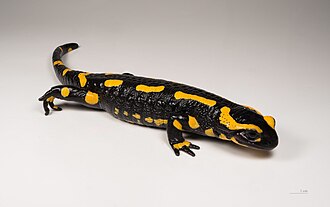
图:Didier Descouens · CC BY-SA 4.0 · Wikimedia Commons
- 学名
- Caudata
- 分类等级
- 目
- 上级类群
- 两栖动物
- 大类
- 两栖动物
- 命名
- 戈特黑尔夫·菲舍尔·冯·瓦尔德海姆,1813 年
- 数据库
- NCBI 分类 · GBIF
分类阶元
- 域真核生物
- 未标等级无定形生物 Amorphea
- 演化支后鞭毛生物 Opisthokonta
- 总界动物总界 Holozoa
- 未标等级蜷丝生物 Filozoa
- 未标等级领鞭毛动物 Choanozoa
- 界动物界 Animalia
- 亚界真后生动物亚界 Eumetazoa
- 未标等级副同源异形基因动物 Parahoxozoa
- 亚界两侧对称动物 Bilateria
- 总门后口动物总门 Deuterostomia
- 门脊索动物门 Chordata
- 亚门脊椎动物亚门 Vertebrata
- 下门有颌下门 Gnathostomata
- 未标等级正真口类 Euteleostomi
- 总纲肉鳍鱼总纲 Sarcopterygii
- 未标等级扇鳍鱼类 Rhipidistia
- 亚纲四足形类 Tetrapodomorpha
- 未标等级始四足目 Eotetrapodiformes
- 下纲希望螈目 Elpistostegalia
- 未标等级坚头类 Stegocephalia
- 总纲四足总纲 Tetrapoda
- 未标等级蛙形类 Batrachomorpha
- 纲两栖动物 Amphibia
- 目有尾目 Caudata
下级类群(12)
百科正文
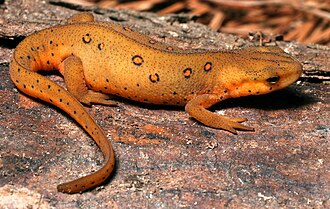
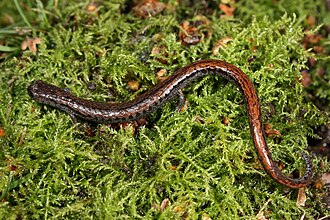
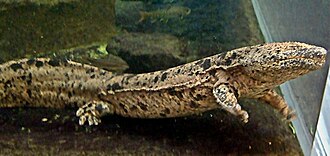
有尾目动物有发展完全的前肢和后肢,大小大约一致,但四肢细弱,少数种类仅有前肢(鳗螈)。眼小,或隐于皮下(洞螈),没有鼓膜或外耳开口。牙齿位于下颌。脊柱和肢骨纤细薄弱,肋骨退化,不足以支撑胸腔。身体有黏膜皮肤,没有鳞片或尖锐的爪子。通常行体内受精。
分类
- 有尾目包括:
- †蛙蜥螈科 Batrachosauroididae
- †科 Scapherpetontidae
- 隐鳃鲵亚目 Cryptobranchoidea
- 隐鳃鲵科 Cryptobranchidae
- 小鲵科 Hynobiidae
- 蝾螈亚目 Salamandroidea
- 钝口螈科 Ambystomatidae
- 两栖鲵科 Amphiumidae
- 陆巨螈科 Dicamptodontidae
- 无肺螈科 Plethodontidae
- 洞螈科 Proteidae
- 急流螈科 Rhyacotritonidae
- 蝾螈科 Salamandridae
- 鳗螈科 Sirenidae
以上内容摘自维基百科「有尾目」,按 CC BY-SA 4.0 使用,去掉了参考文献、外部链接等尾部小节,公式改写成了纯文本。全文、配图和出处见原文。
英文维基百科补充中文条目比较短,下面是英文条目「Salamander」的原文
Salamanders are a group of amphibians typically characterized by their lizard-like appearance, with slender bodies, blunt snouts, short limbs projecting at right angles to the body, and the presence of a tail in both larvae and adults. All ten extant salamander families are grouped together under the order Urodela, the sole surviving order from the group Caudata. Urodela is a scientific Latin term based on the Ancient Greek οὐρά δήλη (ourà dēlē), "conspicuous tail". Caudata is the Latin for "tailed ones", from cauda, "tail".
Salamander diversity is highest in eastern North America, especially in the Appalachian Mountains; most species are found in the Holarctic realm, with some species present in the Neotropical realm. Salamanders never have more than four toes on their front legs and five on their rear legs, but some species have fewer digits and others lack hind limbs. Their permeable skin usually makes them reliant on habitats in or near water or other cool, damp places. Some salamander species are fully aquatic throughout their lives, some take to the water intermittently, and others are entirely terrestrial as adults.
This group of amphibians is capable of regenerating lost limbs as well as other damaged parts of their bodies. Researchers seek to reverse engineer the regenerative processes for potential human medical applications, such as brain and spinal cord injury treatment or preventing harmful scarring during heart surgery recovery. The salamander's ability to regenerate is not limited to limbs but extends to vital organs such as the heart, jaw, and parts of the spinal cord, contrasting most other vertebrates. This ability is special in that it occurs without any type of scarring. This has made salamanders a widespread model organism in scientific research aimed at understanding and achieving regenerative processes for medical advancements in human and animal biology.
Members of the family Salamandridae are mostly known as newts and lack the costal grooves along the sides of their bodies typical of other groups. The skin of some species contains the powerful poison tetrodotoxin; these salamanders tend to be slow-moving and have bright warning coloration to advertise their toxicity. Salamanders typically lay eggs in water and have aquatic larvae, but great variation occurs in their lifecycles. Some species in harsh environments reproduce while still in the Salamander larval state.
以上节选摘自英文维基百科「Salamander」,按 CC BY-SA 4.0 使用,去掉了参考文献、外部链接等尾部小节,公式改写成了纯文本。篇幅所限,较长的小节只摘了开头一部分,有的小节没有收;全文、配图和出处见原文。