 格物
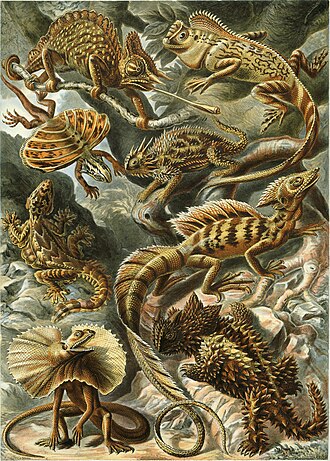
图:Ernst Haeckel · Public domain · Wikimedia Commons
- 学名
- Lepidosauria
- 分类等级
- 总目
- 上级类群
- 鳞龙形下纲
- 大类
- 爬行动物
- 命名
- 恩斯特·海克尔,1866 年
- 数据库
- NCBI 分类 · GBIF
下级类群(1)
- 有鳞目 Squamata 目
百科正文
- 鳞龙超目是蜥形纲下的一个超目,由以下各目构成:
- 有鳞目:有鳞蜥蜴(蜥蜴、蛇、蚓蜥)
- 喙头蜥目
译名
在某些中文网站中,仍然保持早期的传统分类法,鳞龙超目(Lepidosauria)被分类成双孔亚纲的一个下纲,名为鳞龙下纲;或是爬行纲的一个亚纲,名为鳞龙亚纲、有鳞亚纲。
以上内容摘自维基百科「鱗龍超目」,按 CC BY-SA 4.0 使用,去掉了参考文献、外部链接等尾部小节,公式改写成了纯文本。全文、配图和出处见原文。
英文维基百科补充中文条目比较短,下面是英文条目「Lepidosauria」的原文
The Lepidosauria (, from Greek meaning scaled lizards) is a superorder of reptiles, containing the orders Squamata and Rhynchocephalia. Squamata, comprising lizards and snakes, contains over 9,000 species, making it by far the most species-rich and diverse order of non-avian reptiles in the present day. Rhynchocephalia was a formerly widespread and diverse group of reptiles in the Mesozoic Era. However, it is represented by only one living species: the tuatara (Sphenodon punctatus), a superficially lizard-like reptile native to New Zealand.
Lepidosauria is a monophyletic group (i.e. a clade), containing all descendants of the last common ancestor of squamates and rhynchocephalians. Lepidosaurs can be distinguished from other reptiles via several traits, such as large keratinous scales which may overlap one another. Purely in the context of modern taxa, Lepidosauria can be considered the sister taxon to Archelosauria, which includes Testudines (turtles), Aves (birds) and Crocodilia (crocodilians). Lepidosauria is encompassed by Lepidosauromorpha, a broader group defined as all reptiles (living or extinct) closer to lepidosaurs than to archosaurs.
Evolution
Lepidosauromorpha is thought to have split from their sister group, Archelosauria, during the Permian period. The earliest members of Lepidosauromorpha date to the Early Triassic. The oldest known definitive lepidosaur is the rhynchocephalian Agriodontosaurus from the Helsby Sandstone Formation of the United Kingdom, dating to the upper Anisian stage of the Middle Triassic, approximately 244 to 241.5 million years ago. The next earliest rhynchocephalian, Wirtembergia, is known from the Ladinian stage of the Middle Triassic. Sophineta is known from older rocks in the Early Triassic, but its exact placement within the broader clade Lepidosauromorpha is uncertain and it may not be a true lepidosaur.
Description
Extant reptiles are in the clade Diapsida, named for the two pairs of temporal fenestrae present on the skull behind the eye socket. Until recently, Diapsida was said to be composed of Lepidosauria and their sister taxa Archosauria. The Lepidosauria is then split into Squamata and Rhynchocephalia. More recent morphological studies and molecular studies also place turtles firmly within Diapsida, even though they lack temporal fenestrations.
The reptiles in the Lepidosauria can be distinguished from other reptiles by a variety of characteristics.
Biology and ecology
Squamates are represented by viviparous, ovoviviparous, and oviparous species. Viviparous means that the female gives birth to live young, Ovoviviparous means that the egg will develop inside the female's body and Oviparous means that the female lays eggs. A few species within Squamata have the ability to reproduce asexually. The tuatara lays eggs that are usually about one inch in length and which take about 14 months to incubate.
While in the egg, the Squamata embryo develops an egg tooth on the premaxillary that helps the animal emerge from the egg. A reptile will increase three to twentyfold in length from hatching to adulthood. There are three main life history events that lepidosaurs reach: hatching/birth, sexual maturity, and reproductive senility.
Conservation
The geographic ranges of lepidosaurs are vast and cover all but the most extreme cold parts of the globe. Amphisbaenians exist in Florida, mainland Mexico, including Baja California, the Mediterranean region, the Middle East, North Africa, sub-Saharan Africa, South America, and the Caribbean. The tuatara is confined to only a few rocky islands of New Zealand, where it digs burrows to live in and preys mostly on insects.
Climate change has led to the need for conservation efforts to protect the existence of the tuatara. This is because it is not possible for this species to migrate on its own to cooler areas. Conservationists are beginning to consider the possibility of translocating them to islands with cooler climates.
以上节选摘自英文维基百科「Lepidosauria」,按 CC BY-SA 4.0 使用,去掉了参考文献、外部链接等尾部小节,公式改写成了纯文本。篇幅所限,较长的小节只摘了开头一部分,有的小节没有收;全文、配图和出处见原文。