 格物
生命之树 › 真核生物 › 动物界 › 真后生动物亚界 › 两侧对称动物 › 后口动物总门 › 脊索动物门 › 脊椎动物亚门 › 有颌下门 › 肉鳍鱼总纲 › 四足形类 › 希望螈目 › 四足总纲 › 爬行动物 › 坚尾龙类 › 鸟纲 › 今鸟亚纲 › 今颚下纲 › 新鸟总目 › 佛法僧总目 › 佛法僧目
翠𫁡科科
Momotidae
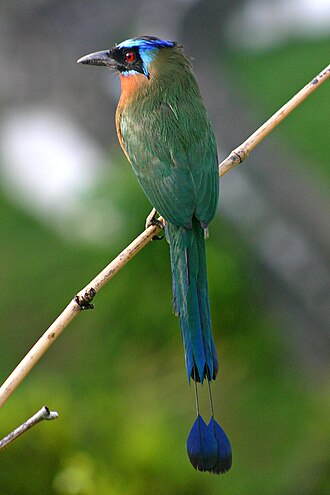
翠𫁡科 是佛法僧目的一个科,现存6属10种,分布于美洲热带地区(新热带界)的森林中。本科的鸟类尾羽较长,在末端附近有段羽干上没有羽毛,形成一条像球拍一样的末端,为本科的一个显著特征。
短尾翠𫁡属(Hylomanes)
短尾翠𫁡
蓝喉翠𫁡属 (Aspatha)
蓝喉翠𫁡
Momotus
高原翠𫁡
锈顶翠𫁡
蓝顶翠𫁡
Baryphthengus
棕翠𫁡
棕顶翠𫁡
Electron
隆嘴翠𫁡
阔嘴翠𫁡
绿眉翠𫁡属 (Eumomota)
绿眉翠𫁡
摘自维基百科「翠鴗科」,CC BY-SA 4.0
- 学名
- Momotidae
- 分类等级
- 科
- 英文名
- motmot
- 上级类群
- 佛法僧目
- 大类
- 鸟类
- 命名
- 乔治·罗伯特·格雷,1840 年
- 数据库
- NCBI 分类 · GBIF
下级类群(3)
百科正文
- 短尾翠𫁡属(Hylomanes)
- 短尾翠𫁡(Hylomanes momotula)
- 蓝喉翠𫁡属 (Aspatha)
- 蓝喉翠𫁡(Aspatha gularis)
- Momotus
- 高原翠𫁡(Momotus aequatorialis)
- 锈顶翠𫁡(Momotus mexicanus)
- 蓝顶翠𫁡(Momotus momota)
- Baryphthengus
- 棕翠𫁡(Baryphthengus martii)
- 棕顶翠𫁡(Baryphthengus ruficapillus)
- Electron
- 隆嘴翠𫁡(Electron carinatum)
- 阔嘴翠𫁡(Electron platyrhynchum)
- 绿眉翠𫁡属 (Eumomota)
- 绿眉翠𫁡(Eumomota superciliosa)
以上内容摘自维基百科「翠鴗科」,按 CC BY-SA 4.0 使用,去掉了参考文献、外部链接等尾部小节,公式改写成了纯文本。全文、配图和出处见原文。
英文维基百科补充中文条目比较短,下面是英文条目「Motmot」的原文
The motmots or Momotidae are a family of birds in the order Coraciiformes, which also includes the kingfishers, bee-eaters and rollers. All extant motmots are restricted to woodland or forests in the Neotropics, and the largest are in Central America. They have a colourful plumage and a relatively heavy bill. All except the tody motmot (Hylomanes momotula) have relatively long tails that in some species have a distinctive racket-like tip.
Behaviour
Motmots eat small prey such as insects and lizards, and will also take fruit. In Nicaragua and Costa Rica, motmots have been observed feeding on poison dart frogs.
Like most of the Coraciiformes, motmots nest in tunnels in banks, laying about four white eggs. Some species form large colonies of up to 40 paired individuals. The eggs hatch after about 20 days, and the young leave the nest after another 30 days. Both parents care for the young.
Motmots often move their tails back and forth in a wag-display that commonly draws attention to an otherwise hidden bird. Research indicates that motmots perform the wag-display when they detect predators (based on studies on turquoise-browed motmot) and that the display is likely to communicate that the motmot is aware of the predator and is prepared to escape. This form of interspecific pursuit-deterrent signal provides a benefit to both the motmot and the predator: the display prevents the motmot from wasting time and energy fleeing, and the predator avoids a costly pursuit that is unlikely to result in capture.
The largest concentration of motmots reside in Honduras and Guatemala, with a total of 7 subspecies. It is also the national bird of Nicaragua and El Salvador.
There is also evidence that the male tail, which is slightly larger than the female tail, functions as a sexual signal in the turquoise-browed motmot.
In several species of motmots, the barbs near the ends of the two longest (central) tail feathers are weak and fall off due to abrasion with substrates, or fall off during preening, leaving a length of bare shaft, thus creating the racket shape of the tail. It was, however, wrongly believed in the past that the motmot shaped its tail by plucking part of the feather web to leave the racket. This was based on inaccurate reports made by Charles William Beebe. It has since been shown that these barbs are weakly attached and fall off due to abrasion with substrates and during routine preening. There are, however, also several species where the tail is "normal", these being the tody motmot, blue-throated motmot, rufous-capped motmot, and the Amazonian populations of the rufous and broad-billed motmots.
Taxonomy
A fossil genus of Oligocene coraciiform from Switzerland has been described as Protornis; it might be a primitive motmot or a more basal lineage. A partial momotid humerus found in early Hemphilian (Late Miocene, c. 8 mya) deposits in Alachua County, USA has not been named; it might belong to an extant genus.
The phylogenetic relationship between the six families that make up the order Coraciiformes is shown in the cladogram below. The number of species in each family is taken from the list maintained by Frank Gill, Pamela C. Rasmussen and David Donsker on behalf of the International Ornithological Committee (IOC).
以上内容摘自英文维基百科「Motmot」,按 CC BY-SA 4.0 使用,去掉了参考文献、外部链接等尾部小节,公式改写成了纯文本。全文、配图和出处见原文。