 格物
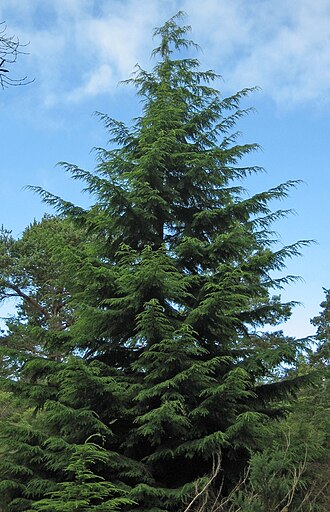
图:MPF · CC BY-SA 4.0 · Wikimedia Commons
- 学名
- Tsuga
- 分类等级
- 属
- 上级类群
- 松科
- 大类
- 其他植物
- 命名
- 伊利-阿贝尔·卡里埃,1855 年
- 数据库
- NCBI 分类 · GBIF
下级类群(1)
- 云南铁杉 Tsuga dumosa 种
百科正文
下属物种
本属包括以下物种:
Hesperopeuce longibracteata Cheng
Tsuga ajanensis Regel ex Beissn.
Tsuga canadensis (L.) Carrière
Tsuga caroliniana Engelm.
铁杉 Tsuga chinensis (Franch.) E.Pritz.
Tsuga diversifolia (Maxim.) Mast.
云南铁杉 Tsuga dumosa (D.Don) Eichler
丽江铁杉 Tsuga forrestii Downie
Tsuga heterophylla (Raf.) Sarg.
Tsuga mertensiana (Bong.) Carrière
Tsuga miosieboldiana Ozaki, 1974
矩鳞铁杉 Tsuga oblongisquamata (W. C. Cheng & L. K. Fu) L. K. Fu & Nan Li
Tsuga nanfengensis Bondarenko et al., 2015
Tsuga sieboldii Carrière
Tsuga thuja A.Murr.
Tsuga ulleungensis G.P.Holman, Del Tredici, Havill, N.S.Lee & C.S.Campb.
- Tsuga xianfengensis Xing & Zhou, 2013
- 杂交种:
- Tsuga ×jeffreyi (A.Henry) A.Henry
以上内容摘自维基百科「铁杉属」,按 CC BY-SA 4.0 使用,去掉了参考文献、外部链接等尾部小节,公式改写成了纯文本。全文、配图和出处见原文。
英文维基百科补充中文条目比较短,下面是英文条目「Tsuga」的原文
Tsuga (, from Japanese 栂 (ツガ), the name of Tsuga sieboldii) is a genus of conifers in the pine family, Pinaceae. The English-language common name, "hemlock" arose from a perceived similarity in the smell of its crushed foliage to that of the unrelated plant hemlock. Unlike the latter, Tsuga species are not poisonous.
The genus comprises eight to ten species (depending on the authority), with four species occurring in North America and four to six in eastern Asia.
Description
Hemlocks are medium-sized to large coniferous trees, ranging from 10–60 metres (33–197 feet) tall, with a conical to irregular crown, the latter occurring especially in some of the Asian species. The leading shoots generally droop. The bark is scaly and commonly deeply furrowed, with the colour ranging from grey to brown. The branches stem horizontally from the trunk and are usually arranged in flattened sprays that bend downward towards their tips. Short spur shoots, which are present in many gymnosperms, are weakly to moderately developed. The young twigs, as well as the distal portions of stem, are flexible and often pendent. The stems are rough with pulvini that persist after the leaves fall. The winter buds are ovoid or globose, usually rounded at the apex and not resinous.
The leaves are flattened to slightly angular and range from 5–35 millimetres (3⁄16–1+3⁄8 inches) long and 1–3 mm (1⁄32–1⁄8 in) broad. They are borne singly and are arranged spirally on the stem; the leaf bases are twisted so the leaves lie flat either side of the stem or more rarely radially. Towards the base, the leaves narrow abruptly to a petiole set on a forward-angled pulvinus.
Taxonomy
Mountain hemlock (T. mertensiana) is unusual in the genus in several respects: the leaves are less flattened and arranged all round the shoot, and have stomata above as well as below, giving the foliage a glaucous colour; and the cones are the longest in the genus, 35–80 mm (1+3⁄8–3+1⁄8 in) long and cylindrical rather than ovoid. Some botanists treat it in a distinct genus as Hesperopeuce mertensiana (Bong.) Rydb., though it is more generally only considered distinct at the rank of subgenus.
The oldest fossils attributed to the genus are twigs, known from the Early Cretaceous of Inner Mongolia, China, though their relationship to modern Tsuga is not unambiguous. The earliest pollen attributed to the genus is known from the Upper Cretaceous of Poland, dating to around 90 million years ago. Abundant remains are only known from Eocene onwards, when the modern Tsuga crown group is thought to have begun to diversify. While formerly present in the region Tsuga became extinct in Europe during the Middle Pleistocene epoch around 780-440,000 years ago, due to unfavourable climate change caused by the ongoing Quaternary glaciation.
Ecology
The species are all adapted to (and are confined to) relatively moist, cool temperate areas with high rainfall, cool summers, and little or no water stress; they are also adapted to cope with heavy to very heavy winter snowfall and tolerate ice storms better than most other trees. Hemlock trees are more tolerant of heavy shade than other conifers; they are, however, more susceptible to drought.
Threats
The two eastern North American species, T. canadensis and T. caroliniana, are under serious threat by the sap-sucking insect Adelges tsugae (hemlock woolly adelgid). This adelgid, related to the aphids, was introduced accidentally from eastern Asia, where it is only a minor pest. Extensive mortality has occurred, particularly east of the Appalachian Mountains. The Asian species are resistant to this pest, and the two western American hemlocks are moderately resistant. In North America, hemlocks are also attacked by hemlock looper. Larger infected hemlocks have large, relatively high root systems that can bring other trees down if one falls. The foliage of young trees is often browsed by deer, and the seeds are eaten by finches and small rodents.
Uses
The wood obtained from hemlocks is important in the timber industry, especially for use as wood pulp. Many species are used in horticulture, and numerous cultivars have been selected for use in gardens. The bark is also used in tanning leather. The needles are sometimes used to make a tea and perfume.
以上节选摘自英文维基百科「Tsuga」,按 CC BY-SA 4.0 使用,去掉了参考文献、外部链接等尾部小节,公式改写成了纯文本。篇幅所限,较长的小节只摘了开头一部分,有的小节没有收;全文、配图和出处见原文。