 格物
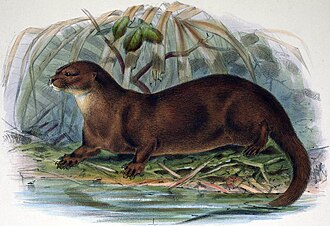
图:John Keulemans · Public domain · Wikimedia Commons
- 学名
- Lutra sumatrana
- 分类等级
- 种
- 英文名
- Hairy-nosed otter
- 上级类群
- 水獭属
- 大类
- 哺乳动物
- 命名
- 约翰·爱德华·格雷,1865 年
- 保护状况(IUCN)
- 濒危 (保育状况)
- 数据库
- NCBI 分类 · GBIF · IUCN 红色名录
百科正文
特征
身长可达1.3米,体重约6.8-7公斤。脚掌有蹼,毛皮会分泌可防水的油脂。背部棕褐色,腹部苍白色,唇部黯淡,鼻子和嘴巴的地方有覆盖短黑色的毛。
习性
毛鼻水獭栖息在内陆溪流的沼泽森林或沿海地区。昼伏夜出,狩猎时多单独活动,或是组成2-4只联合打猎,以鱼类、螃蟹、水禽、水蛇、青蛙、老鼠为食物。
分布
毛鼻水獭的数量十分稀少,目前主要的栖息地在马来西亚和婆罗洲。柬埔寨、泰国、越南则有极少量的分布,
生存威胁
盗猎者为取得其毛皮而杀害、栖息环境被破坏等因素。
以上内容摘自维基百科「毛鼻水獺」,按 CC BY-SA 4.0 使用,去掉了参考文献、外部链接等尾部小节,公式改写成了纯文本。全文、配图和出处见原文。
英文维基百科补充中文条目比较短,下面是英文条目「Hairy-nosed otter」的原文
The hairy-nosed otter (Lutra sumatrana) is a semiaquatic mammal native to Southeast Asia and one of the rarest and least known otter species. It is threatened by loss of natural resources and poaching.
Description
The hairy-nosed otter has a short brown fur that becomes paler on the belly. It has a distinguished rhinarium which is fully covered with short dark hair "from the upper edge of the nostrils". Its upper lip and chin are whitish. Some individuals are reddish-chestnut in colour. Its body is long, its tail slender, and its fully webbed paws have prominent claws. Head-to-body length ranges from 57.5 to 82.6 cm (22.6 to 32.5 in), tail length from 35 to 50.9 cm (13.8 to 20.0 in), and weight from 5 to 8 kg (11 to 18 lb).
Its skull is flatter than that of smooth-coated otter, and it has smaller teeth. Its forepaws are 5.8 cm (2.3 in) wide and smaller than the hind paws with about 6.6 cm (2.6 in).
Distribution and habitat
This hairy-nosed otter occurs in Southeast Asia from southern Thailand, Cambodia, southern Vietnam and Peninsular Malaysia to Sumatra and Borneo. It is locally extinct in India, Singapore and Myanmar, and possibly also in Brunei.
In Thailand, it was recorded in the Pru Toa Daeng peat swamp forest and in areas around the Bang Nara river. It mainly habits lowland flooded forests with climaxing vegetation in three levels: a primary forest zone, a secondary forest zone made up of Melaleuca cajuputi, and a third zone of grasslands. These tiers make the habitat hard to penetrate, providing protection from human disturbance and cover from predators (possibly including grey-headed fish eagles, feral dogs and reticulated pythons). The Bang Nara river habitat, where communities have been discovered, is tidal. The two reserves in Vietnam are both peat swamp forests, surrounded by 15 m high Melaleuca cajuputi, covered in dense lianas such as Stenochlaena palustris in its primary zone, and a second zone of meadows made up of Eleocharis dulcis. These two Vietnamese reserves contain many canals and floating aquatic plants like Eichhornia crassipes, Pistia stratiotes, Salvinia cucullata and Ipomoea aquatica to hunt and play in, with surrounding rice paddies as a third buffer zone.
In Cambodia, it was recorded in lowland flooded forest around Tonle Sap Lake.
In Vietnam, it was sighted and recorded by camera traps in U Minh Thuong National Park in 2000, where also spraints were found with fish scales and remains of crabs. In 2008, it was also recorded in U Minh Ha National Park.
In Sumatra, a hairy-nosed otter was killed on a road next to the Musi River in 2005.
In Sabah, historic records date to the late 19th century. In 2010, one individual was recorded for the first time by a camera trap in Deramakot Forest Reserve incidentally.
Ecology and behavior
The hairy-nosed otter occurs in coastal areas and on larger inland rivers, solitary or in groups of up to four. Its diet includes fish, such as broadhead catfish, snakeheads, and climbing perch, and water snakes, mollusks, and crustaceans.
During the dry season, individuals forage in drainage canals and ponds.
Pairing of a male and a female may be limited to the breeding period. The contact call between otters is a single-syllabic chirp. Adult females call to pups with a staccato chatter.
Populations in Cambodia breed between November and March. The gestation period lasts around two months. A family of both parents and cubs were sighted between December and February.
Threats
The hairy-nosed otter is threatened by the loss of natural resources and poaching.
Conservation
The hairy-nosed otter is the rarest otter in Asia, most likely verging on extinction in the northern parts of its range and of uncertain status elsewhere. Only a few viable populations remain, widely scattered in region. The species is threatened by loss of lowland wetland habitats, hunting for fur and meat, and accidental killing during fishing.
In captivity
In June 2008, the Wildlife Alliance-led Wildlife Rapid Rescue Team received a donated hairy-nosed otter caught near Tonle Sap. Working with Conservation International, they established a safe home for the rescued otter at the Phnom Tamao Wildlife Rescue Centre, but the otter, which had been frequently sick throughout its life in captivity, died of unknown causes in February 2010. Phnom Tamao Wildlife Rescue Centre rescued another hairy-nosed otter in July 2010, and hope it will become part of a future captive breeding program. This is currently the only known hairy-nosed otter in captivity.
以上节选摘自英文维基百科「Hairy-nosed otter」,按 CC BY-SA 4.0 使用,去掉了参考文献、外部链接等尾部小节,公式改写成了纯文本。篇幅所限,较长的小节只摘了开头一部分,有的小节没有收;全文、配图和出处见原文。