 格物

图:Luc Viatour · CC BY-SA 3.0 · Wikimedia Commons
- 学名
- Balearica
- 分类等级
- 属
- 上级类群
- 鹤科
- 大类
- 鸟类
- 命名
- 马蒂兰·雅克·布里松,1760 年
- 数据库
- NCBI 分类 · GBIF
下级类群(2)
百科正文
和其它鹤一样,冠鹤属鸟类以昆虫,爬行动物和一些较小的哺乳动物为食。
分类学
冠鹤属最早由法国动物学家马蒂兰·雅克·布里松于1760年提出。其名称来自于拉丁文的巴利阿里群岛。
以上内容摘自维基百科「冠鹤属」,按 CC BY-SA 4.0 使用,去掉了参考文献、外部链接等尾部小节,公式改写成了纯文本。全文、配图和出处见原文。
英文维基百科补充中文条目比较短,下面是英文条目「Balearica」的原文
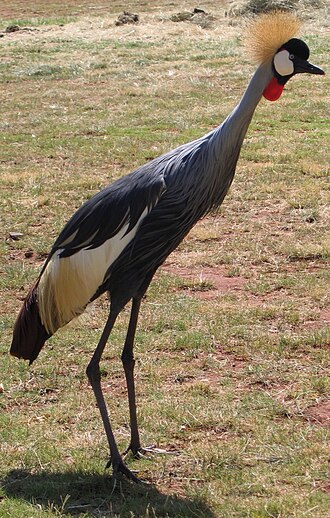
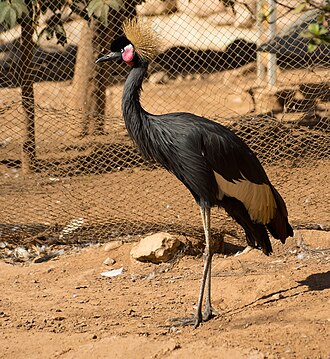
The bird genus Balearica (also called the crowned cranes or Balearic cranes) contains two extant species in the crane family Gruidae: the black crowned crane (B. pavonina) and the grey crowned crane (B. regulorum).
The species today occur only in Africa, south of the Sahara Desert, and are the only cranes that can nest in trees. This habitat is one reason the relatively small Balearica cranes are believed to closely resemble the ancestral members of the Gruidae.
Like all cranes, they eat insects, reptiles, and small mammals.
Taxonomy
The genus Balearica was erected by the French zoologist Mathurin Jacques Brisson in 1760 with the black crowned crane (Balearica pavonina) as the type species. The name is from the Latin Baliaricus for "of the Balearic Islands".
The crane family (Gruidae) is divided into the subfamily Gruinae of typical cranes and the subfamily Balearicinae of crowned cranes.
Fossil record
Crowned cranes seem to have been more widespread prehistorically. Compared to the true cranes, genus Grus, which were always common in the Holarctic and adjacent regions, the present genus appears to have had a more Atlantic distribution, ranging into Europe and North America; it is not known from the fossil record of Asia and South America, as none have yet been discovered.
Balearica rummeli (Mlíkovský, J 1998) (Early Miocene of Germany) – formerly Basityto
Balearica excelsa (Milne-Edwards, 1871) (Early–Middle Miocene of France) – formerly Grus and Ornithocnemus
Balearica exigua Feduccia & Voorhies, 1992 (Miocene of Nebraska)
以上内容摘自英文维基百科「Balearica」,按 CC BY-SA 4.0 使用,去掉了参考文献、外部链接等尾部小节,公式改写成了纯文本。全文、配图和出处见原文。