 格物
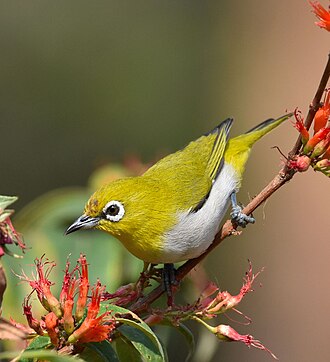
图:AshishTripurwar · CC BY-SA 4.0 · Wikimedia Commons
生命之树 › 真核生物 › 动物界 › 真后生动物亚界 › 两侧对称动物 › 后口动物总门 › 脊索动物门 › 脊椎动物亚门 › 有颌下门 › 肉鳍鱼总纲 › 四足形类 › 希望螈目 › 四足总纲 › 爬行动物 › 坚尾龙类 › 鸟纲 › 今鸟亚纲 › 今颚下纲 › 新鸟总目 › 雀形目 › 绣眼鸟科 › 绣眼鸟属
灰腹绣眼鸟种
Zosterops palpebrosus
灰腹绣眼鸟 为绣眼鸟科绣眼鸟属的鸟类,俗名绣眼鸟。分布于阿富汗、巴基斯坦、尼泊尔、锡金、印度、斯里兰卡、孟加拉、缅甸、中南半岛、菲律宾以及中国大陆的西藏、四川、云南、贵州、广西等地,一般生活环境同暗绿绣眼鸟。该物种的模式产地在印度。
摘自维基百科「灰腹绣眼鸟」,CC BY-SA 4.0
- 学名
- Zosterops palpebrosus
- 分类等级
- 种
- 英文名
- Indian White-eye
- 上级类群
- 绣眼鸟属
- 大类
- 鸟类
- 命名
- 昆拉德·雅各布·特明克,1824 年
- 保护状况(IUCN)
- 无危物种
- 数据库
- NCBI 分类 · GBIF · IUCN 红色名录
百科正文
亚种
灰腹绣眼鸟蒙自亚种(学名:Zosterops palpebrosa joannae)。该物种的模式产地在云南蒙自。
灰腹绣眼鸟西南亚种(学名:Zosterops palpebrosa siamensis)。在中国大陆,分布于西藏、四川、云南、贵州、广西等地。该物种的模式产地在缅甸Tenasserim。
以上内容摘自维基百科「灰腹绣眼鸟」,按 CC BY-SA 4.0 使用,去掉了参考文献、外部链接等尾部小节,公式改写成了纯文本。全文、配图和出处见原文。
英文维基百科补充中文条目比较短,下面是英文条目「Indian white-eye」的原文
The Indian white-eye (Zosterops palpebrosus), formerly the Oriental white-eye, is a small species of passerine bird in the white-eye family. It is a resident breeder in open woodland on the Indian subcontinent. They forage in small groups, feeding on nectar and small insects. The distinctive white eye-ring and overall yellowish upperparts easily identify them. The range previously extended eastwards to Southeast Asia, Indonesia, and Malaysia. Their name was recently changed because previous members of Zosterops palpebrosus in Southeast Asia were reclassified as a new species, making the Indian White-eye a more geographically accurate term for this species.
Taxonomy
The Indian white-eye was described by the Dutch zoologist Coenraad Jacob Temminck in 1824, based on a specimen collected in Bengal. He coined the binomial name Sylvia palpebrosa. The English and scientific names refer to the conspicuous ring of white feathers round the eyes, palpebrosus being Neo-Latin for "having prominent eyelids", from the Latin palpebrae "eyelids".
The English name of this species was changed from "Oriental white-eye" to "Indian white-eye" to more accurately reflect the geographic range following the reorganisation of the taxa with the introduction of Hume's white-eye (Zosterops auriventer), the warbling white-eye (Zosterops japonicus) and Swinhoe's white-eye (Zosterops simplex).
Description
This bird is small (about 8–9 cm long) with yellowish olive upper parts, a white eye ring, a yellow throat, and a vent. The belly is whitish-grey, but may be yellow in some subspecies. The sexes look similar. The species is widespread and belongs to a superspecies complex that includes Zosterops japonicus, Zosterops meyeni, and possibly others. The group's taxonomy is still unclear, with some island populations distinctive while others lack strong support. The population from Flores, Indonesia, for instance, is found closer to the pale white-eye. The family itself is now questioned since they are nested along with the Stachyris babblers.
About eleven subspecies are well recognised; these include the nominate form (type locality Bengal, India), which is found from Oman and Arabia to Afghanistan, northern India, and extends into China and northern Myanmar. The population in the Western Ghats and hills of southern India is placed in the nilgiriensis group. In contrast salimalii of the Eastern Ghats hills (Shevaroy, Chitteri, Seshachalam, Nallamalai) is sometimes subsumed into the nominate race. The population of the plains of India, Laccadives and Sri Lanka are sometimes placed in egregius (= egregia) but is restricted by other works to the population in Sri Lanka. The populations in southern Myanmar, Thailand and Laos are placed in siamensis.
Distribution and habitat
The species is found in a wide range of habitats from scrub to moist forest. They sometimes occur in mangrove areas, such as in the Karachi region, Pakistan, and on islands they may lead a more insectivorous life. They are somewhat rare only in the drier desert regions of western India.
A feral population was detected in San Diego, California, in the 1980s and subsequently eradicated.
Behaviour and ecology
These white-eyes are sociable, forming flocks which only separate on the approach of the breeding season. They are highly arboreal and only rarely descend to the ground. The breeding season is February to September, but April is the peak breeding season and the compact cup nest is placed like a hammock on the fork of a branch. The nest is made of cobwebs, lichens, and plant fibre. The nest is built in about 4 days, and the two pale blue eggs are laid within a couple of days of each other. The eggs hatch in about 10 days. Both sexes take care of brooding the chicks, which fledge in about 10 days.
Though mainly insectivorous, the Indian white-eye will also eat nectar and fruits of various kinds.
They call frequently as they forage, and the usual contact call is a soft nasal cheer. They pollinate flowers when they visit them for flower insects (such as thrips) and possibly nectar (questioned) that form their diet. The forehead is sometimes coloured by poll, leading to mistaken identifications. They have been observed bathing in dew accumulated on leaves.
When nesting, they may mob palm squirrels, but being small birds, they are usually on the defensive. Their predators include bats (esp. Megaderma lyra) and birds such as the white-throated kingfisher.
以上节选摘自英文维基百科「Indian white-eye」,按 CC BY-SA 4.0 使用,去掉了参考文献、外部链接等尾部小节,公式改写成了纯文本。篇幅所限,较长的小节只摘了开头一部分,有的小节没有收;全文、配图和出处见原文。