格物
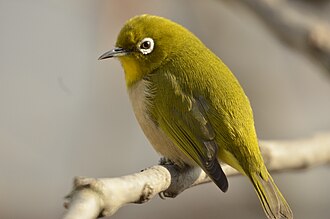
图:荒井信一 · CC BY-SA 3.0 · Wikimedia Commons
- 学名
- Zosteropidae
- 分类等级
- 科
- 上级类群
- 雀形目
- 大类
- 鸟类
- 命名
- 夏尔·吕西安·波拿巴,1853 年
- 数据库
- NCBI 分类 · GBIF
下级类群(7)

- 绣眼鸟属 Zosterops 属
- Heleia 属
- Zosterornis 属
- Rukia 属
- 冠穗鹛属 Sterrhoptilus 属
- 侏穗鹛属 Dasycrotapha 属
- Lophozosterops 属
百科正文
下属分类
- 本科包括以下属:
- 笠原绣眼鸟属 Apalopteron Bonaparte, 1854
- 绿绣眼鸟属 Chlorocharis Sharpe, 1888
- 金绣眼鸟属 Cleptornis Oustalet, 1889
- 侏穗鹛属 Dasycrotapha Tweeddale, 1878
- 大嘴绣眼鸟属 Heleia Hartlaub, 1865
- 冠绣眼鸟属 Lophozosterops Hartert, 1896
马丹绣眼鸟属 Madanga Rothschild & Hartert, 1923
帕劳绣眼鸟属 Megazosterops Stresemann, 1930
侏绣眼鸟属 Oculocincta Mees, 1953
Parayuhina Cai T, Cibois, Alström, Moyle, J.D.Kennedy, Shao S, Zhang R, Irestedt, Ericson, Gelang, Qu Y, Lei W & Fjeldså, 2019
- Parinia Hartlaub, 1857
- 拟绣眼莺属 Pseudozosterops Finsch, 1901
- 大绣眼鸟属 Rukia Momiyama, 1922
- Staphida Swinhoe, 1871
- 冠穗鹛属 Sterrhoptilus Oberholser, 1918
- 双色绣眼鸟属 Tephrozosterops Stresemann, 1931
- 裸眼绣眼鸟属 Woodfordia North, 1906
- 凤鹛属 Yuhina Hodgson, 1836
- 绣眼鸟属 Zosterops Vigors & Horsfield, 1827
- 纹穗鹛属 Zosterornis Ogilvie-Grant, 1894
以上内容摘自维基百科「绣眼鸟科」,按 CC BY-SA 4.0 使用,去掉了参考文献、外部链接等尾部小节,公式改写成了纯文本。全文、配图和出处见原文。
英文维基百科补充中文条目比较短,下面是英文条目「White-eye」的原文
The white-eyes are a family, Zosteropidae, of small passerine birds native to tropical, subtropical and temperate Sub-Saharan Africa, southern and eastern Asia, and Australasia. White-eyes inhabit most tropical islands in the Indian Ocean, the western Pacific Ocean, and the Gulf of Guinea. Discounting some widespread members of the genus Zosterops, most species are endemic to single islands or archipelagos. The silvereye, Zosterops lateralis, naturally colonised New Zealand, where it is known as the "wax-eye" or tauhou ("stranger"), from 1855. The silvereye has also been introduced to the Society Islands in French Polynesia, while the Japanese white-eye has been introduced to Hawaii.
Characteristics
White-eyes are mostly of undistinguished appearance, the plumage being generally greenish olive above, and pale grey below. Some species have a white or bright yellow throat, breast, or lower parts, and several have buff flanks. As their common name implies, many species have a conspicuous ring of tiny white feathers around their eyes. The scientific name of the group also reflects this latter feature, being derived from the Ancient Greek for "girdle-eye". They have rounded wings and strong legs. Like many other nectarivorous birds, they have slender, pointed bills, and brush-tipped tongues. The size ranges up to 15 cm (5.9 in) in length.
All the species of white-eyes are sociable, forming large flocks that only separate on the approach of the breeding season. They build trees nests and lay two to four eggs which are usually pale blue. Though mainly insectivorous, they eat nectar and fruits of various kinds. The silvereye can be a problem in Australian vineyards, by piercing the grape allowing infection or insect damage to follow.
Systematics
The family Zosteropidae was introduced (as a subfamily Zosteropinae) in 1853 by the French naturalist Charles Lucien Bonaparte. The white-eyes were long considered a distinct family Zosteropidae because they are rather homogeneous in morphology and ecology, leading to little adaptive radiation and divergence.
The genus Apalopteron, formerly placed in the Meliphagidae, was transferred to the white eyes in 1995 on genetic and behavioral evidence. It differs much in appearance from the typical white-eyes, Zosterops, but is approached by some Micronesian taxa; its color pattern is fairly unusual save the imperfect white eye-ring.
In 2003, Alice Cibois published the results of her study of mtDNA cytochrome b and 12S/16S rRNA sequence data. According to her results, the white-eyes were likely to form a clade also containing the yuhinas, which were until then placed with the Old World babblers, a large "wastebin" family. Previous molecular studies (e.g. Sibley & Ahlquist 1990, Barker et al. 2002) had together with the morphological evidence tentatively placed white-eyes as the Timaliidae's closest relatives already. But some questions remained, mainly because the white-eyes are all very similar birds in habitus and habits, while the Old World babblers are very diverse (because, as we now know, the group as formerly defined was polyphyletic).
Combined with the yuhinas (and possibly other Timaliidae), the limits of the white-eye clade to the "true" Old World babblers becomes indistinct. Therefore, the current (early 2007) opinion weighs towards merging the group into the Timaliidae, perhaps as a subfamily ("Zosteropinae"). Few white-eyes have been thoroughly studied with the new results in mind, however, and almost all of these are from Zosterops which even at this point appears over-lumped. Also, many "Old World babblers" remain in unresolved relationships. Whether there can be a clear delimitation of a white-eye subfamily or even a young or emerging family is a question that requires a more comprehensive study of both this group and Timaliidae to resolve (Jønsson & Fjeldså 2006).
For example, a revision of the yuhinas and the genus Stachyris (Cibois et al.
List of genera
- The family contains 149 species divided into 13 genera:
- Parayuhina – white-collared yuhina
- Staphida – (3 species)
- Yuhina – yuhinas (7 species)
- Dasycrotapha – babbler and pygmy babblers (3 species)
- Sterrhoptilus – babblers (4 species)
- Zosterornis – striped babblers (5 species)
- Cleptornis – golden white-eye
- Rukia – white-eyes (2 species)
- Megazosterops – giant white-eye
- Heleia – heleias (10 species)
- Apalopteron – Bonin white-eye
- Tephrozosterops – rufescent darkeye
- Zosterops – (110 species including 3 recently extinct)
以上节选摘自英文维基百科「White-eye」,按 CC BY-SA 4.0 使用,去掉了参考文献、外部链接等尾部小节,公式改写成了纯文本。篇幅所限,较长的小节只摘了开头一部分,有的小节没有收;全文、配图和出处见原文。