 格物
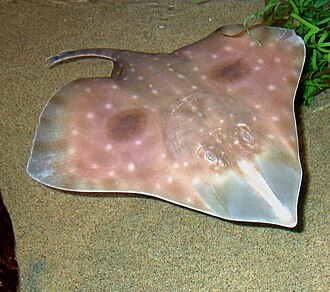
图:valerie mayers · CC BY 2.0 · Wikimedia Commons
- 学名
- Rajidae
- 分类等级
- 科
- 上级类群
- 鳐目
- 大类
- 鱼类
- 命名
- 亨利·马里·迪克罗泰·德·布兰维尔,1816 年
- 数据库
- NCBI 分类 · GBIF
下级类群(9)
百科正文
鳐科鱼生活在海底,以甲壳类动物和小鱼为食,是一种经济鱼类,但根据绿色和平,本科有数种鱼类遭受过度捕捞的危险。
鳐通常长有扁平的身体,眼睛长在头部上方,便于观测水面上的变化;嘴和鳃裂长在身体正方,便于取食海底的带壳动物。有些鳐鱼长有特别宽大的胸鳍,能像飞机一样在水面上滑行。鳐鱼的鼻子下侧长有电子感应系统。这种系统连接着鳐鱼的感觉神经细胞。多数水生动物在游动时都会产生电子信号,鳐鱼就用自身的电子感应系统搜索食物的信号,并进行捕猎。
鳐为卵生软骨鱼类。
分类
白令鳐属 Beringraja
双斑白令鳐 Beringraja binoculata (Girard, 1855):又称双斑鳐。
美白令鳐 Beringraja pulchra (Liu, 1932):又称美鳐。
洪鳐属 Hongeo
朝鲜洪鳐 Hongeo koreana (Jeong & Nakabo, 1997)
棘尾鳐属Spiniraja
怀特氏棘尾鳐 Spiniraja whitleyi (Iredale, 1938)
以上内容摘自维基百科「鳐科」,按 CC BY-SA 4.0 使用,去掉了参考文献、外部链接等尾部小节,公式改写成了纯文本。全文、配图和出处见原文。
英文维基百科补充中文条目比较短,下面是英文条目「Skate (fish)」的原文
Skates are cartilaginous fish belonging to the family Rajidae in the superorder Batoidea of rays. More than 150 species have been described, in 17 genera. Softnose skates and pygmy skates were previously treated as subfamilies of Rajidae (Arhynchobatinae and Gurgesiellinae), but are now considered as distinct families. Alternatively, the name "skate" is used to refer to the entire order of Rajiformes (families Anacanthobatidae, Arhynchobatidae, Gurgesiellidae and Rajidae).
Members of Rajidae are distinguished by a stiff snout and a rostrum that is not reduced.
Taxonomy and systematics
Evolution
Skates belong to the ancient lineage of cartilaginous fishes. Fossil denticles (tooth-like scales in the skin) resembling those of today's chondrichthyans date at least as far back as the Ordovician, with the oldest unambiguous fossils of cartilaginous fish dating from the middle Devonian. A clade within this diverse family, the Neoselachii, emerged by the Triassic, with the best-understood neoselachian fossils dating from the Jurassic. This clade is represented today by sharks, sawfish, rays and skates.
The body plan of skates is caused by skate-specific genomic rearrangements that have altered the three-dimensional regulatory landscape of genes.
Description
General Batoidea characteristics
Skates are cartilaginous fishes like other Chondrichthyes, however, skates, like rays and other Rajiformes, have a flat body shape with flat pectoral fins that extend the length of their body. This structure creates power for forward propulsion, providing the emergence swimming capabilities that enabled skates to colonize the sea floor.
A large portion of the skate's dorsal body is covered by rough skin made of placoid scales. Placoid scales have a pointed tip that is oriented caudally and are homologous to teeth. Their mouths are located on the underside of the body, with a jaw suspension common to Batoids known as euhyostyly.
Distribution and habitats
Skates are primarily found from the intertidal down to depths greater than 3,000 m (9,843 ft). They are most commonly found along outer continental shelves and upper slopes. They are typically more diverse at higher latitudes and in deep-water. In fact, skates are the only cartilaginous fish taxon to exhibit more diversity of species at higher latitudes. A cool, temperate to polar water in the deep sea can be a favorable environment for skates. As the water becomes more shallow and warmer, skates are seen to be replaced by stingrays. Skates are absent from brackish and freshwater environments. However, there is a single estuarine species that has been found in Tasmania, Australia.
Behavior and ecology
Reproduction
Skates mate at the same nursery ground each year. In order to fertilize the egg, males use claspers, a structure attached to the pelvic fins. The claspers allow them to direct the flow of semen into the female's cloaca. Skates are oviparous, meaning they lay eggs with very little development in the mother. This is one major difference from rays, which are viviparous, meaning they give birth to live young. When a female skate is fertilized, a protected case forms around the embryo called an egg case, or more commonly mermaid's purse. This egg case is then deposited out of the mother's body onto the ocean floor where the skates develop for up to 15 months before they enter the external environment.
Skates versus stingrays
Skates are like stingrays in that they have five pairs of gill slits that are located ventrally, which means on the underside of their body (unlike sharks that have their gills located on their sides). Skates and rays both have pectoral fins that are flat and expanded, which are typically fused to the head. Both skates and stingrays typically have their eyes on top of their head. Skates also share similar feeding habits with rays.
Skates are different from rays in that they lack a whip-like tail and stinging spines. However, some skates have electric organs located in their tail. The main difference between skates and rays is that skates lay eggs, whereas rays give birth to live young.
Conservation
Skates have slow growth rates and, since they mature late, low reproductive rates. As a result, skates are vulnerable to overfishing and appear to have been overfished and are suffering reduced population levels in many parts of the world.
As food
Like stingrays, skates are also used as food source in various types of dishes.
以上节选摘自英文维基百科「Skate (fish)」,按 CC BY-SA 4.0 使用,去掉了参考文献、外部链接等尾部小节,公式改写成了纯文本。篇幅所限,较长的小节只摘了开头一部分,有的小节没有收;全文、配图和出处见原文。