格物

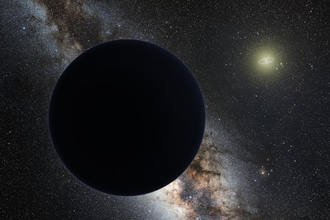
图:NASA/JHU-APL/SwRI/Roman Tkachenko · Public domain · Wikimedia Commons
- 类型
- 冥王星的卫星
- 发现 / 发明时间
- 2005 年
- 发现者 / 提出者
- 阿兰·斯特恩、哈勃空间望远镜
- 命名来源
- 倪克斯
- 属于
- Pluto System
- 学科
- 物理学
相关科学家
百科正文
2005年5月首次被冥王星伴侣搜索队通过哈勃太空望远镜观测到。其照片于2005年5月15日和2005年5月18日被哈勃望远镜拍摄到;2005年5月15日Max J. Mutchler经确认和预估后,于2005年10月31日公布卫星发现的消息,初被编号为S/2005 P2,于2006年6月下旬的国际天文学联合会会议上正式被命名为Nix(尼克斯,希腊神话中代表黑夜的女神)(原本建议命名为Nyx,但是为了不和小行星3908(Nyx)混淆,所以把它命名为与Nyx同音的Nix),名字以2006年1月启程飞往冥王星的新视野号(New Horizons)探测器名字的首个字母为概念。
观测显示其与冥卫一(卡戎)类似,轨道半径49,000公里,以25天周期绕冥王星运转;估计其直径在31-50公里之间(依反照率判定将可研判出更精确的数据)。冥卫二比冥卫三暗25%,所以可能也比较小。
初时研究时认为冥卫二和冥王星一样是红色的,后来才发现冥卫二和其他两颗卫星一样是灰色的。
根据观察,冥卫二并没有稳定的自转(自转一周大约1.829天)。
以上内容摘自维基百科「冥卫二」,按 CC BY-SA 4.0 使用,去掉了参考文献、外部链接等尾部小节,公式改写成了纯文本。全文、配图和出处见原文。
英文维基百科补充中文条目比较短,下面是英文条目「Nix (moon)」的原文
Nix, formal designation (134340) Pluto II, is a natural satellite of Pluto, with a diameter of 49.8 km (30.9 mi) across its longest dimension. It was discovered along with Pluto's outermost moon Hydra on 15 May 2005 by astronomers using the Hubble Space Telescope, and was named after Nyx, the Greek goddess of the night. Nix is the third moon of Pluto by distance, orbiting between the moons Styx and Kerberos.
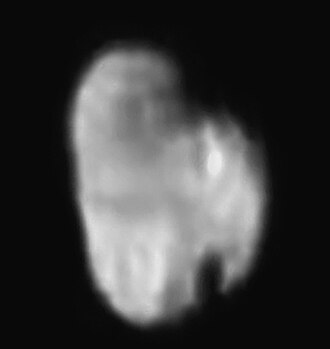
Nix was imaged along with Pluto and its other moons by the New Horizons spacecraft as it flew by the Pluto system in July 2015. These images reveal a large reddish area on Nix that is likely an impact crater.
Discovery
Nix was independently discovered by Max Mutchler and Andrew Steffl, members of the Pluto Companion Search Team, using the Hubble Space Telescope. The New Horizons team had suspected that Pluto and its moon Charon might be accompanied by other moons, hence they used Hubble to search for faint moons around Pluto in 2005. Since Nix's brightness is about 5,000 times fainter than Pluto, long exposure images were taken in order to find it.
The discovery images were taken on 15 May 2005 and 18 May 2005. The discoveries were announced on 31 October 2005, after confirmation by precovering archival Hubble images of Pluto from 2002.
Naming
The name Nix was approved by the International Astronomical Union (IAU) and was announced on 21 June 2006 along with the naming of Hydra in the IAU Circular 8723. Nix was named after Nyx, the Greek goddess of darkness and night and mother of Charon, the ferryman of Hades in Greek mythology. The two newly named moons were intentionally named that the order of their initials N and H honors the New Horizons mission to Pluto, similarly to how the first two letters of Pluto's name honors Percival Lowell.
Origin
Pluto's smaller moons, including Nix, were thought to have formed from debris ejected from a massive collision between Pluto and another Kuiper belt object, similarly to how the Moon is believed to have formed from debris ejected by a large collision of Earth. The ejecta from the collision would then have coalesced into the moons of Pluto. However, the collisional hypothesis cannot explain how Nix maintained its highly reflective surface.
Physical characteristics
Nix has an elongated shape, with its longest axis measured at 49.8 km (30.9 mi) across and its shortest axis 31.1 km (19.3 mi) across. This gives Nix the measured dimensions of 49.8 km × 33.2 km × 31.1 km (30.9 mi × 20.6 mi × 19.3 mi). It is the third-largest moon of Pluto, being slightly smaller than Hydra.
Early research appeared to show that the surface of Nix is reddish in color. Contrary to this, other studies show that Nix is spectrally neutral, similar to the small moons of Pluto. The neutral spectrum of Nix signifies that water ice is present on its surface. Nix also appeared to vary in brightness and albedo, or reflectivity.
Orbit
Nix orbits the Pluto–Charon barycenter at a distance of 48,694 km (30,257 mi), between the orbits of Styx and Kerberos. All of Pluto's moons including Nix have very circular orbits that are coplanar to Charon's orbit; the moons of Pluto have very low orbital inclinations to Pluto's equator. The nearly circular and coplanar orbits of Pluto's moons suggest that they may have gone through tidal evolutions since their formation. At the time of the formation of Pluto's smaller moons, Nix may have had a more eccentric orbit around the Pluto–Charon barycenter.
Exploration
The New Horizons spacecraft visited the Pluto system and photographed Pluto and its moons during its flyby on 14 July 2015. Of Pluto's smaller moons, only Nix and Hydra were imaged at resolutions high enough for surface features to be visible. Prior to the flyby of the Pluto system, measurements of Nix's size were performed by the Long Range Reconnaissance Imager on board New Horizons, initially estimating Nix to be about 35 km (22 mi) in diameter. The first detailed images of Nix taken by New Horizons from a distance of about 231,000 km (144,000 mi) were downlinked, or received from the spacecraft on 18 July 2015 and released to the public on 21 July 2015.
以上节选摘自英文维基百科「Nix (moon)」,按 CC BY-SA 4.0 使用,去掉了参考文献、外部链接等尾部小节,公式改写成了纯文本。篇幅所限,较长的小节只摘了开头一部分,有的小节没有收;全文、配图和出处见原文。