格物
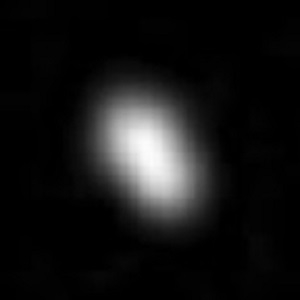
图:NASA/JHUAPL/SwRI · Public domain · Wikimedia Commons
- 类型
- 冥王星的卫星
- 发现 / 发明时间
- 2012 年
- 发现者 / 提出者
- 马克·R·肖沃尔特
- 命名来源
- 斯堤克斯
- 属于
- Pluto System
- 学科
- 天文学
相关科学家
百科正文
发现
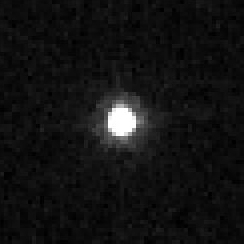
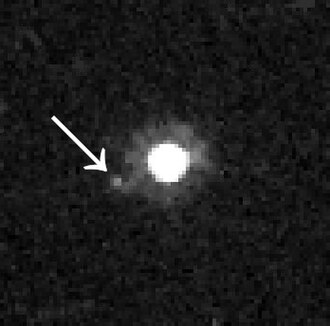
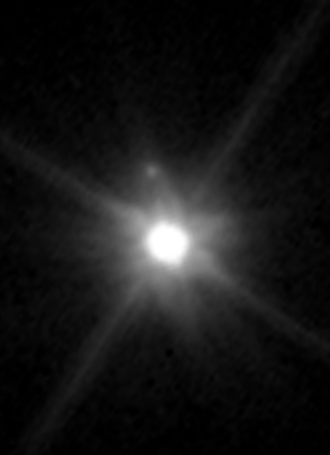
哈勃空间望远镜上装有的第三代广域照相机在2012年6月26日至7月9日间拍摄了九组照片,天文学家从这些照片发现了这颗卫星。这些照片原本为新视野号对冥王星的探测而准备,当时该飞船正在飞往冥王星,并预计在2015年7月14日飞过冥王星系统。人们不由得担忧,该区域可能隐藏着更多的难以观测到的小天体,高速穿越此区域的新视野号可能与这些未知小天体碰撞。
物理性质
据估计,该卫星的上下边缘大约为0.04,反照率大约为0.35。再结合视星等,这颗卫星直径在10公里至25公里之间。
轨道参数
冥卫五的公转周期约为20.2天,这说明它与冥卫一—冥王星体系处于大约5.4%的1:3共振。加上冥王星的其他卫星——冥卫二、冥卫四和冥卫三,它们形成了部分1:3:4:5:6共振的近心点进动。
起源
据推测,环绕冥王星的复杂卫星系统是冥王星与另一个柯伊伯带天体在很久以前碰撞的结果。冥王星的卫星可能是这样的相撞事件的残骸所形成的,这与月球形成的大碰撞说类似。轨道共振可能使残骸中聚集物质形成了卫星。
以上内容摘自维基百科「冥卫五」,按 CC BY-SA 4.0 使用,去掉了参考文献、外部链接等尾部小节,公式改写成了纯文本。全文、配图和出处见原文。
英文维基百科补充中文条目比较短,下面是英文条目「Styx (moon)」的原文
Styx, formal designation (134340) Pluto V, is a small natural satellite of Pluto whose discovery was announced on 11 July 2012. It was discovered by use of the Hubble Space Telescope, and is the smallest of the five known moons of Pluto. It was imaged along with Pluto and Pluto's other moons by the New Horizons spacecraft in July 2015, albeit poorly with only a single image of Styx obtained.
Styx is the second-closest known satellite to Pluto, and the fifth discovered. It was discovered one year after Kerberos. Styx is approximately 16 km (9.9 mi) across its longest dimension, and its orbital period is 20.1 days.
Discovery and observations
Styx was discovered by a team led by astronomer Mark R. Showalter, using fourteen sets of images taken between 26 June and 9 July 2012 by the Wide Field Camera 3 fitted to the Hubble. The discovery was announced on 11 July 2012. Styx is about half as bright as the dimmest previously known object in the system, Kerberos, and about one hundred thousandth as bright as Pluto. It was designated S/2012 (134340) 1, and informally referred to as P5.
The survey work leading to the discovery of Styx was in preparation for the mission of the uncrewed New Horizons spacecraft, which flew by the Pluto system on 14 July 2015. The discovery of another small Plutonian moon heightened concerns that this region of space may harbor more bodies too small to be detected, and that the spacecraft could be damaged by an uncharted body or planetary ring as it traversed the system at a speed of over 13 km/s.
Origin
The unexpectedly complex moon system around Pluto may be the result of a collision between Pluto and another sizable Kuiper belt object in the distant past. Pluto's moons may have coalesced from the debris from such an event, similar to the early giant impact thought to have created the Earth's Moon. The orbital resonances may have acted as "ruts" to gather material from the collision.
Physical characteristics
Styx was originally estimated to have a diameter of between 10 and 25 km (6.2 and 15.5 mi). These figures were inferred from the apparent magnitude of Styx and by using an estimated albedo of 0.35 and 0.04 for the lower and upper bounds, respectively. Measurements made by New Horizons found an elongated shape with dimensions measuring approximately 16 km × 9 km × 8 km (9.9 mi × 5.6 mi × 5.0 mi). It is thought to have formed from the debris lofted by a collision, which would have led to losses of the more volatile ices, such as those of nitrogen and methane, in the composition of the impactors. This process is expected to have created a body consisting mainly of water ice.
Orbit
Styx orbits the Pluto–Charon barycenter at a distance of 42,656 km, putting it between the orbits of Charon and Nix. All of Pluto's moons appear to travel in orbits that are very nearly circular and coplanar, described by Styx's discoverer Mark Showalter as "neatly nested... a bit like Russian dolls".
Its orbital period of 20.16155 days is about 5.0% from a 1:3 mean-motion resonance with the Charon–Pluto orbital period of 6.387 days. With the other moons Nix, Kerberos, and Hydra, it forms part of an unusual 1:3:4:5:6 (period ratio) sequence of near resonances. In contrast to the orbit, Stygian rotation is chaotic; like the other small Plutonian moons, Styx is not tidally locked, and its rotation varies over short timescales (at a rate of about 3.239 days at the time of the New Horizons flyby).
Naming
Before any of Pluto's moons were discovered, author Edmond Hamilton referred to three moons of Pluto in his 1940 science fiction novel Calling Captain Future, naming them Charon, Styx, and Cerberus.
Upon discovery, Styx received the minor planet designation S/2012 (134340) 1 because it was the first satellite (S) discovered orbiting the minor planet 134340 Pluto in 2012. It is known informally as "P5", meaning the fifth Plutonian moon to be discovered. The designation S/2012 P 1 has sometimes been used, following the pre-2006 format where Pluto was still considered a planet and given its own single-letter abbreviation.
The convention for naming Plutonian moons is to use names associated with the god Pluto in classical mythology. To decide on names for P4 and P5, Mark Showalter and the SETI Institute, on behalf of the discovery team, conducted a non-binding internet poll in 2013, in which the general public was invited to vote for their favorite names.
以上节选摘自英文维基百科「Styx (moon)」,按 CC BY-SA 4.0 使用,去掉了参考文献、外部链接等尾部小节,公式改写成了纯文本。篇幅所限,较长的小节只摘了开头一部分,有的小节没有收;全文、配图和出处见原文。