格物
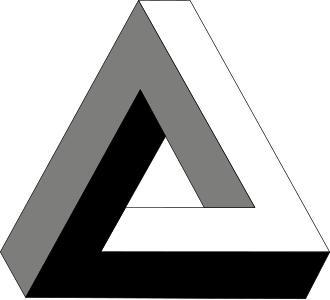
图:Tobias R. – Metoc · Public domain · Wikimedia Commons
- 类型
- 不可能的几何物体、数学概念
- 发现 / 发明时间
- 1934 年
- 发现者 / 提出者
- 奥斯卡·路透斯沃德、莱昂内尔·彭罗斯、罗杰·彭罗斯
- 命名来源
- 莱昂内尔·彭罗斯、罗杰·彭罗斯
- 研究学科
- 立体几何
- 学科
- 生物学、物理学
- 上级概念
- 不可能的几何物体、形状
相关科学家
百科正文
彭罗斯三角看起来像是一个固体,由三个截面为正方形的长方体所构成,三个长方体组合成为一个三角形,但两长方体之间的夹角似乎又是直角。上述的性质无法在任何一个正常三维空间的物体上实现。这种物件只能存在于一些特定的欧氏三维流形中。
彭罗斯三角虽然是不可能的物体,但是确实存在有三维物体,若在特定的角度下观看时,其看到的图案和彭罗斯三角的二维图案相同。彭罗斯三角可以指不可能的物体本身,也可以指其二维下的图案。
荷兰艺术家莫里茨·科内利斯·埃舍尔的版画瀑布描绘了一个沿着二个拉长的彭罗斯三角边上曲折行进的水道,水道结束时的高度比原来的高度高二层楼,水最后形成瀑布,也是二个彭罗斯三角的短边,再由瀑布驱动水车旋转。
其他彭罗斯多边形
可以依类似彭罗斯三角的方式创建其他的正多边形,不过视觉上的冲击效果不如彭罗斯三角,当边数较多时,多边形看起来只是像是由扭转过的梁所构成。
以上内容摘自维基百科「潘洛斯三角」,按 CC BY-SA 4.0 使用,去掉了参考文献、外部链接等尾部小节,公式改写成了纯文本。全文、配图和出处见原文。
英文维基百科补充中文条目比较短,下面是英文条目「Penrose triangle」的原文
The Penrose triangle, also known as the Penrose tribar, the impossible tribar, or the impossible triangle, is a triangular impossible object, an optical illusion consisting of an object that can be depicted in a perspective drawing. It cannot exist as a solid object in ordinary three-dimensional Euclidean space, although its surface can be embedded isometrically (bent but not stretched) in five-dimensional Euclidean space. It was first created by the Swedish artist Oscar Reutersvärd in 1934. Independently from Reutersvärd, the triangle was devised and popularized in the 1950s by psychiatrist Lionel Penrose and his son, the mathematician and Nobel Prize laureate Roger Penrose, who described it as "impossibility in its purest form". It is featured in the lithograph Waterfall (1961) by artist M. C. Escher, whose earlier depictions of impossible objects partly inspired it.
Description
The tribar/triangle appears to be a solid object, made of three straight beams of square cross-section that meet pairwise at right angles at the vertices of the triangle they form. The beams may be broken, forming cubes or cuboids.
This combination of properties cannot be realized by any three-dimensional object in ordinary Euclidean space. Such an object can exist in certain Euclidean 3-manifolds. A surface with the same geodesic distances as the depicted surface of the tribar, but without its flat shape and right angles, are to be preserved, can also exist in 5-dimensional Euclidean space, which is the lowest-dimensional Euclidean space within which this surface can be isometrically embedded. There also exist three-dimensional solid shapes each of which, when viewed from a certain angle, appears the same as the 2-dimensional depiction of the Penrose triangle, such as the sculpture "Impossible Triangle" in East Perth, Western Australia The term "Penrose Triangle" can refer to the 2-dimensional depiction or the impossible object.
If a line is traced around the Penrose triangle, a 4-loop Möbius strip is formed.
Creation of the Penrose triangle from partial figures
If the left part of the figure is moved parallel to the right until its upper horizontal edge coincides with the upper horizontal edge of the middle part of the figure, the Penrose triangle (right) is created by overlapping the two parts.
The first two partial views of the Penrose triangle are individually perceptible, whereas the resulting tribar represents an impossible figure.
Depictions
M. C. Escher's lithograph Waterfall (1961) depicts a watercourse that flows in a zigzag along the long sides of two elongated Penrose triangles, so that it ends up two stories higher than it began. The resulting waterfall, forming the short sides of both triangles, drives a water wheel. Escher points out that in order to keep the wheel turning, some water must occasionally be added to compensate for evaporation. A third Penrose triangle lies between the other two, formed by two segments of waterway and a support tower.
以上内容摘自英文维基百科「Penrose triangle」,按 CC BY-SA 4.0 使用,去掉了参考文献、外部链接等尾部小节,公式改写成了纯文本。全文、配图和出处见原文。