格物
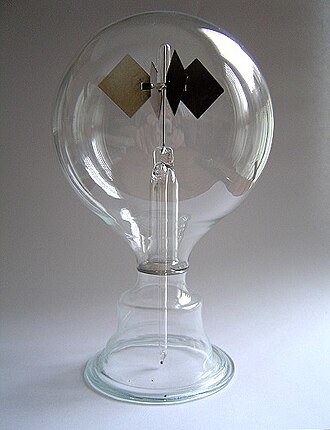
图:The original uploader was Timeline at English Wikipedia. · CC BY-SA 3.0 · Wikimedia Commons
- 发现 / 发明时间
- 1873 年
- 发现者 / 提出者
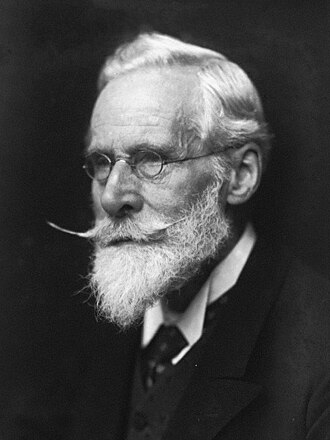
- 威廉·克鲁克斯
- 命名来源
- 威廉·克鲁克斯
- 学科
- 物理学
- 上级概念
- 办公室玩具、辐射计
相关科学家
百科正文
光能辐射计是英国化学家威廉·克鲁克斯在1873年进行一些化学研究时顺带发明的。当他要非常精确的定量化学工作,在真空箱中称重样品时,注意到只要有光线照射到天平,称量就会不稳定。为了研究这个现象,克鲁克斯创造了这个以他命名的设置。光能辐射计是发明之后的前十年内,科学界曾经对叶片旋转的原因有过辩论,直到1879年才出现了目前公认的旋转解释。今日,此设备主要用于物理教育,作为光能运行的热机的演示。
基本介绍
辐射计由一个玻璃灯泡制成,抽去大部分空气形成部分真空。 灯泡内部,在低摩擦的主轴上,安装数个(通常为四个)垂直的轻质金属叶片转子,围绕轴线均匀间隔。所有叶片一侧是抛光或白色的,另一侧是黑色的。
当暴露于阳光、人工光源或红外线(即使手放在附近的热量也可能足够)时,叶片会缓缓转动。暗面远离辐射源,亮面靠近辐射源。冷却辐射计时则旋转方向会相反。
奈米级太阳风车
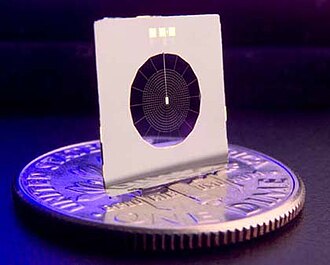
2010年,加州大学柏克莱分校的研究人员成功地建立了一个奈米尺度的太阳风车,运作原理与克鲁克斯辐射计完全不同。一个直径仅为100奈米的金太阳风车,由已调谐的激光照射。通过入射光与金结构中表面等离子体的共振耦合,大大提高了转动力矩。普林斯顿大学物理学家理查德·贝思(Richard Beth)曾在1936年提出过这种可能性。
以上内容摘自维基百科「光能輻射計」,按 CC BY-SA 4.0 使用,去掉了参考文献、外部链接等尾部小节,公式改写成了纯文本。全文、配图和出处见原文。
英文维基百科补充中文条目比较短,下面是英文条目「Crookes radiometer」的原文
The Crookes radiometer (also known as a light mill) consists of an airtight glass bulb containing a partial vacuum, with a set of vanes which are mounted on a spindle inside. The vanes rotate when exposed to light, with faster rotation for more intense light, providing a quantitative measurement of electromagnetic radiation intensity.
The reason for the rotation was a cause of much scientific debate in the ten years following the invention of the device, but in 1879 the currently accepted explanation for the rotation was published. Today the device is mainly used in physics education as a demonstration of a heat engine run by light energy.
It was invented in 1873 by the chemist Sir William Crookes as the by-product of some chemical research. In the course of very accurate quantitative chemical work, he was weighing samples in a partially evacuated chamber to reduce the effect of air currents, and noticed the weighings were disturbed when sunlight shone on the balance. Investigating this effect, he created the device named after him.
It is still manufactured and sold as an educational aid or for curiosity.
General description
The radiometer is made from a glass bulb from which much of the air has been removed to form a partial vacuum. Inside the bulb, on a low-friction spindle, is a rotor with several (usually four) vertical lightweight vanes spaced equally around the axis. The vanes are polished or white on one side and black on the other.
Thermodynamic explanation
Movement with absorption
When a radiant energy source is directed at a Crookes radiometer, the radiometer becomes a heat engine. The operation of a heat engine is based on a difference in temperature that is converted to a mechanical output. In this case, the black side of the vane becomes hotter than the other side, as radiant energy from a light source warms the black side by absorption faster than the silver or white side.
Explanations for the force on the vanes
Incorrect theories
Crookes incorrectly suggested that the force was due to the pressure of light. This theory was originally supported by James Clerk Maxwell, who had predicted this force. This explanation is still often seen in leaflets packaged with the device. The first experiment to test this theory was done by Arthur Schuster in 1876, who observed that there was a force on the glass bulb of the Crookes radiometer that was in the opposite direction to the rotation of the vanes.
All-black light mill
To rotate, a light mill does not have to be coated with different colors across each vane. In 2009, researchers at the University of Texas, Austin created a monocolored light mill which has four curved vanes; each vane forms a convex and a concave surface. The light mill is uniformly coated by gold nanocrystals, which are a strong light absorber.
Horizontal vane light mill
The thermal creep from the hot side of a vane to the cold side has been demonstrated in a mill with horizontal vanes that have a two-tone surface with a black half and a white half. This design is called a Hettner radiometer. This radiometer's angular speed was found to be limited by the behavior of the drag force due to the gas in the vessel more than by the behavior of the thermal creep force.
Nanoscale light mill
In 2010 researchers at the University of California, Berkeley, succeeded in building a nanoscale light mill that works on an entirely different principle to the Crookes radiometer. A gold light mill, only 100 nanometers in diameter, was built and illuminated by laser light that had been tuned. The possibility of doing this had been suggested by the Princeton physicist Richard Beth in 1936.
Practical applications
The radiometric effect has not been often used for practical applications. Marcel Bétrisey made in 2001 two different clocks (Le Chronolithe and Conti) powered by the light. Their pendulums had bulb lamps located outside the glass dôme and pointing against 4 mica vanes. One meter pendulum gives one second, two lamps placed in either side light up alternately, thus "pushing" the 4 kilos pendulum each time.
以上节选摘自英文维基百科「Crookes radiometer」,按 CC BY-SA 4.0 使用,去掉了参考文献、外部链接等尾部小节,公式改写成了纯文本。篇幅所限,较长的小节只摘了开头一部分,有的小节没有收;全文、配图和出处见原文。