格物
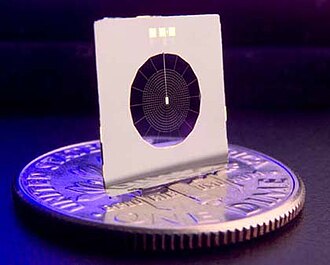
图:NASA/JPL-Caltech · Public domain · Wikimedia Commons
辐射热测量计1878
bolometer
device for measuring the power of incident electromagnetic radiation via the heating of a material with a temperature-dependent electrical resistance
辐射热测量计是一种物体测量辐射热量的传感器。
简明原理: 吸收光的辐射功率 → 温度升高 → 改变电阻大小。
特点:该仪器具有很高的灵敏性。相对于其他辐射探测器(比如光电管及光电二极管)而言,辐射热测量计具有比较高的带宽,以及对比较难或者未知的射线的探测(比如远红外射线和太赫射线)
摘自维基百科「辐射热测量计」,CC BY-SA 4.0
- 发现 / 发明时间
- 1878 年
- 发现者 / 提出者
- 塞缪尔·兰利
- 学科
- 物理学
- 上级概念
- 测量仪器
- 用途
- 全波段校正
相关科学家

百科正文
常用有两种:
黑球温度计:利用黑体吸收辐射热量最强的原理,用一个涂黑色的空心铜球和一支插在铜球中心的温度计构成;测定时悬挂在测点,大约15分钟后可读出稳定读数,同时测定同一地点的气温和风向,可算出平均辐射热强度。
热电偶单向辐射热计:可测定来自一个方向的辐射热强度;仪器背面有棋盘形黑白相间铝箱制成的辐射热接收体,其后固定有240对康铜热电偶,仪器正面为电流表。
以上内容摘自维基百科「辐射热测量计」,按 CC BY-SA 4.0 使用,去掉了参考文献、外部链接等尾部小节,公式改写成了纯文本。全文、配图和出处见原文。
英文维基百科补充中文条目比较短,下面是英文条目「Bolometer」的原文
A bolometer is a device for measuring radiant heat by means of a material having a temperature-dependent electrical resistance. It was invented in 1878 by the American astronomer Samuel Pierpont Langley.
Principle of operation
A bolometer consists of an absorptive element, such as a thin layer of metal, connected to a thermal reservoir (a body of constant temperature) through a thermal link. The result is that any radiation impinging on the absorptive element raises its temperature above that of the reservoir – the greater the absorbed power, the higher the temperature.
Langley's bolometer
The first bolometers made by Langley consisted of two steel, platinum, or palladium foil strips covered with lampblack. One strip was shielded from radiation and one exposed to it. The strips formed two branches of a Wheatstone bridge which was fitted with a sensitive galvanometer and connected to a battery. Electromagnetic radiation falling on the exposed strip would heat it and change its resistance. By 1880, Langley's bolometer was refined enough to detect thermal radiation from a cow a quarter of a mile (400 m) away.
Applications in astronomy
While bolometers can be used to measure radiation of any frequency, for most wavelength ranges there are other methods of detection that are more sensitive. For sub-millimeter wavelengths through millimeter wavelengths (from around 200 μm to a few mm wavelength, also known as the far-infrared, terahertz) bolometers are among the most sensitive available detectors, and are therefore used for astronomy at these wavelengths.
Applications in particle physics
The term bolometer is also used in particle physics to designate an unconventional particle detector. They use the same principle described above. The bolometers are sensitive not only to light but to every form of energy.
The operating principle is similar to that of a calorimeter in thermodynamics. However, the approximations, ultra low temperature, and the different purpose of the device make the operational use rather different.
Applications in plasma physics
Bolometers play a pivotal role in monitoring radiation in fusion plasmas. The Wendelstein 7-X (W7-X) stellarator employs a two-camera bolometer system to capture plasma radiation. This setup is optimized to identify 2D radiation distributions within a symmetrical triangular plasma cross-section. Recent progress includes the refinement of a tomographic reconstruction algorithm, which leans on the principle of relative gradient smoothing (RGS) of emission profiles.
Microbolometers
A microbolometer is a specific type of bolometer used as a detector in a thermal camera. It is a grid of vanadium oxide or amorphous silicon heat sensors atop a corresponding grid of silicon. Infrared radiation from a specific range of wavelengths strikes the vanadium oxide or amorphous silicon, and changes its electrical resistance. This resistance change is measured and processed into temperatures which can be represented graphically.
Hot electron bolometer
The hot electron bolometer (HEB) operates at cryogenic temperatures, typically within a few degrees of absolute zero. At these very low temperatures, the electron system in a metal is weakly coupled to the phonon system. Power coupled to the electron system drives it out of thermal equilibrium with the phonon system, creating hot electrons. Phonons in the metal are typically well-coupled to substrate phonons and act as a thermal reservoir.
Microwave measurement
A bolometer can be used to measure power at microwave frequencies. In this application, a resistive element is exposed to microwave power. A DC bias current is applied to the resistor to raise its temperature via Joule heating, such that the resistance is matched to the waveguide characteristic impedance. After applying microwave power, the bias current is reduced to return the bolometer to its resistance in the absence of microwave power. The change in the dc power is then equal to the absorbed microwave power.
以上节选摘自英文维基百科「Bolometer」,按 CC BY-SA 4.0 使用,去掉了参考文献、外部链接等尾部小节,公式改写成了纯文本。篇幅所限,较长的小节只摘了开头一部分,有的小节没有收;全文、配图和出处见原文。