格物
- 发现 / 发明时间
- 1882 年
- 发现者 / 提出者
- 菲利克斯·克莱因
- 命名来源
- 菲利克斯·克莱因
- 学科
- 物理学
- 上级概念
- 面、Dianalytic流形、one-sided surface
相关科学家

百科正文
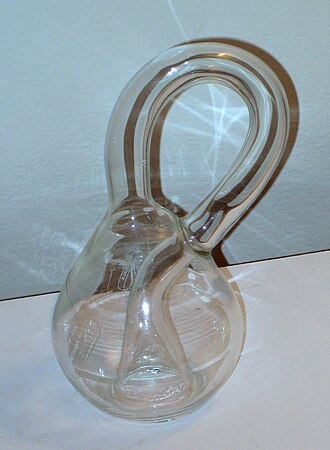
要想像克莱因瓶的结构,可先试想一个底部镂空的红酒瓶。现在延长其颈部,向外扭曲后伸进瓶子的内部,再与底部的洞相连接。
和我们平时用来喝水的杯子不一样,这个物体没有“边”,它的表面不会终结。它也不类似于气球,一只苍蝇可以从瓶子的内部直接飞到外部而不用穿过表面(所以说它没有内外部之分)。
其名称可能源自德语中的“Kleinsche Fläche”(克莱因平面),后来被误解为“Kleinsche Flasche”(克莱因瓶)。德语最终也沿用了“克莱因瓶”这种称呼。
性质
从拓扑学角度上看,克莱因瓶可以定义为[0,1] × [0,1]的矩阵,边定义为(0,y) ~ (1,y),其中0 ≤ y ≤ 1;和(x,0) ~ (1-x,1),其中0 ≤ x ≤ 1。
可以用图表示为
就像莫比乌斯带一样,克莱因瓶是不可定向的。但是与之不同的是,克莱因瓶是一个闭合的曲面,也就是说它没有边界。莫比乌斯带可以嵌入到三维或更高维的欧几里得空间,克莱因瓶只能嵌入到于四维或更高维空间。
参数方程模型
克莱因瓶的参数十分复杂: (公式略)
还有一个较简单的 (公式略)
以上内容摘自维基百科「克莱因瓶」,按 CC BY-SA 4.0 使用,去掉了参考文献、外部链接等尾部小节,公式改写成了纯文本。全文、配图和出处见原文。
英文维基百科补充中文条目比较短,下面是英文条目「Klein bottle」的原文
In mathematics, the Klein bottle is an example of a surface with no distinct inside or outside. In other words, it is a one-sided surface which, if traveled upon, could be followed back to the point of origin while flipping the traveler upside down. More formally, it is an example of a non-orientable surface, a two-dimensional manifold on which one cannot define a consistent direction perpendicular to the surface (normal vector) that varies continuously over the whole shape. It is named for Felix Klein, who first described it in 1882.
The Klein bottle is related to other non-orientable surfaces like the Möbius strip, which also has only one side but does have a boundary. In contrast, the Klein bottle is boundaryless, like a sphere or torus, though it cannot be embedded in ordinary three-dimensional space without intersecting itself.
Construction
The following square is a fundamental polygon of the Klein bottle. The idea is to 'glue' together the corresponding red and blue edges with the arrows matching, as in the diagrams below. Note that this is an "abstract" gluing, in the sense that trying to realize this in three dimensions results in a self-intersecting Klein bottle.
To construct the Klein bottle, glue the red arrows of the square together (left and right sides), resulting in a cylinder. To glue the ends of the cylinder together so that the arrows on the circles match, one would pass one end through the side of the cylinder.
Properties
Like the Möbius strip, the Klein bottle is a two-dimensional manifold which is not orientable. Unlike the Möbius strip, it is a closed manifold, meaning it is a compact manifold without boundary. While the Möbius strip can be embedded in three-dimensional Euclidean space R3, the Klein bottle cannot. It can be embedded in R4, however.
Dissection
Dissecting a Klein bottle into halves along its plane of symmetry results in two mirror image Möbius strips, i.e. one with a left-handed half-twist and the other with a right-handed half-twist (one of these is pictured on the right). Remember that the intersection pictured is not really there.
Simple-closed curves
One description of the types of simple-closed curves that may appear on the surface of the Klein bottle is given by the use of the first homology group of the Klein bottle calculated with integer coefficients. This group is isomorphic to Z×Z2. Up to reversal of orientation, the only homology classes which contain simple-closed curves are as follows: (0,0), (1,0), (1,1), (2,0), (0,1).
Parametrization
The figure 8 immersion
To make the "figure 8" or "bagel" immersion of the Klein bottle, one can start with a Möbius strip and curl it to bring the edge to the midline; since there is only one edge, it will meet itself there, passing through the midline. It has a particularly simple parametrization as a "figure-8" torus with a half-twist: (公式略)
In this immersion, the self-intersection circle (where sin(v) is zero) is a geometric circle in the xy plane. The positive constant r is the radius of this circle.
Homotopy classes
Regular 3D immersions of the Klein bottle fall into three regular homotopy classes.
- The three are represented by:
- the "traditional" Klein bottle;
- the left-handed figure-8 Klein bottle;
the right-handed figure-8 Klein bottle.
The traditional Klein bottle immersion is achiral. The figure-8 immersion is chiral. (The pinched torus immersion above is not regular, as it has pinch points, so it is not relevant to this section.)
If the traditional Klein bottle is cut in its plane of symmetry it breaks into two Möbius strips of opposite chirality.
Generalizations
The generalization of the Klein bottle to higher genus is given in the article on the fundamental polygon.
In another order of ideas, constructing 3-manifolds, it is known that a solid Klein bottle is homeomorphic to the Cartesian product of a Möbius strip and a closed interval. The solid Klein bottle is the non-orientable version of the solid torus, equivalent to D²× S¹.
以上节选摘自英文维基百科「Klein bottle」,按 CC BY-SA 4.0 使用,去掉了参考文献、外部链接等尾部小节,公式改写成了纯文本。篇幅所限,较长的小节只摘了开头一部分,有的小节没有收;全文、配图和出处见原文。