格物
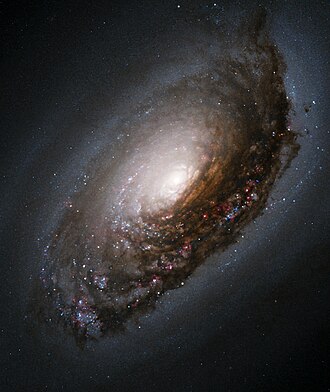
图:NASA and The Hubble Heritage Team (AURA/STScI) · Public domain · Wikimedia Commons
黑眼星系1779
Black Eye Galaxy
spiral galaxy in the constellation Coma Berenices
黑眼星系 由英国天文学家爱德华·皮戈特 于1779年3月发现,亦在同年4月被德国天文学家约翰·艾勒特·博帝 独立发现,此外,查尔斯·梅西耶也在1780年发现它。M64有一条引人入胜的壮观黑暗尘带,横亘在明亮的星系核心之前,因而被称为"黑眼星系"或"魔眼星系"。M64是位于后发座的螺旋星系,因为在小望远镜下的景观使他在业余天文学界中非常出名。
摘自维基百科「黑眼星系」,CC BY-SA 4.0
- 类型
- 螺旋星系、红外线光源、天体的X射线源
- 发现 / 发明时间
- 1779 年
- 发现者 / 提出者
- 爱德华·皮戈特
- 属于
- M94星系团
- 学科
- 天文学
相关科学家
百科正文
总览
第一眼看见M64,它似乎是一个相当正常的螺旋星系。和多数的星系一样,M64所有的恒星都以相同的方向运转,如同在哈伯望远镜的影像中看见的方向是顺时针的。
然而,最近更详细的研究有着直得注意的发现,显示星际气体和恒星在M64的外缘地区和内部地区的运转方向是相反的。内部区域的半径约为3,000光年,而外缘的范围可以达到40,000光年。这样的运转模式应该会在交界处触发许多新恒星的诞生。
两个星系碰撞合并成一个星系时,会出现异常的外观和内部运动。天文学家相信反向转动气体的出现,是M64吸收了与他碰撞的卫星星系,而这个碰撞可能发生在十亿年之前。因为反向运动的气体互相碰撞、压缩或合并,使得相切的区域成为活跃的恒星诞生区。
特别引人注意的是图像中炙热呈蓝色且刚诞生的年轻恒星,伴随着被恒星的紫外线照射而发出萤光、粉红色富含氢的云气。
在冲击之下被毁坏的是曾经是邻居的小星系,它所拥有的恒星被并入星系之中或是被驱散入太空内,但是在M64外缘反向运行的气体明显的呈现了碰撞的痕迹。
以上内容摘自维基百科「黑眼星系」,按 CC BY-SA 4.0 使用,去掉了参考文献、外部链接等尾部小节,公式改写成了纯文本。全文、配图和出处见原文。
英文维基百科补充中文条目比较短,下面是英文条目「Black Eye Galaxy」的原文
The Black Eye Galaxy (also called Sleeping Beauty Galaxy or Evil Eye Galaxy and designated Messier 64, M64, or NGC 4826) is a relatively isolated spiral galaxy 17 million light-years away in the constellation of Coma Berenices. It was discovered by Edward Pigott in March 1779, and independently by Johann Elert Bode the following month, as well as by Charles Messier the next year. A dark band of absorbing dust partially in front of its bright nucleus gave rise to its nicknames of the "Black Eye", "Evil Eye", or "Sleeping Beauty" galaxy. M64 is well known among amateur astronomers due to its form in small telescopes and visibility across inhabited latitudes.
This galaxy is inclined 60° to the line-of-sight and has a position angle of 112°. At the distance of this galaxy, it has a linear scale of 65 ly (20 pc) per arcsecond. The morphological classification in the De Vaucouleurs system is (R)SA(rs)ab, where the '(R)' indicates an outer ring-like structure, 'SA' denotes a non-barred spiral, '(rs)' means a transitional inner ring/spiral structure, and 'ab' says the spiral arms are fairly tightly wound. Ann et al. (2015) gave it a class of SABa, suggesting a weakly barred spiral galaxy with tightly wound arms.
M64 is a type 2 Seyfert galaxy with an HII/LINER nucleus. The central region is a weak source of radio emission. A soft X-ray source has been detected at the nucleus, which is most likely coming from the circumnuclear region rather than directly from an active galactic nucleus. There is an inner disk of molecular gas that is truncated at a radius of 2,300 ly (700 pc). At present, the non-rotational motions of this disk do not significantly feed the core, but the disk does produce a vigorous rate of star formation, with also approximately 100 billion stars inside the galaxy. There is also evidence of a recent large inflow of mass. The central supermassive black hole is calculated to have a mass of about 8.4×10⁶ M☉.
The interstellar medium of Messier 64 consists of two counter-rotating disks that are approximately equal in mass. The inner disk contains the prominent dust lanes of the galaxy. The stellar population of the galaxy exhibits no measurable counter-rotation. Possible formation scenarios include a merger with a gas-rich satellite galaxy in a retrograde orbit, or the continued accretion of gas clouds from the intergalactic medium. It has a diameter of 16.51 kiloparsecs (53,800 light-years).
Messier 64 is part of the Virgo Supercluster.
以上内容摘自英文维基百科「Black Eye Galaxy」,按 CC BY-SA 4.0 使用,去掉了参考文献、外部链接等尾部小节,公式改写成了纯文本。全文、配图和出处见原文。