格物

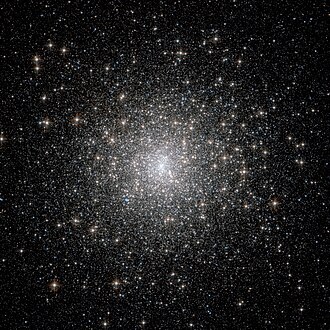
图:Sloan Digital Sky Survey · CC BY 4.0 · Wikimedia Commons
M31764
Messier 3
galactic globular cluster in the constellation Canes Venatici
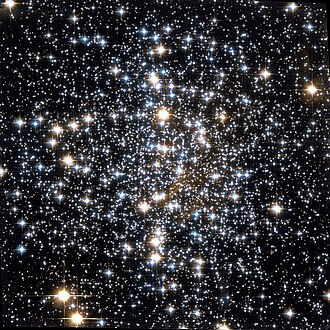
M3 是在北天星座,猎犬座中的一个球状星团。它在1764年5月3日被梅西耶发现,并且是他自己发现的第一个梅西耶天体。梅西耶最初把它误认为是没有恒星的星云,直到1784年威廉·赫歇尔解析出其中的恒星,这个错误才被改正。从那时起,它就成为被研究得最多的球状星团之一。1913年,美国天文学家索伦·欧文·贝利开始对星团中为数众多的变星族群进行辨识,到2004年,新的变星依旧继续被识别出来。
摘自维基百科「M3 (球狀星團)」,CC BY-SA 4.0
- 类型
- 球状星团
- 发现 / 发明时间
- 1764 年
- 发现者 / 提出者
- 夏尔·梅西耶
- 属于
- 银河系
- 学科
- 天文学
相关科学家
百科正文
许多业余天文学家认为M3是仅次于M13,在北天最易于观赏的球状星团。M3的视星等是6.2等,使它即使在足够黑暗的环境下,也很难以肉眼看见。使用中等大小的望远镜,可以明确的辨识这个星团。可以使用大角星(牧夫座α)与常陈一(猎犬座α)连线来寻找它,M3几乎就在连线中点的西北方。使用口径 25 cm(9.8英寸)的望远镜,可以看见星团的明亮核心,直径约为6弧分,但它的总跨度是这个的两倍。
这个星团大约由50万颗恒星组成,是已知最大和最亮的星团之一,估计它的年龄约114亿年。它与地球的距离大约是33,900光年。
M 3相当的孤立,它在银河平面上方约31.6 kly(9.7 kpc),距离银河中心约38.8 kly(11.9 kpc)。已知它有274颗变星,这是迄今为止所知拥有最多变星的球状星团。变星中有133颗是天琴座RR型变星,其中大约三分之一显示长周期模式的伯拉兹科效应。除了氢和氦之外,其它元素(天文学家都称之为金属)的总丰度在-1.34〜-1.50dex之间。这个数值提供了相对于太阳的金属量丰度的对数值,实际的比例为太阳丰度的3.2%〜4.6%。M3是奥斯特霍夫I型的原型,这种类型被认为是"金属丰富的"。即对球状星团而言,M3具有相对较高的重元素丰度。
以上内容摘自维基百科「M3 (球狀星團)」,按 CC BY-SA 4.0 使用,去掉了参考文献、外部链接等尾部小节,公式改写成了纯文本。全文、配图和出处见原文。
英文维基百科补充中文条目比较短,下面是英文条目「Messier 3」的原文
Messier 3 (M3; also NGC 5272) is a globular cluster located 33.9 thousand light years from Earth in the northern constellation of Canes Venatici. It is one of the largest and brightest globular clusters discovered with around 500,000 stars.
Discovery
It was discovered on May 3, 1764, and was the first Messier object to be discovered by Charles Messier himself. Messier originally mistook the object for a nebula without stars. This mistake was corrected after the stars were resolved by William Herschel around 1784. Since then, it has become one of the best-studied globular clusters. Identification of the cluster's unusually large variable star population was begun in 1913 by American astronomer Solon Irving Bailey and new variable members continue to be identified up through 2025.
Visibility
Many amateur astronomers consider it one of the finest northern globular clusters, following only Messier 13. M3 has an apparent magnitude of 6.2, making it a difficult naked eye target even with dark conditions with averted vision. However, with a moderate-sized telescope, the cluster can be seen as a cloudy smudge even in severely light-polluted skies, and can be further defined in darker conditions. It can be found by looking almost exactly halfway along the north-west line that would join Arcturus (α Boötis) to Cor Caroli (α Canum Venaticorum). Using a telescope with a 25 cm (9.8 in) aperture, the cluster has a bright core with a diameter of about 6 arcminutes and spans a total of double that.
Characteristics
This cluster is one of the largest and brightest, and is made up of around 500,000 stars. It is estimated to be 11.4 billion years old. It is centered at 32,600 light-years (10.0 kpc) away from Earth.
Messier 3 is quite isolated as it is 31.6 kly (9.7 kpc) above the Galactic plane and roughly 38.8 kly (11.9 kpc) from the center of the Milky Way. It contains 274 known variable stars, by far the most found in any globular cluster. These include 133 RR Lyrae variables, of which about a third display the Blazhko effect of long-period modulation. The overall abundance of elements other than hydrogen and helium, what astronomers term the metallicity, is in the range of −1.34 to −1.50 dex. This value gives the logarithm of the abundance relative to the Sun; the actual proportion is 3.2–4.6% of the solar abundance. Messier 3 is the prototype for the Oosterhoff type I cluster, which is considered "metal-rich". That is, for a globular cluster, Messier 3 has a relatively high abundance of heavier elements.
以上内容摘自英文维基百科「Messier 3」,按 CC BY-SA 4.0 使用,去掉了参考文献、外部链接等尾部小节,公式改写成了纯文本。全文、配图和出处见原文。