格物
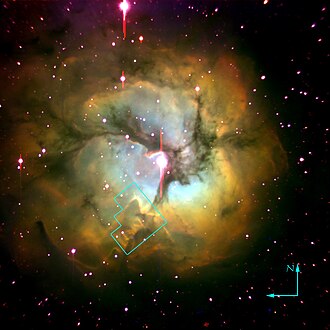
图:Public domain · Wikimedia Commons
- 类型
- 电离氢区、无线电波源
- 发现 / 发明时间
- 1764 年
- 发现者 / 提出者
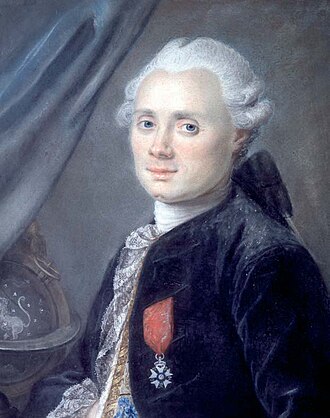
- 夏尔·梅西耶
- 属于
- 银河系
- 学科
- 天文学
相关科学家
百科正文
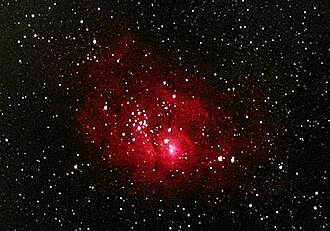
三叶星云在银河系的盾牌臂中,是一个恒星形成区。
在这一区中质量最大的恒星是HD 164492A,其质量在20倍太阳质量以上,光谱为O7.5III。
这颗恒星在拥有3,100颗年轻恒星的星团之中。
性质
1997年,天文学家利用哈伯太空望远镜对这个星云进行了一项调查,使用滤镜分别筛检出氢原子、电离的硫原子、和双电离的氧原子的发射谱线。使用这些影像组合成一张模拟眼睛观察星云颜色的假色影像
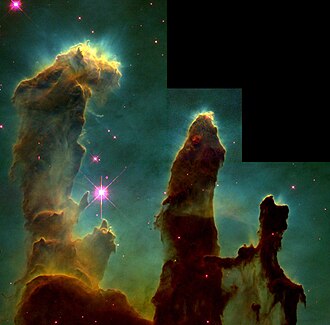
特写的影像显示出浓密的尘埃和气体云,显示这是一个充满胚胎恒星的恒星苗圃,而这片云气距离星云中心远达8 ly。一个恒星喷流从云的头部伸出来大约0.75 ly长。喷流是恒星形成时排出的废气,来源是云层深处的一颗年轻恒星体,而来自星云中新恒星的辐射使喷流发光。
影像还显示喷流右侧的手指样茎。它从密密的头部直接指向三叶星云提供能源的恒星。此茎是蒸发气体球或"EGG"的突出例子。茎幸存下来的原因是它的尖端是一个气体结,其密度足以抵抗来自恒星的强大辐射,才不至于被吃掉。
在2005年1月,NASA的史匹哲太空望远镜发现了30颗胚胎恒星和120颗在可见光图像中未能看见的新生恒星。
三叶星云与地球的距离大约5000 光年,视星等6.3等。
以上内容摘自维基百科「三葉星雲」,按 CC BY-SA 4.0 使用,去掉了参考文献、外部链接等尾部小节,公式改写成了纯文本。全文、配图和出处见原文。
英文维基百科补充中文条目比较短,下面是英文条目「Trifid Nebula」的原文
The Trifid Nebula (catalogued as Messier 20 or M20 and as NGC 6514) is an H II region in the north-west of Sagittarius in a star-forming region in the Milky Way's Scutum–Centaurus Arm. It was discovered by Charles Messier on June 5, 1764. Its name means 'three-lobe'. The object is an unusual combination of an open cluster of stars, an emission nebula (the relatively dense, reddish-pink portion), a reflection nebula (the mainly NNE blue portion), and a dark nebula (the apparent 'gaps' in the former that cause the trifurcated appearance, also designated Barnard 85). Viewed through a small telescope, the Trifid Nebula is a bright and peculiar object, and is thus a perennial favorite of amateur astronomers.
The most massive star that has formed in this region is HD 164492A, an O7.5III star with a mass more than 20 times the mass of the Sun.
This star is surrounded by a cluster of approximately 3100 young stars.
Characteristics
The Trifid Nebula was the subject of an investigation by astronomers using the Hubble Space Telescope in 1997, using filters that isolate emission from hydrogen atoms, ionized sulfur atoms, and doubly ionized oxygen atoms. The images were combined into a false-color composite picture to suggest how the nebula might look to the eye.
The close-up images show a dense cloud of dust and gas, which is a stellar nursery full of embryonic stars. This cloud is about
8 ly away from the nebula's central star. A stellar jet protrudes from the head of the cloud and is about 0.75 ly long. The jet's source is a young stellar object deep within the cloud. Jets are the exhaust gasses of star formation and radiation from the nebula's central star makes the jet glow.
The images also showed a finger-like stalk to the right of the jet. It points from the head of the dense cloud directly toward the star that powers the Trifid Nebula. This stalk is a prominent example of evaporating gaseous globules, or 'EGGs'. The stalk has survived because its tip is a knot of gas that is dense enough to resist being eaten away by the powerful radiation from the star.
In January 2005, NASA's Spitzer Space Telescope discovered 30 embryonic stars and 120 newborn stars not seen in visible light images.
It is centered about 4100 ly from Earth. Its apparent magnitude is 6.3.
以上内容摘自英文维基百科「Trifid Nebula」,按 CC BY-SA 4.0 使用,去掉了参考文献、外部链接等尾部小节,公式改写成了纯文本。全文、配图和出处见原文。