格物
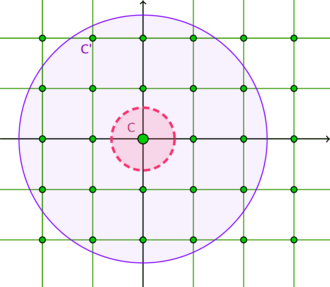
图:Cgolds · CC BY-SA 3.0 · Wikimedia Commons
- 发现 / 发明时间
- 1894 年
- 发现者 / 提出者
- 赫尔曼·闵可夫斯基
- 学科
- 物理学
- 上级概念
- 数论
相关科学家

百科正文
闵可夫斯基的结果
闵可夫斯基定理,有时也被称为闵可夫斯基第一定理:
假设Γ是在n维欧氏空间Rn的格和K是中心对称凸体, vol(K)>2ⁿvol(Rⁿ/Γ),则K包含Γ非零的向量。
闵可夫斯基第二定理,是他的第一定理加强。定义K数字λ最大下界,为 λk,称为连续最低。
则λK在Γ中ķ线性无关,则有: λ ₁λ ₂⋯ λ ₙvol(K)≤ 2ⁿvol(Rⁿ/Γ).
近现代几何数论研究
在1930年至1960年的很多数论学家取得了很多成果(包括路易·莫德尔,哈罗德·达文波特和卡尔·路德维希·西格尔)。近年来,Lenstra,奥比昂,巴尔维诺克对组合理论的扩展对一些凸体的格数量进行了列举。
施密特子空间定理
在几何数论的子空间定理,由沃尔夫冈·施密特在1972年证明
设n是正整数,如果n个n维线性型L1,...,Ln都具有代数系数,并且是线性无关的,那么对于任何给定的实数ε> 0,所有满足条件: |L₁(x)⋯ Lₙ(x)|<|x|^(-ε) 的n维非零整数点x都在有限多个Qn的真子空间内。
对泛函分析的影响
始于闵可夫斯基的几何数论在泛函分析上产生深远的影响。闵可夫斯基证明,对称凸体诱导有限维向量空间的范数。闵可夫斯基定理由柯尔莫哥洛夫推广到拓扑向量空间。柯尔莫哥洛夫的定理证明有界闭对称凸集生成Banach空间的拓扑。当前Kalton et alia. Gardner对星形集和非凸集取得了一些成果。
以上内容摘自维基百科「几何数论」,按 CC BY-SA 4.0 使用,去掉了参考文献、外部链接等尾部小节,公式改写成了纯文本。全文、配图和出处见原文。
英文维基百科补充中文条目比较短,下面是英文条目「Geometry of numbers」的原文
Geometry of numbers, also known as geometric number theory, is the part of number theory which uses geometry for the study of algebraic numbers. Typically, a ring of algebraic integers is viewed as a lattice in R ⁿ, and the study of these lattices provides fundamental information on algebraic numbers. Hermann Minkowski (1896) initiated this line of research at the age of 26 in his work The Geometry of Numbers.
The geometry of numbers has a close relationship with other fields of mathematics, especially functional analysis and Diophantine approximation, the problem of finding rational numbers that approximate an irrational quantity.
Minkowski's results
Suppose that Γ is a lattice in n -dimensional Euclidean space R ⁿ and K is a convex centrally symmetric body.
Minkowski's theorem, sometimes called Minkowski's first theorem, states that if vol (K)>2ⁿvol (R ⁿ/Γ), then K contains a nonzero vector in Γ.
The successive minimum λ ₖ is defined to be the infimum of the numbers λ such that λ K contains k linearly independent vectors of Γ.
Minkowski's theorem on successive minima, sometimes called Minkowski's second theorem, is a strengthening of his first theorem and states that λ ₁λ ₂⋯ λ ₙvol (K)≤ 2ⁿvol (R ⁿ/Γ).
Algebraic number theory
Minkowski applied his results to the area of algebraic number theory, and this was one motivation for the term geometry of numbers. The ring of integers in a number field can be embedded as a lattice in a higher dimensional space. The Gaussian integers, which are all a+ib with a,b integers, already is a lattice in the complex plane. Other rings of integers are not obviously lattices, like Z [√2], which is contained in the real line, but is dense.
Minkowski's basic idea was to embed numbers in a higher dimensional space, and this gives one explanation of why the general theory has been termed "the geometry of numbers". Every ring of integers can be embedded into a higher-dimensional Euclidean space in which it becomes a lattice.
Quadratic forms
Another application of Minkowski theory is to quadratic forms. A positive-definite quadratic form in n variables defines an ellipsoid in R ⁿ. Asking for small values of a quadratic form on integers is equivalent to asking whether scalings of this ellipsoid contain non-zero integer lattice points. Minkowski's convex body theorem then gives bounds for the minimum of the quadratic form on integers, in terms of its determinant.
Diophantine approximation
The geometry of numbers also gives geometric proofs of results in Diophantine approximation. The problem of approximating real numbers by rationals, for example, can be formulated as a problem of finding nonzero integer points in a suitable convex body. Inequalities involving several linear forms in integer variables can be interpreted as conditions defining a symmetric convex region in Euclidean space. Minkowski's theorem then gives the existence of integer solutions satisfying prescribed bounds.
This method underlies classical results on simultaneous approximation and on small values of systems of linear forms, such as Dirichlet's approximation theorem.
Later research in the geometry of numbers
In 1930–1960 research on the geometry of numbers was conducted by many number theorists (including Louis Mordell, Harold Davenport and Carl Ludwig Siegel). In recent years, Lenstra, Brion, and Barvinok have developed combinatorial theories that enumerate the lattice points in some convex bodies.
Subspace theorem of W. M. Schmidt
In the geometry of numbers, the subspace theorem was obtained by Wolfgang M. Schmidt in 1972. It states that if n is a positive integer, and L1,...,Ln are linearly independent linear forms in n variables with algebraic coefficients and if ε>0 is any given real number, then the non-zero integer points x in n coordinates with |L₁(x)⋯ Lₙ(x)|<|x|^(-ε)
lie in a finite number of proper subspaces of Qn.
Significance in other areas
Because convex bodies are ubiquitous in many areas of mathematics, Minkowski's geometry of numbers led to developments in other areas that are not directly related to number theory and lattice theory.
Convex geometry
The geometry of numbers contributed to the development of convex geometry. A central operation on convex bodies is the Minkowski sum (公式略). The Brunn–Minkowski inequality relates the volume of this sum to the volumes of the summands, asserting in one form that vol (A+B)^(1/n)≥ vol (A)^(1/n)+vol (B)^(1/n).
Such results belong to the convex-geometric side of Minkowski's work: they concern the behavior of bodies, volume, and linear structure in Euclidean space.
以上节选摘自英文维基百科「Geometry of numbers」,按 CC BY-SA 4.0 使用,去掉了参考文献、外部链接等尾部小节,公式改写成了纯文本。篇幅所限,较长的小节只摘了开头一部分,有的小节没有收;全文、配图和出处见原文。