格物
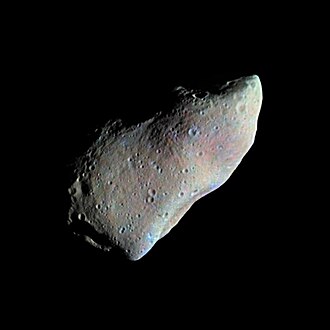
图:NASA · Public domain · Wikimedia Commons
- 类型
- 小行星
- 发现 / 发明时间
- 1916 年
- 发现者 / 提出者
- 格里高利·诺伊明
- 命名来源
- 哈斯普拉
- 学科
- 天文学
- 前一项
- 小行星950
- 后一项
- 小行星952
相关科学家
百科正文
小行星951是第一颗人类飞行器所探访过的小行星。1991年10月29日,伽利略号在前往木星的途中掠过了该颗小行星。
特征
除了大量的小型环形山,小行星951上还存在着6个以上的大面积平原地区和凹面地区。其中的一片平原(Dunne Regio)的范围达到5×7km,海拔起伏不超过200m。目前无法确定这些是撞击的结果还是它在与其母星分离时的琢面。不平衡的重力作用会很容易地使撞击坑呈现出平坦的模样。
以上内容摘自维基百科「加斯普拉星」,按 CC BY-SA 4.0 使用,去掉了参考文献、外部链接等尾部小节,公式改写成了纯文本。全文、配图和出处见原文。
英文维基百科补充中文条目比较短,下面是英文条目「951 Gaspra」的原文
951 Gaspra is an S-type asteroid that orbits very close to the inner edge of the asteroid belt. Gaspra was discovered by Russian astronomer G. N. Neujmin in 1916. Neujmin named it after Gaspra, a Black Sea retreat that was visited by his contemporaries, such as Gorky and Tolstoy.
Gaspra was the first asteroid to ever be visited by a spacecraft when it was visited by the Galileo spacecraft, which flew by on its way to Jupiter on 29 October 1991.
Physical characteristics
Apart from a multitude of small craters, Gaspra has half a dozen large flat areas and concavities. One of these flat areas, Dunne Regio, is a 5 km × 7 km (3 mi × 4+1⁄2 mi) area that is flat to within 200 m (660 ft). It is uncertain whether these are the result of impacts or whether they are instead facets formed when Gaspra broke off its parent asteroid. In the weak, lopsided gravity of Gaspra, impact craters would naturally take on such flat, lopsided shapes, making this determination difficult. The flat facets and concavities give Gaspra a very angular appearance.
Gaspra's surface area has been calculated at about 525 km2, which, for comparison, is about the size of Guam, or half the land area of Hong Kong.
Composition
Gaspra appears to be fairly olivine-rich among the S-type asteroids (the surface appears to contain olivine and pyroxene in the proportions 4:1 to 7:1). There are no prominent albedo or color patterns, although a subtle color variation is seen across the surface.
Surface features
Gaspra's surface lacks unambiguous craters of a size comparable to its radius, like those seen for example on 253 Mathilde. A probable reason is that the collision that produced the Flora family and Gaspra was relatively recent on an astronomical timescale, so that Gaspra has not yet had the opportunity to acquire many large craters since. Analysis of cratering rates suggests the age of the surface is between about 20 to 300 million years. It was suggested in 2007 that the fresh, steep craters on Gaspra were formed by the Baptistina family-forming event that happened near it.
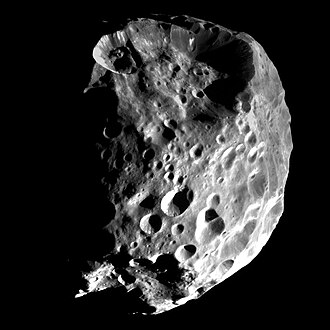
Grooves about 100 m (330 ft) to 300 m (980 ft) wide, up to 2.5 km (1.6 mi) long, and tens of meters deep are seen on Gaspra's surface, which may be related to Gaspra's formation along with the rest of the Flora family in an asteroid collision. Their presence also suggest that it is a single coherent body, rather than a rubble pile. The grooves were likely created by impacts that shattered the underlying rock. A system of much more prominent grooves is seen on the Martian moon Phobos. The pitted appearance of some grooves may suggest that the surface is covered by a regolith.
Orbit and rotation
Gaspra orbits the Sun at an average distance of about 2.21 astronomical units. Gaspra completes one orbit around the Sun in 3.29 years.
Gaspra's rotational axis has been determined to point in the direction of RA 0h40m, declination 27±2°. This is equivalent to ecliptic coordinates (β, λ) = (21°, 20°) and gives an axial tilt of 72°.
The Galileo flyby was too distant for a body of Gaspra's small size to noticeably affect Galileo's trajectory, so no information on Gaspra's mass was obtained. (Galileo also visited 243 Ida where it discovered a moon, allowing a mass estimate there.)
Exploration
Galileo flew by Gaspra on 29 October 1991, passing within 1,600 km (990 mi) at a relative speed of about 8 km/s (18,000 mph). Fifty-seven images were returned to Earth, the closest taken from a distance of 5,300 km (3,300 mi). The best images have a resolution of about 54 meters per pixel (177.16 ft). The area around the southern pole was not seen during the flyby, but the remaining 80% of the asteroid was imaged.
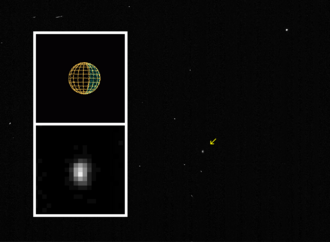
Because Gaspra's position was only known to within about 200 km (120 mi) before the encounter, and the camera's field of view was only about 5° across, Galileo would not know where to point to capture images of the asteroid once it was closer than 70,000 km (43,000 mi). This would render the encounter not very interesting scientifically. To overcome this problem, a pioneering optical navigation campaign was implemented by the Galileo spacecraft team to reduce the uncertainty of Gaspra's position using images captured during the approach to Gaspra. This was successful and allowed the spacecraft to obtain images from as close as 5,300 km (3,300 mi). At this closest range, the pointing was still not known accurately enough, but the camera took a 51 image mosaic so as to capture Gaspra on at least one image.
以上节选摘自英文维基百科「951 Gaspra」,按 CC BY-SA 4.0 使用,去掉了参考文献、外部链接等尾部小节,公式改写成了纯文本。篇幅所限,较长的小节只摘了开头一部分,有的小节没有收;全文、配图和出处见原文。